

Suppose a supermarket keeps stocking Harbor Coffee, our fictional coffee business, but asks it to pay more toward promotions. Harbor could sell just as much coffee and keep less profit.
Even when customer demand holds up, someone else can claim more of each sale. The supermarket has not launched a rival brand; it has asked for better terms. A competitor list would miss this pressure.
You have time to investigate one pressure first: rival roasters, suppliers, or the stores selling the coffee. The useful question is who can change the terms.
Start with the market you mean
Industry structure is the pattern of competitors, customers and suppliers, and the limits on their choices. Michael Porter's Five Forces asks how those relationships affect who keeps the money from a sale. It covers rivalry, entry, substitutes, suppliers and buyers.
For this map, focus on Harbor's larger business: packaged coffee sold through retailers. The shops need a separate map: selling a bag for home and serving a cup locally are different businesses.
The industry sets the pressures. A company's economic moat, its durable competitive advantage, helps it withstand them. Two companies can face the same pressures and keep different shares of each sales dollar.
All five arrows point toward the profit coffee producers keep.
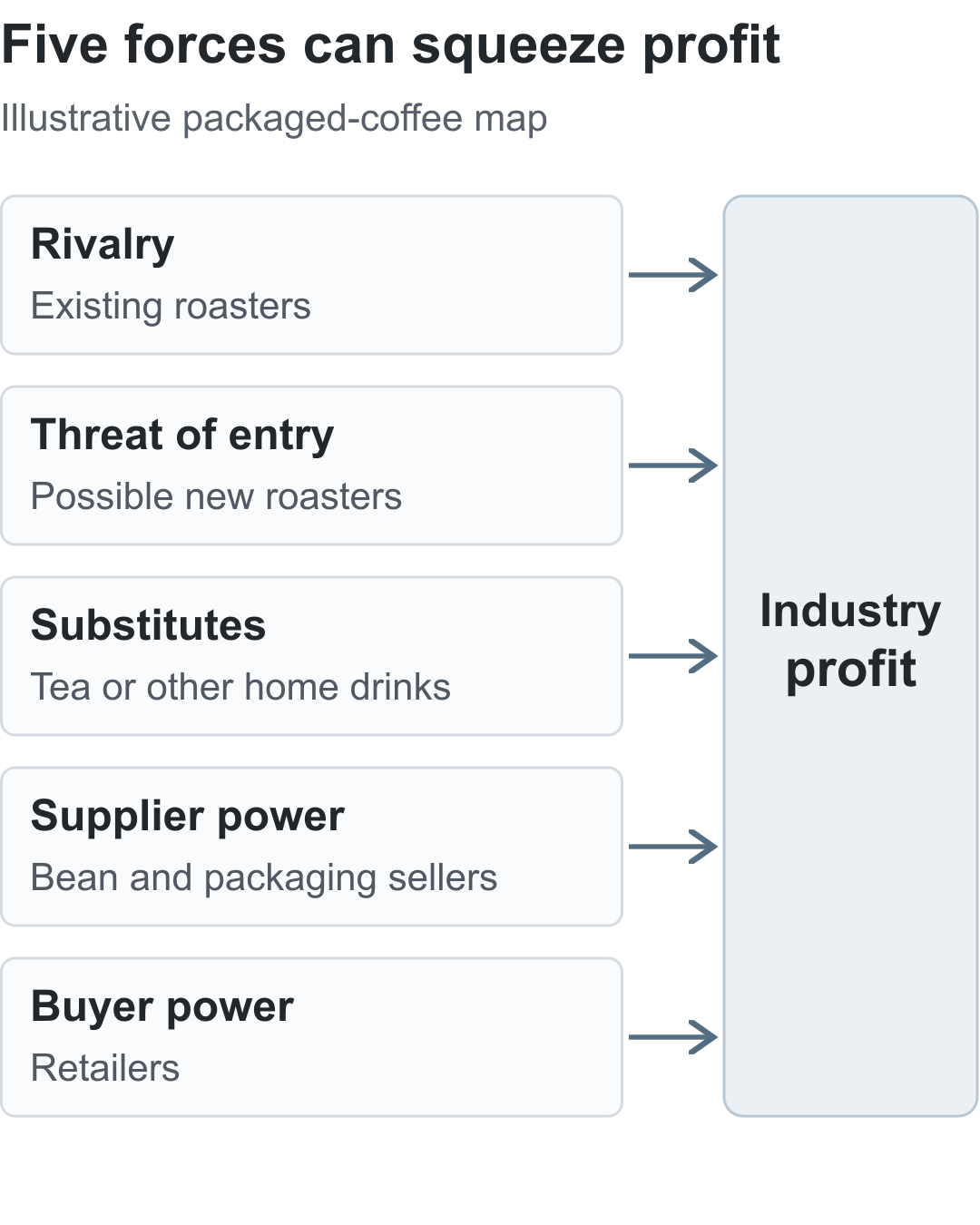 Five arrows show possible pressure on profit.
Look beyond the rival brand
Competitive rivalry is the contest among existing sellers. For packaged coffee, that means other roasters chasing the same purchase. Discounts lower the selling price; extra advertising raises the cost of winning the sale.
Threat of entry comes from sellers that could join the market. A roaster that has not opened yet can still matter: existing sellers may keep prices down to make entering less attractive.
A barrier to entry is an obstacle to joining the market, such as the cost of building a name or securing distribution. Buying a roasting machine and getting shelf space are different problems.
A substitute meets the same need in a different way. Tea could replace coffee for a morning drink at home. Another roaster competes for the coffee purchase; a substitute competes for the occasion.
Who can win better terms
Supplier bargaining power lets sellers of inputs win better prices or terms. Buyer bargaining power lets customers do the same. Each side's alternatives matter.
Here, bean and packaging providers are suppliers. Retailers are buyers who resell to the person drinking the coffee. A store that can replace Harbor easily has a stronger negotiating position than one whose shoppers insist on Harbor.
Harbor's alternatives matter too. If it can reach those shoppers through other stores at little extra cost, it has more room to refuse. Size alone does not settle the negotiation. The key is what each side can do after saying no.
A temporary jump in bean prices can hurt profits without proving lasting supplier power. Look for a lasting constraint: few alternative sources, an expensive switch or a restrictive contract.
Turn one pressure into dollars
Harbor reports $1,100 million of revenue and $220 million of operating profit in year 3. That is a 20% operating margin. These company-wide figures cover packaged coffee and shops; the case gives no separate segment margins.
Suppose an added operating cost recurs each year and equals 1% of that revenue, with selling prices, volumes and all other costs unchanged. That adds $11 million a year.
Operating profit becomes $209 million, leaving a 19% margin: 209 ÷ 1,100.
For every $100 of sales, Harbor's operating profit falls from $20 to $19. Margin drops one percentage point, but profit falls 5% because $1 ÷ $20 = 5%. A small claim on sales can take a large bite out of profit.
The arithmetic measures the cost's effect. The contract and the alternatives tell you whether Harbor has to keep paying it. Changing suppliers or raising prices are possible responses to investigate.
Choose the pressure to investigate
The case gives no market shares, retailer concentration or contract terms. These gaps connect each force to a possible financial effect:
| Competitive force | Evidence needed | Possible effect |
|---|---|---|
| Rivalry | Discounts; ad spending | Lower prices or higher costs |
| Entry | New sellers' shelf access | Price pressure |
| Substitutes | Shifts to other drinks | Less demand for coffee |
| Suppliers | Other sources; switching costs | Higher input costs |
| Buyers | Sales by retailer; terms | Discounts; promotion costs |
For a US public company, start with its annual filing. The business and risk sections describe its operations and major risks. The company writes those disclosures; compare its account with retailer and supplier filings.
For Harbor, retailer terms are a useful first check because stores can seek better terms even while coffee keeps selling. How much of packaged-coffee sales depends on its biggest retail buyers, and how costly would it be to replace those sales? Buyers are a research priority; their strength is still unproven.
If sales are spread across many retailers and other channels are easy to use, retailer power moves down the list. A supplier contract with costly exit terms would move suppliers up.
One bottleneck can matter more than four weak pressures. Averaging five ratings cannot tell you next year's margin or whether a stock is a buy. The business quality scorecard brings this evidence together with the company's financial results.
In short
- Selling a bag of coffee and serving a cup need different competitive maps.
- An entrant can pressure prices before it opens; a substitute can take the sale from outside the industry.
- Bargaining power depends on what each side can do after saying no.
- At Harbor, an extra $1 of cost per $100 of unchanged sales turns $20 of operating profit into $19: a 5% decline.
- One pressure backed by evidence tells you more than an average of five guesses.