
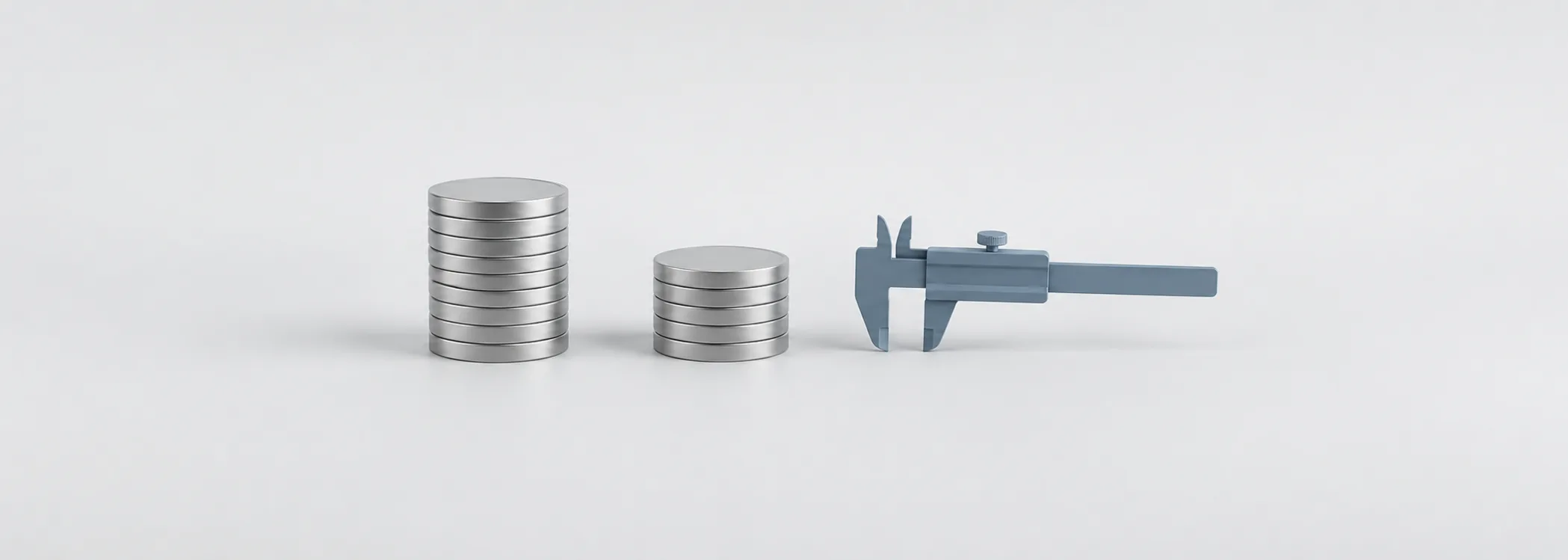
Two funds hold the same investments and earn the same returns before fees. One charges 0.03% a year; the other charges 1.00%. On $10,000, a quick estimate puts their annual costs at $3 and $100.
Use our fictional Market Basket Fund's ETF version as the cheaper one.
How can that $97 first-year difference leave about $18,050 between their balances after 30 years? Money spent on fees misses years of growth, too.
What the percentage measures
An expense ratio measures a fund's annual operating costs as a percentage of its average net assets: what it owns minus what it owes.
Say a fund has $1 million in annual costs and $100 million in average net assets. Its expense ratio is $1 million ÷ $100 million × 100% = 1%.
These operating costs include management, administration and any fees for selling fund shares or servicing shareholders. Separate broker or personal adviser charges sit outside this number.
Expenses build up inside the fund, generally daily, reducing its net asset value (NAV). You pay through the value of your holding, without a separate annual bill. Holding for one month means bearing about a month's expenses.
Translate the fee into dollars
For a rough annual cost, multiply your balance by the ratio as a decimal. Divide the percentage by 100: 0.03% becomes 0.0003, and 1.00% becomes 0.01.
Each column below is one invested balance, held flat for a full year:
| Annual ratio | On $200 | On $10,000 |
|---|---|---|
| 0.03% | $0.06 | $3 |
| 1.00% | $2 | $100 |
For $200 in Market Basket, that is $200 × 0.0003 = $0.06.
A basis point is one-hundredth of a percentage point. These ratios are 3 and 100 basis points: another way to write the same rates.
The percentage can stay the same while your balance and dollar cost change. A losing year still has expenses: the fund charges against assets, not profits.
Thirty years widen the gap
Say each $10,000 holding earns a steady 7% annual total return before fees, with all income reinvested. There are no later deposits or withdrawals, taxes or other costs, and no inflation adjustment.
Subtract each annual fee from 7%, then let the balance compound. That leaves 6.97% for Market Basket and 6.00% for the other fund. This simple annual model isolates the fee's effect; real markets will not follow these smooth paths.
After 30 years, the balances round to $75,485 and $57,435. The gap opens faster as the balances grow.
Without fees, the same calculation gives $76,123. Even Market Basket finishes below it.
The $18,050 gap between the two funds includes costs plus the growth that money no longer earns. A dollar taken out early loses every later chance to compound.
Compare like with like
There is no universal cutoff for a good fee. Broad index funds tend to cost less than active or specialized funds. The useful comparison starts with what each fund owns.
Compare funds with similar holdings and strategies, then account for differences in how they trade. For a mutual fund, check the share class you can buy: a version of the same portfolio with its own fees and minimum investment.
Here, 1.00% is over thirty times 0.03%. In our annual model, the pricier fund needs 7.97% before fees to match Market Basket's 6.97% after fees. The extra fee sets a hurdle; whether a different strategy can clear it is a separate question.
The prospectus, the fund's disclosure document, may show two ratios:
- Gross expense ratio: the annual ratio before any fee waiver or reimbursement.
- Net expense ratio: the ratio after those reductions. A fee waiver means the provider gives up a fee; a reimbursement means it covers some fund expenses.
Check the waiver's end date and terms. A discounted fee can expire while you still own the fund.
The costs outside that number
A sales load is a charge for buying or selling fund shares. A 5% front-end load takes $500 from a $10,000 purchase, leaving $9,500 invested before recurring expenses begin.
Fund turnover describes how much the fund replaces its holdings over a year. More trading can mean more transaction costs outside the expense ratio.
For a US tax resident holding US-registered funds in a taxable account, turnover can also affect taxable distributions. It is a clue about costs, not a tax bill or a verdict on the strategy.
ETF trading also involves the bid-ask spread and any commissions your broker charges. Separate account or adviser fees can add to the total. No-load and zero-expense funds can still cost money to own.
On a flat $200 balance, Market Basket's annual fee estimate is six cents. That does not settle the purchase: a trading spread or broker charge could matter more to this small order.
The next checks are the price you pay relative to the basket and the fund's return relative to its index. How ETFs work explains why those are different gaps.
In short
- An expense ratio is an ongoing percentage of fund assets, not profits.
- Costs leave less money to compound, widening the balance gap over time.
- Published fund returns usually already include operating expenses.
- Compare funds doing the same job, and check when fee discounts can end.
- Loads, trading costs and account charges can sit outside the headline ratio.