
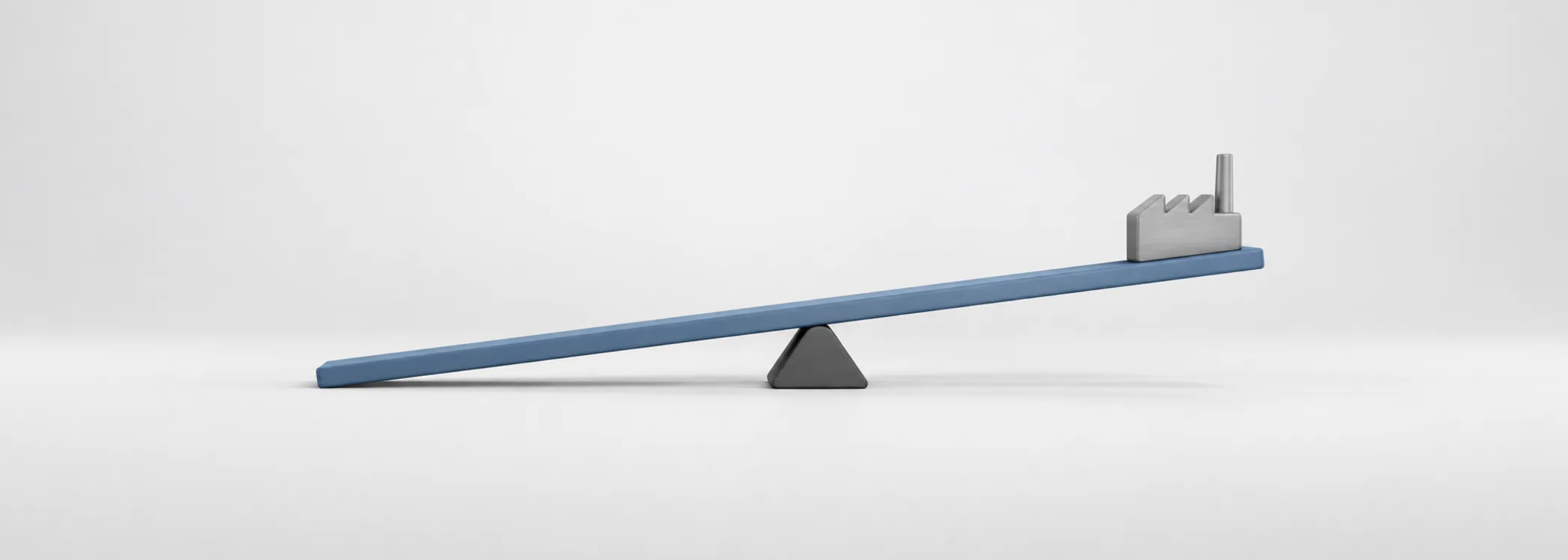
Ironvale Steel, our fictional steelmaker, earns $500 million of operating profit on $3,200 million in sales in FY3, its peak year. Suppose it makes and sells 10% less steel. Would profit fall 10% too, to $450 million?
Using its costs, the model below leaves just $370 million. Losing a tenth of sales takes away more than a quarter of profit. To judge how exposed the business is to a slowdown, you need to know which costs disappear with an order. The same test belongs in an expansion plan.
Some costs move and some stay
A variable operating cost changes with activity. Making less steel uses less raw material, so the total material cost falls if its price stays the same.
A fixed operating cost stays roughly unchanged in total over a given time and production range. A factory's monthly rent does not fall because fewer tons leave it. Fixed does not mean forever: the business could move when the lease ends.
Some bills mix both. Electricity can include a standing charge plus usage; payroll can include salaries and overtime. An expense's name alone does not tell you how it behaves.
Operating leverage is the way fixed operating costs magnify the effect of sales changes on operating profit. It exists without borrowing; debt adds a separate interest burden.
Orders can disappear faster than the costs of being ready for them.
What is left after costs
The model stops at operating profit, before interest and tax. Ironvale's reported annual costs for FY3 are:
- Variable production: $1,900 million.
- Fixed production: $600 million.
- General and administrative (G&A): $200 million.
The $170 million depreciation expense is already inside that $600 million. For this one-year comparison, treat G&A as fixed too: $600 + $200 = $800 million of fixed costs.
In millions, that is $3,200 − $1,900 − $800 = $500.
Contribution is revenue less variable operating costs: $3,200 − $1,900 = $1,300 million. It covers the $800 million of fixed costs, leaving $500 million of profit.
When contribution falls but fixed costs hold, profit absorbs every dollar of the drop.
Run the same business both ways
Compare 10% fewer tons produced and sold with 10% more. Assume spare capacity for the increase, with unchanged selling prices, product mix, variable cost per ton and total fixed costs.
The middle column is the reported FY3 base, with G&A grouped into fixed costs; the side columns are calculated from it. All amounts are in millions of dollars.
| $m | Volume −10% | Base FY3 | Volume +10% |
|---|---|---|---|
| Revenue | 2,880 | 3,200 | 3,520 |
| Variable costs | 1,710 | 1,900 | 2,090 |
| Fixed costs | 800 | 800 | 800 |
| Operating profit | 370 | 500 | 630 |
In the downturn, sales fall $320 million and variable costs fall $190 million. The $130 million gap comes out of profit: $130 ÷ $500 = 26%.
In the upturn, extra sales bring the same $130 million of contribution. Fixed costs are already covered, so it all reaches operating profit: $500 + $130 = $630 million, up 26%.
The longer profit bars show the same amplifier working in both directions.
Ironvale remains profitable in the downturn, but calling the setback "only 10%" understates the squeeze. Its profit margin shrinks because the same fixed costs take a bigger share of sales.
Where the amplifier is strongest
Operating break-even is where operating profit reaches zero. Contribution exactly covers fixed operating costs: $800 million in this model, with nothing left over.
The thinner the profit cushion, the harder each lost dollar hits. A $100 million hit takes 20% of a $500 million profit, but 50% of a $200 million profit. That smaller denominator is why the amplification grows as profit approaches zero.
Factories make the commitments easy to see. Tessel Software, our fictional subscription business, raises the same question: how quickly could it reduce development spending if demand weakened? Selling and computing costs can behave differently. Owning little machinery does not make every cost flexible.
Where the model stops working
A price cut on the same tons sold reduces revenue without saving raw materials. More expensive inputs squeeze contribution too. The reason sales changed matters as much as the size of the change.
A new production line adds fixed costs; closing one can reduce them. The relevant capacity range is the band of output over which the cost assumptions hold. Outside it, the cost model needs rebuilding.
Ironvale's variable costs are not a constant share of sales across its five reported years. This test isolates volume; a forecast needs a view on prices and costs too.
For a real business, look first for spare capacity and costs that can adjust. Plant utilization, contracts and staffing plans help test both.
When an order disappears, which expenses disappear with it, and how soon?
The optional comparison of cyclical and defensive businesses adds context on demand shocks. Next, capital allocation weighs investment commitments against other uses of the same cash.
In short
- Fixed operating costs magnify both the reward from more orders and the damage from fewer.
- In both scenarios, Ironvale's sales move 10% while operating profit moves 26% from FY3.
- Operating leverage exists even without debt.
- The thinner the profit cushion, the larger the percentage swing; use dollars when the base is zero or negative.
- A cost is fixed only for a given time and capacity range.