
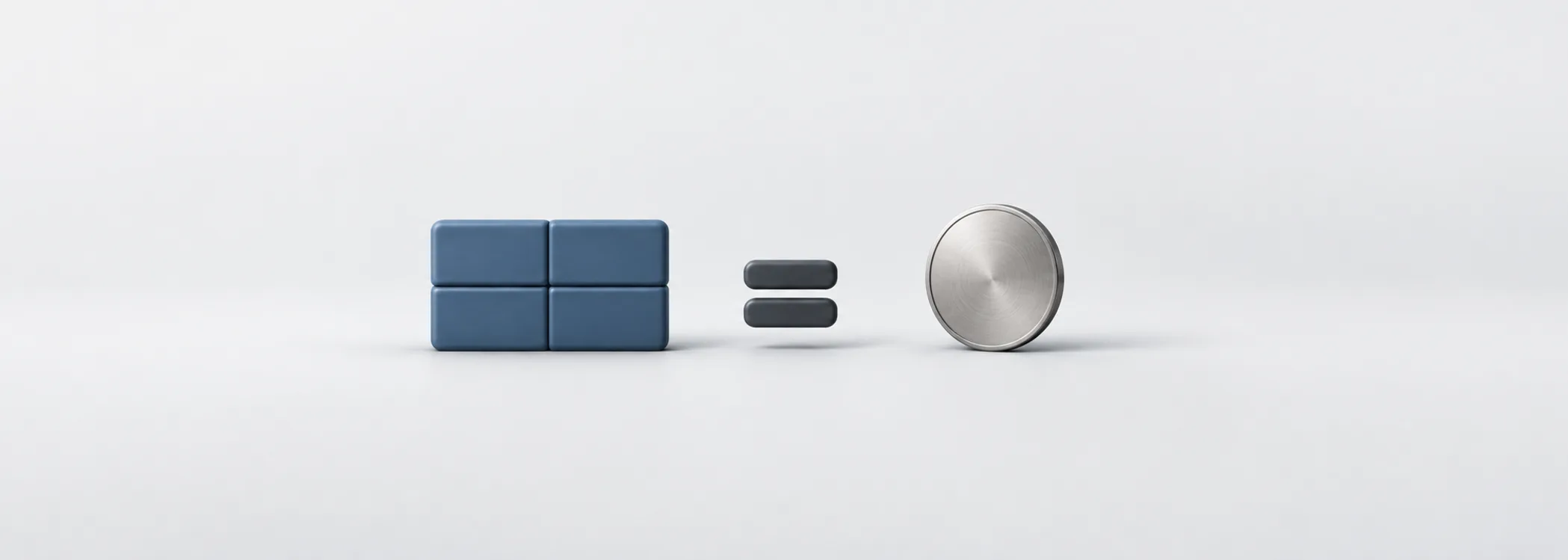
You own 20 shares of Harbor Coffee, our fictional coffee business. After a two-for-one split, your account shows 40. Has your investment doubled?
At Harbor's year 3 closing price of $66, your original holding was 20 × $66 = $1,320. At half that price, the new holding is 40 × $33 = $1,320.
The share count doubled. Your money did not. Both Harbor splits are hypothetical: no business news, market moves, fees or leftover fractions.
More shares, smaller units
A forward stock split divides each existing share into smaller units of ownership. Two-for-one means each old share becomes two shares in total: one extra share.
Read the split ratio as new shares for old shares. For two-for-one, 2 ÷ 1 = 2.
For your holding, 20 × 2 = 40 shares. Divide the old price by the same ratio: $66 ÷ 2 = $33. In the two columns, each block represents ten shares. More blocks divide the same $1,320.
Harbor has 50 million shares outstanding at the end of year 3. The split doubles everyone's share count, including yours.
| Measure | Before | After 2-for-1 |
|---|---|---|
| Company shares | 50 million | 100 million |
| Market cap | $3.3 billion | $3.3 billion |
Price × shares outstanding gives the same market cap on both sides: $66 × 50 million and $33 × 100 million each equal $3.3 billion.
Your fraction of the business is unchanged: 20 out of 50 million equals 40 out of 100 million. Everyone's stake has been divided the same way.
A split brings no fresh cash into Harbor. Selling new shares to raise money is a different transaction. Cutting a coffee cake into more pieces does not bake another cake.
A higher price can mean fewer shares
A reverse stock split combines shares into fewer, larger units. One-for-ten means ten old shares become one new share. Its new-for-old ratio is 1 ÷ 10 = 0.1.
Start again with the original 20 Harbor shares at $66, separately from the forward split. Multiplying by 0.1 is the same as dividing by ten:
- Shares: 20 ÷ 10 = 2.
- Price per share: $66 × 10 = $660.
- Holding value: 2 × $660 = $1,320.
The $660 price has not made Harbor ten times more valuable. Each share now represents ten times as much of the company.
Companies can use reverse splits to lift their quoted price, including to meet a US exchange's minimum-price requirement. Repeated efforts to rescue a falling price invite a closer look at the business. A higher price tag cannot repair weak sales or pay off debt. The reason for the split matters more than the ratio.
Why a neutral event attracts attention
A forward split lowers the cost of one whole share. That can make a stock easier to buy in small amounts. Fractional-share access can offer another way to buy small amounts without waiting for a split.
Prices can move when a split is announced, before the share count changes. Some investors read the announcement as a sign of management's confidence; others respond to the attention it attracts. Those reactions can change what investors are willing to pay.
No extra operating profit or cash comes from the split itself. More shares cannot sell another bag of coffee.
A lower sticker price leaves the question of price versus value unanswered. A share can cost less simply because it represents less.
Check the dates and the chart
Start with the company's announcement: the ratio and first day of split-adjusted trading tell you which share units a quote uses. Check your broker's treatment of fractions, fees and open orders. Buying before the record date does not create extra value.
Apple announced a four-for-one split on July 30, 2020, saying it wanted to make the stock accessible to more investors. Split-adjusted trading began August 31, 2020. Each old share became four: 300% more shares, with no return created by the split itself.
A split-adjusted share price restates older prices in the new share units. For Harbor, the old $66 becomes $33 on an adjusted chart. Without that change, the chart would show a 50% fall even though your holding kept its value.
The figure sets the old price to 100. Adjusting it to 50 removes the false cliff.
An old trade confirmation can still show $66. The chart's $33 expresses that old price in the new units; it does not rewrite what you paid. Dividend adjustments and other chart settings are covered in how to read a stock chart.
For your account, compare share count × price per share on both sides of the split. If Harbor then trades at $34 instead of $33, your 40 shares are worth 40 × $34 = $1,360. The $40 gain came from a $1 price move across 40 shares.
In both splits, your ownership percentage stayed the same. In a share buyback, the company spends cash and continuing owners can end up with a larger fraction of the business.
In short
- A forward split divides your stake into more units; a reverse split combines them.
- The split itself does not make you richer or enlarge your share of the business.
- Raising the price per share does not repair a weak business.
- Check the ratio and split-adjusted trading date, plus your broker's treatment of fractions, fees and open orders.
- Compare prices across a split using the same share units.