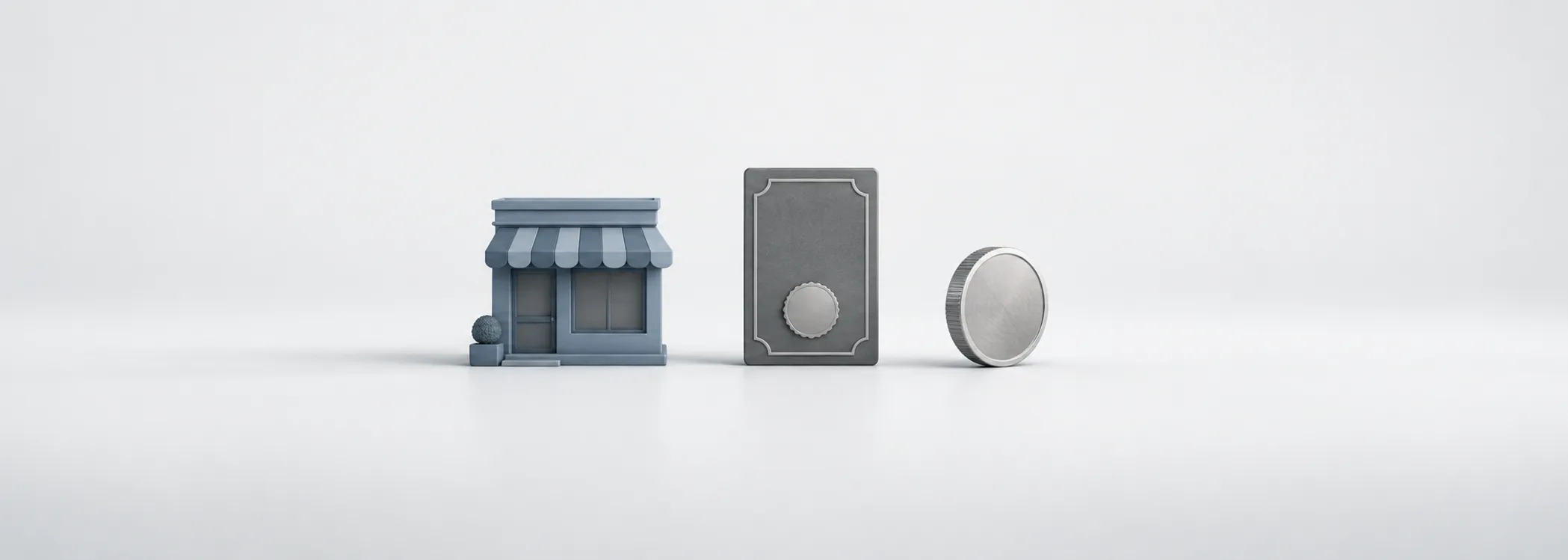
Three shares of Harbor Coffee, our fictional coffee business, cost $174 at the purchase price in this example. They fit within your $200 budget and make you an owner. Yet you cannot take its bagging machine home or demand free coffee.
What did your money buy?
Your $174 bought a stake in the business, with possible cash payments and a changing resale value. It bought no promise of a paycheck.
The company owns the coffee business
In the asset-class map, stock gives you an ownership interest in a company. A share is one unit of that ownership; someone who holds shares is a shareholder. Equity is another name for ownership.
Treat Harbor as a US corporation, a legal entity separate from its owners. The company owns the equipment, signs contracts and pays the bills. Your shares are a claim on the company. They do not give you direct ownership of its machines.
At the end of Harbor's third fiscal year (FY3), shareholders hold 50 million shares in total. These are its shares outstanding. Your three shares give you a claim on that same business, as the ownership map shows.
Your part at that date is 3 out of 50,000,000: 3 / 50,000,000 × 100 = 0.000006%. A tiny fraction is still ownership.
Owning three shares does not put you in charge of daily operations. You may have a vote on matters such as electing directors; the rights depend on the share class.
Profit is not cash in your account
Common stock is the basic form of ownership used here. It carries a residual claim: you share in what remains after the company's obligations are met. Wages, supplier bills, interest and taxes come first. The shares promise no fixed payment.
The profit Harbor earns belongs to the company. Your stake gives you an interest in it, but you cannot demand that Harbor send your slice to your bank account.
A dividend is a distribution to shareholders. A profitable business can keep money in the business without paying one.
For our example, you buy three common shares at the end of year two (FY2) for $58 each, paid in full from your own $200. You hold them all year, qualify for every FY3 dividend, and keep the payments as cash, with no more trades, fees or taxes.
Harbor paid $1.20 in cash dividends per share in FY3, so you receive 3 × $1.20 = $3.60. Harbor's profit is a business result. Your dividend is money you can spend.
Follow three shares through one year
At FY3 year-end, Harbor's share price is $66. Your three shares are worth $198, and you also have the cash dividends received during the year. The table separates the shares' value from the cash, in US dollars.
| Item | Calculation | Dollars |
|---|---|---|
| Initial holding | 3 × $58 | $174 |
| Ending shares | 3 × $66 | $198 |
| FY3 dividends | 3 × $1.20 | $3.60 |
| Total gain | $198 + $3.60 − $174 | $27.60 |
Your gain is $27.60. Only $3.60 arrived as cash; the other $24 is a rise in the shares' market value.
A capital gain is the profit when you sell shares above their purchase price; selling below it creates a capital loss. Until you sell, the price change is an unrealized gain or loss. Here, the $24 gain values your shares at the $66 quote. You have not sold them or locked in that gain.
The holding-period total return compares your gain or loss, including dividends, with the amount invested. Here it is $27.60 / $174 ≈ 15.86% for FY3. The unused $26 from your $200 budget never entered the holding, so it stays out of this calculation.
The same calculation works with one share, using dollars per share throughout:
($66 − $58 + $1.20) / $58 = $9.20 / $58 ≈ 15.86%. This measures your return before inflation; measuring returns covers deposits and longer periods.
Price alone misses the dividend. But a cash dividend moves money out of a company you own; the payment does not create wealth by itself. If a price fall is larger than the dividend per share, total return is negative.
An ownership claim can lose its value
Harbor can sell the same coffee on two mornings and have a different share price on each. Buyers and sellers change their expectations for profits and risk. Some need cash or want different investments; wider economic events can also change what they will pay.
Over time, the business's ability to earn money matters. Yet a good business can be a poor investment at too high a starting price. A thriving company can still disappoint investors who paid for even better results. That distinction drives price versus value.
In a liquidation, a company's assets are sold to settle claims. Creditors—the people and institutions it owes—come first, then preferred shareholders. Common owners get what remains, which may be nothing. Even creditors may not recover everything they are owed.
Under US corporate law, limited liability means owning these fully paid shares alone generally does not make you responsible for Harbor's debts. You can lose every dollar of the $174 purchase; Harbor's unpaid bills do not follow you home. A separate loan or a personal guarantee, a promise to repay someone else's debt, remains your own obligation.
With a bond, you become a lender with payments set by its terms. Your three shares give you an owner's uncertain payoff.
In short
- A share gives you ownership in the company, not a right to take its equipment.
- Company profit belongs to the company; a cash dividend is money paid to you.
- Total return counts both the share-price change and cash dividends.
- Common shareholders are last in line and can lose the entire investment.
- Limited liability shields you from company debts, not losses or your own borrowing.