

By the late 1990s, people were already shopping and booking flights online. The internet did change daily life. After the March 2000 peak, the Nasdaq Composite still lost almost four-fifths of its value.
That leaves a harder question for this month's $200: which business can turn a technology's success into cash for its owners, and at what price?
The Nifty Fifty separated business quality from investment return. The internet boom adds a funding test: a young company needs enough cash to reach the future it promises.
The internet was real
By the late 1990s, you could search for information, order goods and book flights online. Useful services were reaching real customers.
The dot-com bubble was the speculative boom in internet-related shares in the late 1990s and the collapse that followed. Investors made a bigger leap: a fast-growing market would make its companies valuable enough to justify steep share prices.
With profits often absent, investors watched eyeballs: audience counts such as website visitors and page views. Customers and market share offered clues to future demand. But attracting a crowd did not prove that serving it would make money.
The price-to-sales ratio connects a stock's price to the sales behind it. Free cash flow, cash from operations after capital spending, shows whether growth leaves money behind. A busy website still had bills to pay.
The story outran the funding
Fresh money made losses easier to live with. Investors backed young private firms and bought newly issued shares. Companies used the cash to expand and cover operating costs. The hope was that winning enough customers would eventually turn losses into profits.
Cash runway is roughly how long a business can fund its cash losses before it needs more financing. It depends on the money available and how quickly the business spends more than it brings in. Funding buys time to make a business work; it cannot make the business work by itself.
As share prices fell, investors grew wary and fresh financing became harder to find. Companies relying on the next round of funding had less room to fix their finances. For a company losing cash on each order, selling more could deepen the problem.
An honest business with a useful product could still run out of money. A business that survived could still disappoint shareholders who paid too much. Survival and a good investment return were separate achievements.
The Nasdaq lost almost four-fifths
On March 10, 2000, the Nasdaq Composite closed at 5,048.62. By October 9, 2002, it had fallen to 1,114.11. Those closing levels put the decline at 77.93%.
The Composite included companies beyond internet startups. It took more than two years to reach the low. Rallies interrupted the slide, offering hope before another fall. A rising market for a few weeks did not mean the damage was over.
The chart sets the March 2000 high to 100 and follows the long road back. It shows prices only, without dividends or an adjustment for inflation.
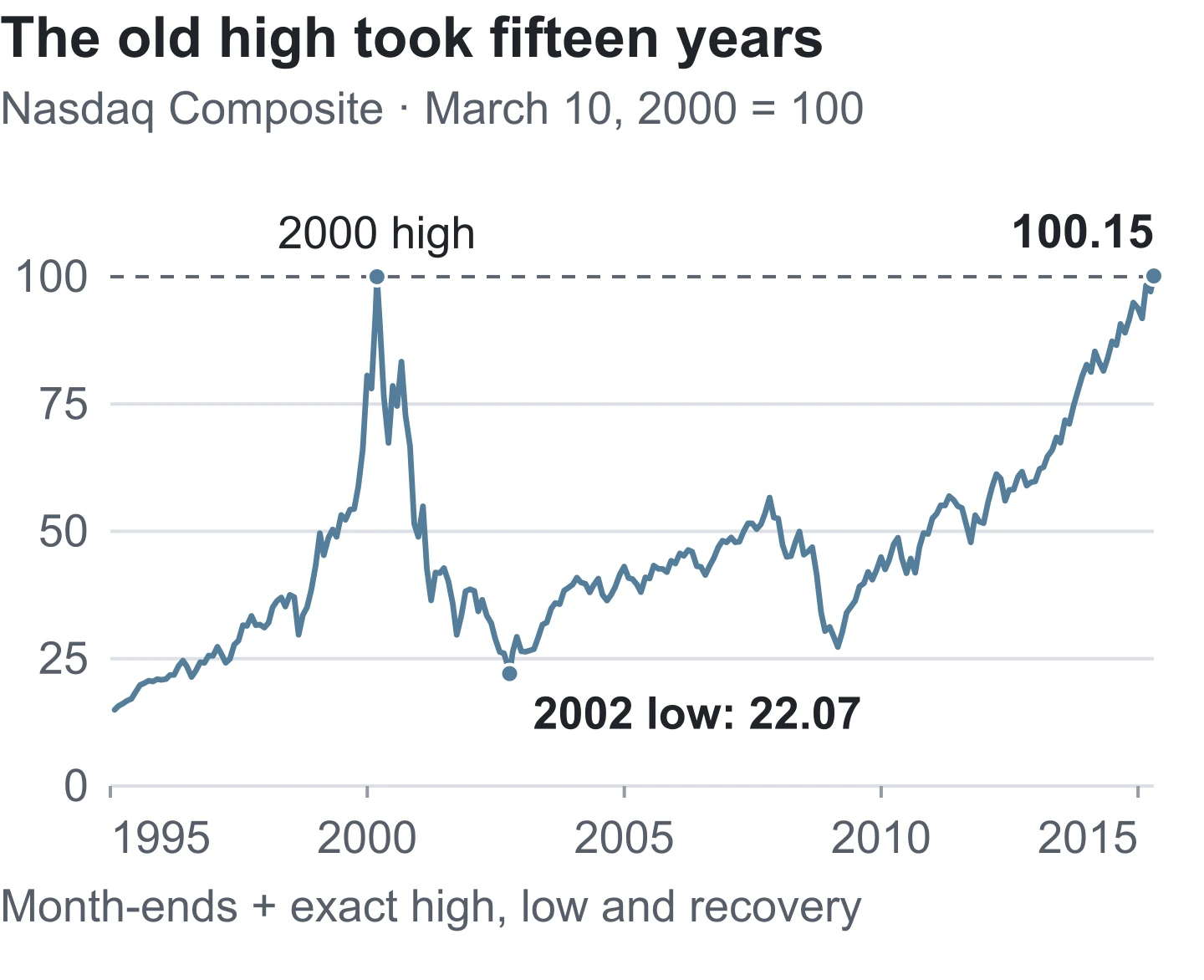 Nasdaq/FRED shows a 78% fall and recovery.
The slide continued through the 2001 US recession. Companies seeking another round of funding faced investors who were already nursing losses.
Survival was a separate question
Pets.com sold pet products online, but lost money even before marketing and other overhead costs. On November 4, 2000, its board chose to shut down and liquidate: sell the assets, pay what it owed and return any money left to shareholders. Stockholders approved the plan the following January. There was no operating business left to ride a market recovery.
Amazon was still trying to make its business work. Its 2001 annual report, published in early 2002, reported roughly $997 million in cash, cash equivalents and marketable securities at year-end, down from $1.10 billion a year earlier. It also described job cuts and facility closures to reduce costs.
That balance was not all available to spend. Some investments were pledged as collateral, and holiday sales brought in cash before supplier bills came due. To judge Amazon's runway, you needed to know which funds were available and which bills were waiting.
These were clues to survival that an investor could examine at the time. They were no guarantee of Amazon's eventual success, or of a good return at any share price.
The old high took fifteen years
On April 23, 2015, the Composite closed at 5,056.06, finally passing its March 2000 closing record. Fifteen years had gone by. As in Japan, the record belonged to a changing index. Here, Pets.com makes the distinction concrete: its original business was gone long before the rebound.
For your $200 decision, the technology forecast leaves three gaps:
- The business. It needs available funding and a path to lasting cash generation. A lower share price alone cannot solve a cash shortage.
- The price. Success may already be priced in. A margin of safety, paying less than your estimate of value, leaves room for your forecast to be wrong.
- Your exposure. Funds and other shares you own may already depend on the same theme. A new purchase can deepen a bet you have already made.
Keeping your diversified fund plan, or waiting for better evidence, is a complete decision. You can believe a technology will change the world without changing where this month's $200 goes.
Enron is the next test: what if even reported profits and cash flows give a misleading picture of the business?
In short
- A technology can succeed while investments in it fail.
- Funding buys time; a business still needs a way to generate lasting cash.
- The Nasdaq Composite lost about 78% from its March 2000 closing high to its October 2002 low.
- An index's recovery cannot bring back a failed business or pay a bill that was due years earlier.