
GlobalFoundries (GFS)
Manufactures feature-differentiated chips through foundries across the United States, Europe and Asia.
Something off on this page? Send us feedback.
GlobalFoundries makes chips that other companies design, in fabs in New York, Vermont, Dresden and Singapore. The biggest share of its sales still comes from parts inside phones — a pool it is shrinking on purpose as handset demand cools. Rising in its place: chips for cars and factories, and the silicon behind the light-based links that carry data inside AI datacentres.
Item facts: FY2025 · year ended Dec 31, 2025, from filings, earnings calls and company pages.
Judgment weights, not filed revenue
The band summarizes business focus and direction. ~ marks estimates.
9 in detail · 17 more below
Smart Mobile Devices
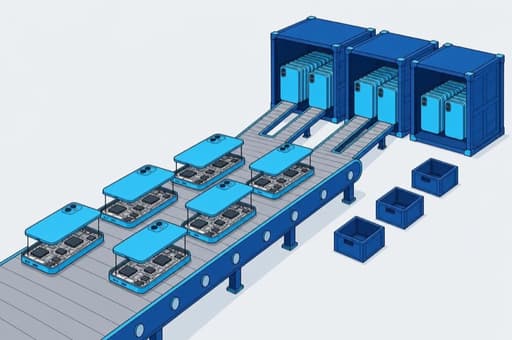
The radio, power and display chips inside phones, plus backplanes for AR glasses. Still GF's largest business at 39% of sales — but it was half of revenue two years ago, and GF guides it down a low-teens percentage this year.
Competes with 55nm RF-SOI radio chips (UMC) · 300mm RF-SOI line (Tower Semiconductor)
In plain English
Every phone carries a handful of chips whose only job is to reach the cell tower, keep the power steady and drive the screen. GlobalFoundries makes those — the supporting cast of parts arranged around the phone's main processor.
The chip companies hand over their designs; GF runs them through its fabs and bills for each wafer, the round silicon plate a batch of chips is cut from. High volume, steady, and for years GF's living. Two things press on it now: handset makers are ordering less silicon this year, and three different buyers have each crossed a tenth of GF's wafer sales in recent years — none of them named in its filings.
Automotive
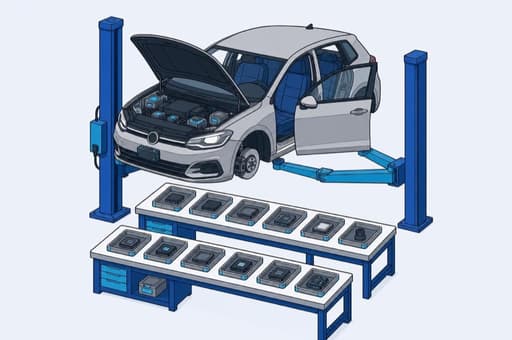
Power, radar and control chips for vehicles — 21% of sales, grown more than tenfold in five years from almost nothing. Deliveries are lumpy: last quarter fell 10% on customer timing, while the full-year outlook held at low-double-digit growth.
Competes with 55/40/28nm embedded-memory processes (UMC) · Mature-node automotive capacity (TSMC) · In-house automotive fabs (Infineon)
In plain English
A modern car is a rolling pile of electronics. Something has to manage the battery and the power rails, something has to watch the road with radar, something has to run the small controllers scattered through the rest of it. GF makes that unglamorous silicon.
Its named buyers here are parts makers and chip firms: Bosch finished a radar design at GF last quarter, and NXP and Infineon buy from GF while running fabs of their own — customers and rivals at once. The growth does not need more cars sold, only more chips per car. Europe is the centre of gravity, and GF is spending about a billion euros to expand its Dresden plant, with government incentives helping pay.
Home and Industrial IoT
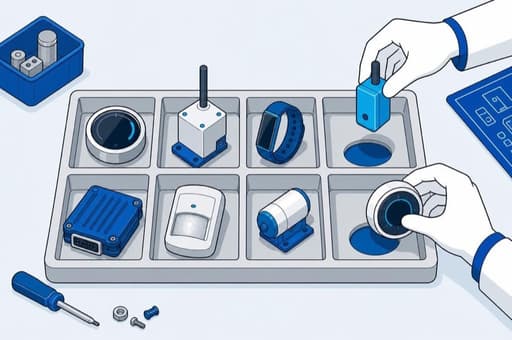
Chips for smart-home gear, factory equipment, wearables and defence systems — 18% of sales, just under $1.2B. Two years of decline ended last quarter with 30% growth over the quarter before, and the 2026 outlook was raised to 10–15%.
Competes with 22ULP ultra-low-power process (UMC) · FD-SOI foundry line (Samsung Foundry)
In plain English
A thermostat, a factory sensor, a fitness band, a piece of defence kit — the chips in things that are not phones, cars or servers. They need small, frugal brains and radios that sip battery, and that is what GF builds here.
The work arrives one design win at a time: three wins with Lockheed Martin last quarter, wireless chips for Silicon Labs made at the New York fab. This was GF's weakest line for two years while customers worked through chips they had already stockpiled. It has turned, and the reason GF gives is edge AI — gadgets doing their own thinking instead of sending everything to a distant datacentre.
Power Platforms — BCD, GaN and IVR
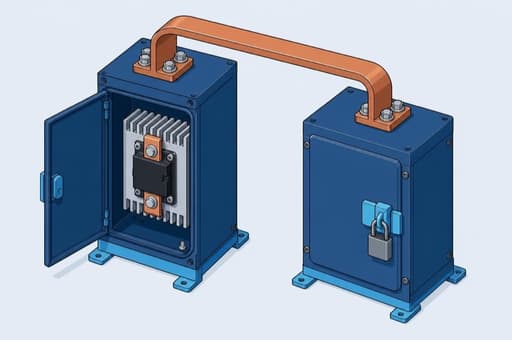
The chips that shape and regulate electricity, inside phones, cars and datacentre racks. Not broken out as revenue. GF licensed gallium nitride technology from TSMC after TSMC left that business, and its first named volume customer starts in early 2027.
Competes with GaN power portfolio (Infineon) · GaN power devices (onsemi) · Power-management foundry services (Tower Semiconductor)
In plain English
Electricity arriving at a chip is never quite the right shape — wrong voltage, not steady enough. Power chips fix that: they step the current down and hold it clean. Phones, cars and racks of servers each need their own set.
GF builds them to its customers' designs. Two things shifted recently. TSMC stopped making chips from gallium nitride, a material used for higher-voltage power parts, and licensed the recipe to GF, which is starting production in Vermont. And Monolithic Power Systems, which sells power chips of its own, will run its process inside GF's Singapore fab from early 2027. None of it is broken out as revenue yet.
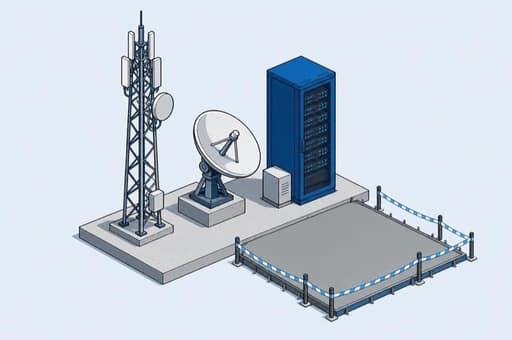
Communications Infrastructure and Data Center
Chips for optical links, mobile towers, satellites and datacentre power — GF's fastest-growing disclosed line. 11% of sales last year, 16% last quarter, with 2026 growth guidance raised twice in two quarters to 50–60%.
Competes with COUPE optical packaging (TSMC) · Photonics and SiGe foundry portfolio (Tower Semiconductor)
In plain English
Inside a datacentre, machines increasingly talk to each other in pulses of light rather than electrical signals. Turning ones and zeros into light and back again takes its own chips, and GF makes them — along with silicon for mobile base stations and satellites.
The buyers are the firms that build network gear and the plug-in optical modules that network gear runs on; four of the top five makers of those modules are GF customers. Orders follow how fast AI datacentres get built and how fast the switch to optical happens — management expects most datacentre ports to be optical by the end of the decade. A small line, and the one GF keeps raising its forecast for.
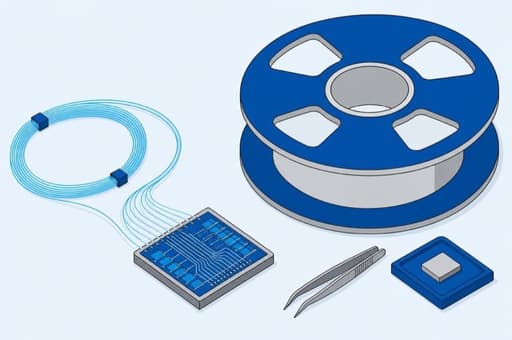
Silicon Photonics — GF Fotonix
Chips with light-handling parts and electronics built onto one piece of silicon. Most of the money today comes from plug-in optical modules; GF says this more than doubles in 2026 and targets over $1B a year leaving 2028.
Competes with PH18 photonics process (Tower Semiconductor) · COUPE stacked optical engine (TSMC)
In plain English
An ordinary chip only pushes electricity around. This one handles light too: the light-carrying channels and the electronics sit on the same slab of silicon, so the part that turns a signal into light is built in rather than bolted alongside.
Most of what ships today goes inside the plug-in modules that slot into network switches, and GF counts more than forty customers for the technology. The next step, called SCALE, moves the optical parts right up against the big processor package. Seven customers are working on it and one design was completed last quarter; the U.S. Commerce Department has signed a letter of intent for a $300M award towards the work.
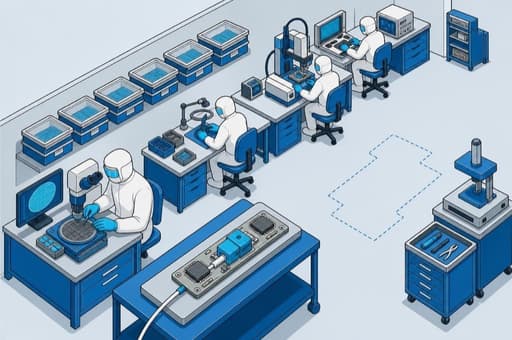
Silicon Germanium (SiGe)
The amplifier and driver chips that sit beside the optical parts inside each module. Made in Vermont, where management has called capacity oversubscribed through 2027 — and Marvell has just expanded a multi-year deal for more of it.
Competes with SiGe foundry platform (Tower Semiconductor) · COUPE — electronics stacked onto the optical die (TSMC)
In plain English
Two small chips bracket every optical link — one to push the signal out, one to handle what comes back. Silicon germanium, silicon with germanium mixed into it, is the material GF uses for them, and the same platform also serves phones, mobile base stations and satellite links.
It is made at GF's Vermont fab, and the limit here is not demand: management has said the capacity is spoken for through 2027. That is the backdrop to Marvell — a chip company making connectivity parts for AI datacentres — expanding a multi-year agreement in September for more Vermont capacity. Revenue is capped by how fast GF frees up floor space, not by orders.
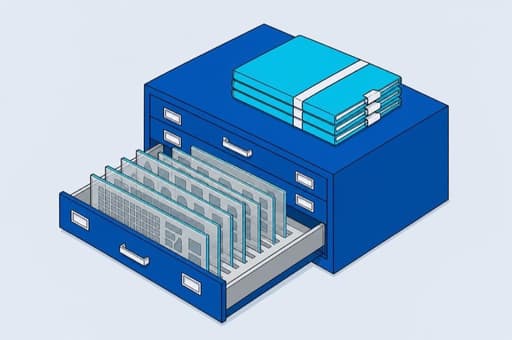
Technology Services
Everything GF sells that is not a chip it made: design licences, software, photomasks, engineering and rush fees. $769M last year, higher every year since 2022, at margins GF says beat the rest of the company.
Competes with Cortex processor designs (Arm) · RISC-V core licences (SiFive) · RISC-V processor cores (Codasip)
In plain English
The part of GF with no factory in it. Alongside manufactured chips it sells the know-how around them: licences to ready-made circuit designs that customers drop into their own chips, the software to work with them, the patterned glass stencils used to print each layer onto silicon, and paid engineering — including a fee to jump the queue.
There is no factory floor to fill here, and GF says the margins run well above the rest of the company. It has been buying in: MIPS in 2025 and Synopsys's ARC design business in 2026 brought roughly three hundred customers and about four hundred engineers, and pull GF into a customer's project earlier in the design process.
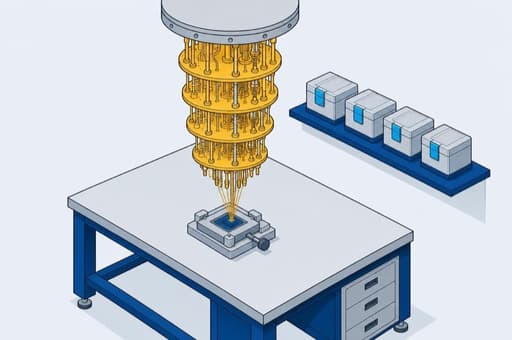
Quantum Technology Solutions
A team launched in May 2026 to build quantum processors at scale, whatever design a customer has chosen. The U.S. Commerce Department finalised a $375M research award in September — a grant, not a contract. GF expects no manufacturing revenue until towards the end of the decade.
Competes with Quantum Solutions foundry (SkyWater) · Physical-qubit fabrication programmes (imec)
In plain English
Quantum computers are still laboratory machines, and nobody has settled what the working part should be made of — superconducting loops, trapped ions, light, spinning electrons. GF's answer is to not choose: it offers to manufacture whichever kind a customer has picked, using its existing fabs and packaging, adapted to work in extreme cold.
So far the money is a grant rather than orders. GF is working with eight quantum companies and has started four customer projects since launch. It expects engineering fees first, showing up inside its services line, and manufacturing revenue only towards the end of the decade.


 Smart Mobile DevicesThe radio, power and display chips inside phones, plus backplanes for AR glasses. Still GF's largest business at 39% of sales — but it was half of revenue two years ago, and GF guides it down a low-teens percentage this year.
The radio, power and display chips inside phones, plus backplanes for AR glasses. Still GF's largest business at 39% of sales — but it was half of revenue two years ago, and GF guides it down a low-teens percentage this year.
In plain English
Every phone carries a handful of chips whose only job is to reach the cell tower, keep the power steady and drive the screen. GlobalFoundries makes those — the supporting cast of parts arranged around the phone's main processor.
The chip companies hand over their designs; GF runs them through its fabs and bills for each wafer, the round silicon plate a batch of chips is cut from. High volume, steady, and for years GF's living. Two things press on it now: handset makers are ordering less silicon this year, and three different buyers have each crossed a tenth of GF's wafer sales in recent years — none of them named in its filings.
Competes with 55nm RF-SOI radio chips (UMC) · 300mm RF-SOI line (Tower Semiconductor)
 AutomotivePower, radar and control chips for vehicles — 21% of sales, grown more than tenfold in five years from almost nothing. Deliveries are lumpy: last quarter fell 10% on customer timing, while the full-year outlook held at low-double-digit growth.
Power, radar and control chips for vehicles — 21% of sales, grown more than tenfold in five years from almost nothing. Deliveries are lumpy: last quarter fell 10% on customer timing, while the full-year outlook held at low-double-digit growth.
In plain English
A modern car is a rolling pile of electronics. Something has to manage the battery and the power rails, something has to watch the road with radar, something has to run the small controllers scattered through the rest of it. GF makes that unglamorous silicon.
Its named buyers here are parts makers and chip firms: Bosch finished a radar design at GF last quarter, and NXP and Infineon buy from GF while running fabs of their own — customers and rivals at once. The growth does not need more cars sold, only more chips per car. Europe is the centre of gravity, and GF is spending about a billion euros to expand its Dresden plant, with government incentives helping pay.
Competes with 55/40/28nm embedded-memory processes (UMC) · Mature-node automotive capacity (TSMC) · In-house automotive fabs (Infineon)
 Home and Industrial IoTChips for smart-home gear, factory equipment, wearables and defence systems — 18% of sales, just under $1.2B. Two years of decline ended last quarter with 30% growth over the quarter before, and the 2026 outlook was raised to 10–15%.
Chips for smart-home gear, factory equipment, wearables and defence systems — 18% of sales, just under $1.2B. Two years of decline ended last quarter with 30% growth over the quarter before, and the 2026 outlook was raised to 10–15%.
In plain English
A thermostat, a factory sensor, a fitness band, a piece of defence kit — the chips in things that are not phones, cars or servers. They need small, frugal brains and radios that sip battery, and that is what GF builds here.
The work arrives one design win at a time: three wins with Lockheed Martin last quarter, wireless chips for Silicon Labs made at the New York fab. This was GF's weakest line for two years while customers worked through chips they had already stockpiled. It has turned, and the reason GF gives is edge AI — gadgets doing their own thinking instead of sending everything to a distant datacentre.
Competes with 22ULP ultra-low-power process (UMC) · FD-SOI foundry line (Samsung Foundry)
 Power Platforms — BCD, GaN and IVRThe chips that shape and regulate electricity, inside phones, cars and datacentre racks. Not broken out as revenue. GF licensed gallium nitride technology from TSMC after TSMC left that business, and its first named volume customer starts in early 2027.
The chips that shape and regulate electricity, inside phones, cars and datacentre racks. Not broken out as revenue. GF licensed gallium nitride technology from TSMC after TSMC left that business, and its first named volume customer starts in early 2027.
In plain English
Electricity arriving at a chip is never quite the right shape — wrong voltage, not steady enough. Power chips fix that: they step the current down and hold it clean. Phones, cars and racks of servers each need their own set.
GF builds them to its customers' designs. Two things shifted recently. TSMC stopped making chips from gallium nitride, a material used for higher-voltage power parts, and licensed the recipe to GF, which is starting production in Vermont. And Monolithic Power Systems, which sells power chips of its own, will run its process inside GF's Singapore fab from early 2027. None of it is broken out as revenue yet.
Competes with GaN power portfolio (Infineon) · GaN power devices (onsemi) · Power-management foundry services (Tower Semiconductor)
 Communications Infrastructure and Data CenterChips for optical links, mobile towers, satellites and datacentre power — GF's fastest-growing disclosed line. 11% of sales last year, 16% last quarter, with 2026 growth guidance raised twice in two quarters to 50–60%.
Chips for optical links, mobile towers, satellites and datacentre power — GF's fastest-growing disclosed line. 11% of sales last year, 16% last quarter, with 2026 growth guidance raised twice in two quarters to 50–60%.
In plain English
Inside a datacentre, machines increasingly talk to each other in pulses of light rather than electrical signals. Turning ones and zeros into light and back again takes its own chips, and GF makes them — along with silicon for mobile base stations and satellites.
The buyers are the firms that build network gear and the plug-in optical modules that network gear runs on; four of the top five makers of those modules are GF customers. Orders follow how fast AI datacentres get built and how fast the switch to optical happens — management expects most datacentre ports to be optical by the end of the decade. A small line, and the one GF keeps raising its forecast for.
Competes with COUPE optical packaging (TSMC) · Photonics and SiGe foundry portfolio (Tower Semiconductor)
 Silicon Photonics — GF FotonixChips with light-handling parts and electronics built onto one piece of silicon. Most of the money today comes from plug-in optical modules; GF says this more than doubles in 2026 and targets over $1B a year leaving 2028.
Chips with light-handling parts and electronics built onto one piece of silicon. Most of the money today comes from plug-in optical modules; GF says this more than doubles in 2026 and targets over $1B a year leaving 2028.
In plain English
An ordinary chip only pushes electricity around. This one handles light too: the light-carrying channels and the electronics sit on the same slab of silicon, so the part that turns a signal into light is built in rather than bolted alongside.
Most of what ships today goes inside the plug-in modules that slot into network switches, and GF counts more than forty customers for the technology. The next step, called SCALE, moves the optical parts right up against the big processor package. Seven customers are working on it and one design was completed last quarter; the U.S. Commerce Department has signed a letter of intent for a $300M award towards the work.
Competes with PH18 photonics process (Tower Semiconductor) · COUPE stacked optical engine (TSMC)
 Silicon Germanium (SiGe)The amplifier and driver chips that sit beside the optical parts inside each module. Made in Vermont, where management has called capacity oversubscribed through 2027 — and Marvell has just expanded a multi-year deal for more of it.
The amplifier and driver chips that sit beside the optical parts inside each module. Made in Vermont, where management has called capacity oversubscribed through 2027 — and Marvell has just expanded a multi-year deal for more of it.
In plain English
Two small chips bracket every optical link — one to push the signal out, one to handle what comes back. Silicon germanium, silicon with germanium mixed into it, is the material GF uses for them, and the same platform also serves phones, mobile base stations and satellite links.
It is made at GF's Vermont fab, and the limit here is not demand: management has said the capacity is spoken for through 2027. That is the backdrop to Marvell — a chip company making connectivity parts for AI datacentres — expanding a multi-year agreement in September for more Vermont capacity. Revenue is capped by how fast GF frees up floor space, not by orders.
Competes with SiGe foundry platform (Tower Semiconductor) · COUPE — electronics stacked onto the optical die (TSMC)
 Technology ServicesEverything GF sells that is not a chip it made: design licences, software, photomasks, engineering and rush fees. $769M last year, higher every year since 2022, at margins GF says beat the rest of the company.
Everything GF sells that is not a chip it made: design licences, software, photomasks, engineering and rush fees. $769M last year, higher every year since 2022, at margins GF says beat the rest of the company.
In plain English
The part of GF with no factory in it. Alongside manufactured chips it sells the know-how around them: licences to ready-made circuit designs that customers drop into their own chips, the software to work with them, the patterned glass stencils used to print each layer onto silicon, and paid engineering — including a fee to jump the queue.
There is no factory floor to fill here, and GF says the margins run well above the rest of the company. It has been buying in: MIPS in 2025 and Synopsys's ARC design business in 2026 brought roughly three hundred customers and about four hundred engineers, and pull GF into a customer's project earlier in the design process.
Competes with Cortex processor designs (Arm) · RISC-V core licences (SiFive) · RISC-V processor cores (Codasip)
 Quantum Technology SolutionsA team launched in May 2026 to build quantum processors at scale, whatever design a customer has chosen. The U.S. Commerce Department finalised a $375M research award in September — a grant, not a contract. GF expects no manufacturing revenue until towards the end of the decade.
A team launched in May 2026 to build quantum processors at scale, whatever design a customer has chosen. The U.S. Commerce Department finalised a $375M research award in September — a grant, not a contract. GF expects no manufacturing revenue until towards the end of the decade.
In plain English
Quantum computers are still laboratory machines, and nobody has settled what the working part should be made of — superconducting loops, trapped ions, light, spinning electrons. GF's answer is to not choose: it offers to manufacture whichever kind a customer has picked, using its existing fabs and packaging, adapted to work in extreme cold.
So far the money is a grant rather than orders. GF is working with eight quantum companies and has started four customer projects since launch. It expects engineering fees first, showing up inside its services line, and manufacturing revenue only towards the end of the decade.
Competes with Quantum Solutions foundry (SkyWater) · Physical-qubit fabrication programmes (imec)
Named in filings, launches and programs
- FDX (22FDX, 12FDX)PlatformGF's low-power process for battery-run gadgets, car radar and the extreme-cold chips behind its quantum work; management calls the capacity oversubscribed.
- FinFET (12LP / 12LP+)PlatformGF's most advanced logic family, and the one that carried its Lockheed Martin and Microchip design wins.
- 9SW RF-SOIPlatformFourth-generation radio process built in Singapore; the backbone of the chips GF sells into phones.
- UX platform family — 40UX, 22UXPlatform · AnnouncedOpened to customers in September 2026 for smart edge devices and AI built into physical products; made in Singapore and Dresden.
- SLATE wafer-to-wafer bondingPlatformPackaging that bonds two finished silicon discs face to face; approved for use on the phone-radio process in June 2026.
- GlobalShuttle MPW programServiceShared trial production runs that act as the on-ramp to GF's new 40UX and 22UX processes.
- MIPSBrandProcessor design house bought in August 2025; its RISC-V processor designs are licensed to chipmakers and sit inside GF's services line.
- Synopsys ARC processor IP businessBrandBought in June 2026: processor, signal and AI core designs plus the software toolkit, folded into GF's licensing business.
- Advanced Micro FoundryBrandSingapore photonics outfit bought in November 2025, adding capability for plug-in optical modules plus cost savings.
- Photon Technologies custom power teamProduct · Pre-revenueEuropean power-design team hired in as a group in July 2026, bringing chip-level voltage regulators to GF's power range.
- Marvell SiGe capacity agreementCustomer programExpanded in September 2026: a multi-year commitment of Vermont capacity for Marvell's optical connectivity parts.
- Monolithic Power Systems partnershipCustomer programAnnounced September 2026; the customer runs its own process inside GF's Singapore fab, with volume from early 2027.
- Lockheed Martin chiplet programCustomer programThree design wins last quarter across GF's advanced-logic and low-power processes, for defence and aerospace parts.
- Silicon Labs wireless SoC programCustomer programWireless connectivity chips for Silicon Labs, built at GF's Malta, New York fab.
- CHIPS R&D and incentive awardsCustomer program$1.5B of direct U.S. funding, up to $1.6B of loans, over $550M from New York, $375M for quantum and a $300M photonics letter of intent.
- $16B U.S. capacity and R&D programCustomer programAnnounced June 2025: $13B of fab expansion plus about $3B of research, with Apple, AMD, SpaceX, Qualcomm, NXP and GM named as supporting customers.
- Dresden expansionCustomer programAbout €1.1B to push the German fab past a million silicon discs a year by the end of 2028.
FDX (22FDX, 12FDX)Platform
GF's low-power process for battery-run gadgets, car radar and the extreme-cold chips behind its quantum work; management calls the capacity oversubscribed.
FinFET (12LP / 12LP+)Platform
GF's most advanced logic family, and the one that carried its Lockheed Martin and Microchip design wins.
9SW RF-SOIPlatform
Fourth-generation radio process built in Singapore; the backbone of the chips GF sells into phones.
UX platform family — 40UX, 22UXPlatform · Announced
Opened to customers in September 2026 for smart edge devices and AI built into physical products; made in Singapore and Dresden.
SLATE wafer-to-wafer bondingPlatform
Packaging that bonds two finished silicon discs face to face; approved for use on the phone-radio process in June 2026.
GlobalShuttle MPW programService
Shared trial production runs that act as the on-ramp to GF's new 40UX and 22UX processes.
MIPSBrand
Processor design house bought in August 2025; its RISC-V processor designs are licensed to chipmakers and sit inside GF's services line.
Synopsys ARC processor IP businessBrand
Bought in June 2026: processor, signal and AI core designs plus the software toolkit, folded into GF's licensing business.
Advanced Micro FoundryBrand
Singapore photonics outfit bought in November 2025, adding capability for plug-in optical modules plus cost savings.
Photon Technologies custom power teamProduct · Pre-revenue
European power-design team hired in as a group in July 2026, bringing chip-level voltage regulators to GF's power range.
Marvell SiGe capacity agreementCustomer program
Expanded in September 2026: a multi-year commitment of Vermont capacity for Marvell's optical connectivity parts.
Monolithic Power Systems partnershipCustomer program
Announced September 2026; the customer runs its own process inside GF's Singapore fab, with volume from early 2027.
Lockheed Martin chiplet programCustomer program
Three design wins last quarter across GF's advanced-logic and low-power processes, for defence and aerospace parts.
Silicon Labs wireless SoC programCustomer program
Wireless connectivity chips for Silicon Labs, built at GF's Malta, New York fab.
CHIPS R&D and incentive awardsCustomer program
$1.5B of direct U.S. funding, up to $1.6B of loans, over $550M from New York, $375M for quantum and a $300M photonics letter of intent.
$16B U.S. capacity and R&D programCustomer program
Announced June 2025: $13B of fab expansion plus about $3B of research, with Apple, AMD, SpaceX, Qualcomm, NXP and GM named as supporting customers.
Dresden expansionCustomer program
About €1.1B to push the German fab past a million silicon discs a year by the end of 2028.