
L3Harris Technologies (LHX)
Builds tactical communications, sensing, mission systems and missile propulsion for government customers.
Something off on this page? Send us feedback.
This is the company armed forces buy from when they need radios, night-vision goggles, satellites that watch for missile launches, rocket motors, or business jets rebuilt into surveillance aircraft. Almost all of it is sold to governments, and the United States government alone takes about three-quarters. The rocket-motor arm is now being readied for a stock listing of its own, with the American military itself holding a stake in it.
Item facts: FY2026 · guidance year; H1 filed to Jul 3, 2026, from filings, earnings calls and company pages.
Judgment weights, not filed revenue
The band summarizes business focus and direction. ~ marks estimates.
8 in detail · 14 more below
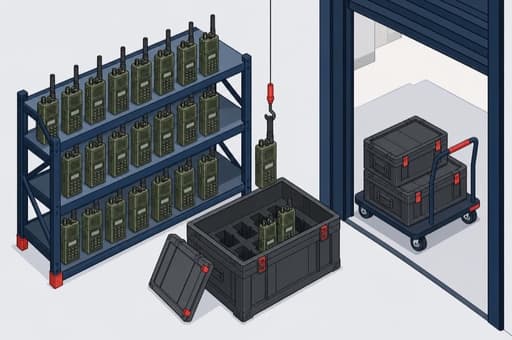
Falcon tactical radios
The handheld and backpack radios troops use to talk to each other — roughly a million already in service. They ship from a catalogue at far better margins than the long-build programmes, and NATO rearmament is pulling orders: $460M from three NATO members in a single quarter.
Competes with SYNAPS / SquadNet radios (Thales) · TruNet / ARC-210 radios (Collins Aerospace (RTX)) · StreamCaster mesh radios (Silvus)
In plain English
A soldier's radio is not a walkie-talkie you buy once. Falcon sets are software-defined: the same handset is reprogrammed to run a different encrypted radio 'language', so it is updated with new software instead of swapped for new hardware.
The money behaves like a phone business with government customers. More than a hundred allied militaries buy from a price list, mostly ordering through the US government, and the sets go out fast rather than being built to order over years. Every extra code set, satellite terminal and data-link box sold into that million-radio base is another sale on top.
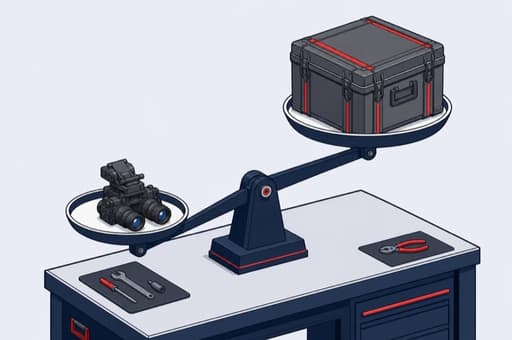
Integrated Vision Solutions
Night-vision goggles for soldiers and swivelling camera balls for aircraft. More than ten thousand US Army soldiers have been issued the goggles so far. Both sell from stock at high margins, and both were named as growth drivers this year.
Competes with Star SAFIRE turrets (Teledyne FLIR) · F6025 night-vision goggles (Elbit America) · Airborne camera turrets (Leonardo DRS)
In plain English
Two products with one job between them: seeing what the other side cannot. The goggle is a helmet-mounted binocular that blends faint available light with heat, so a soldier gets shape and warmth in the same view. The turret is a stabilised ball of cameras slung under an aircraft or fixed to a ship, holding a steady picture of something far away.
Neither is a decade-long programme. Armies, police air units and allied surveillance operators order finished units and take delivery, which is why a small box like this earns far more per dollar of sales than building a satellite does.

Next Generation Jammer Low Band & Viper Shield
Pods that hang under Navy jets and drown out enemy radar. The low-band jammer won a $587M development award in 2024 and is ramping now; government auditors warned in July 2026 that the Navy's other priorities could delay it.
Competes with NGJ Mid Band pod (Raytheon (RTX)) · Fighter self-protection suites (BAE Systems) · Airborne electronic-attack systems (Northrop Grumman)
In plain English
Radar finds an aircraft by bouncing radio waves off it and listening for the echo. A jamming pod — a smooth container bolted under a wing — floods those same frequencies with noise, so the screen back on the ground fills with nothing useful. Low band names the stretch of the radio dial this pod covers; a different company builds the mid-band pod for the same aircraft.
Payment arrives in stages. First a contract to design the pod and prove it works, then, if the Navy commits, orders for production sets — two per aircraft. So the risk here is the schedule rather than the requirement.
Missile Solutions (AXYV)
Motors, seekers and guidance for every major US interceptor, up about 16% in the first half. Across the whole company $42.0B of work sits under contract; the September 2026 Patriot motor deal alone runs $4.7B over seven years, its terms still being settled. The stock listing slipped to mid-2027.
Competes with Propulsion Systems rocket motors (Northrop Grumman) · Solid rocket motors (Anduril) · 2.75-inch extended-range motors (Ursa Major)
In plain English
Strip a missile down and much of it is a tube packed with rubbery fuel that burns once, for seconds, and cannot be throttled or switched off. L3Harris is one of the two established American makers of those motors, and also builds the seekers and steering that aim what the motor pushes.
It is usually not the missile's lead contractor. Lockheed Martin builds Patriot and THAAD; L3Harris supplies the propulsion underneath and is paid as it delivers. Capacity is going up before the orders are signed — about $2B into roughly sixty new buildings — and the Department of War bought $1B of stock in the business itself, about a tenth of it, ahead of the planned listing.
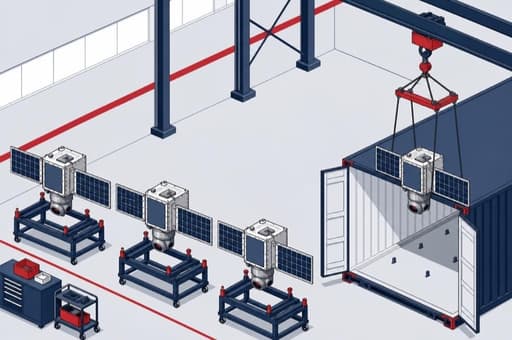
Missile warning and tracking satellites
Small satellites flying in low orbit that spot missile launches and follow what comes off the pad. L3Harris has taken a share of every round of tracking-satellite orders so far, including $955M in July 2026 for eighteen. Funding rides on the Golden Dome effort.
Competes with Tranche 3 tracking satellites (Lockheed Martin) · Accelerated tracking satellites (Sierra Space) · Tranche 3 tracking satellites (Rocket Lab)
In plain English
The Space Development Agency does not buy one enormous satellite. It buys dozens of small ones flying low and working as a single net, each watching for missile launches and tracking what follows, including weapons that fly at extreme speed. L3Harris builds them in batches — eighteen ordered in December 2025, eighteen more in July 2026.
Constellations wear out and get replaced, so the orders recur rather than arriving once. But this is one buyer's programme, paid for only as long as Congress funds the Golden Dome missile-defence push, and four companies split the last big round between them.

Special-mission aircraft
Business jets stripped and rebuilt into flying radar and surveillance aircraft — more than a hundred delivered in a decade, twenty on the line now. South Korea's order, over $2.26B, beat Boeing and Saab; a NATO ally's followed at over $2.2B.
Competes with E-7 Wedgetail (Boeing) · GlobalEye (Saab) · Special-mission conversions (Sierra Nevada)
In plain English
Buy a business jet, take out the seats, cut into the airframe and fit a radar, aerials and operator consoles. What comes out the other end is an aircraft whose job is to see other aircraft long before they arrive. The base jets are Bombardier Global-class; the radar comes from an outside supplier, IAI ELTA.
A country pays roughly a couple of hundred million dollars per aircraft, judging by those orders, and waits years for delivery — so a single win books a long stream of work. The sales argument is that a business jet now does a job air forces used to need a much larger aircraft for, which is how Korea's contest was won.
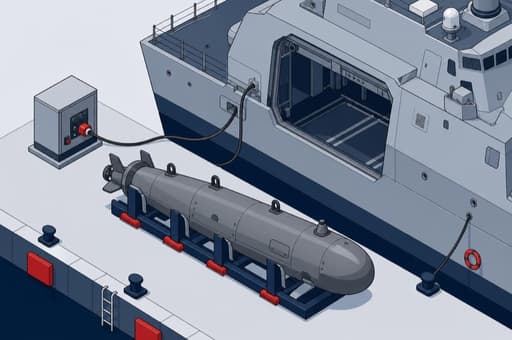
Maritime and naval systems
The power, wiring and control systems inside warships, plus uncrewed boats and undersea vessels. Revenue follows hulls, not orders — and this is the weak spot: poor performance on maritime work pulled one unit's margin down about 2.7 points in late FY2025.
Competes with Naval power and propulsion systems (Leonardo DRS) · Unmanned maritime systems (HII Mission Technologies) · Dive-XL / Ghost Shark (Anduril)
In plain English
Below a warship's deck sits a small town's worth of electrical plant — switchboards, power conversion, the panels a crew uses to run the ship — and all of it has to keep working at sea. L3Harris builds that, along with underwater listening gear and optical systems, and increasingly boats and submersibles that operate with nobody aboard.
The customer is the US Navy's shipbuilding budget, and the catch is timing: the money comes as hulls actually get built, not when contracts are signed, so a shipyard's slippage lands on L3Harris too. A new maritime plant opened in Providence in August 2026.
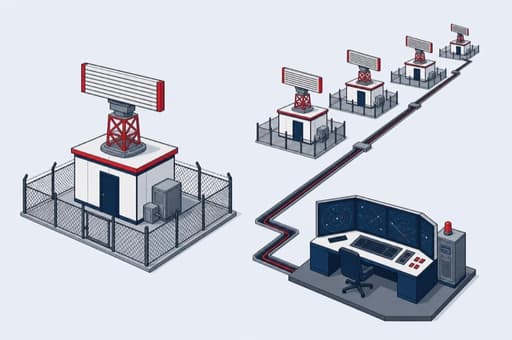
FAA Airspace Surveillance Modernization
The network that tracks aircraft across the United States — more than 700 ground stations feeding every tower and control centre. L3Harris already operates it and, since July 2026, is modernising it under a contract management sizes at about $4B running to 2045.
Competes with Air traffic management systems (Raytheon (RTX)) · Air traffic solutions (Leidos) · TopSky air traffic management (Thales)
In plain English
Air traffic control only works if somebody knows where every aircraft is. That knowledge comes from radars and receivers scattered across the country and wired back to towers and control centres — plumbing rather than gadgetry, and L3Harris already runs that plumbing for the Federal Aviation Administration.
In July 2026 the agency also hired it to replace and upgrade the equipment, through 2045. Spread across two decades, the upgrade is worth roughly $200M a year on top of what the company already earns for operating the network. So: not a growth spurt, but a very long, very steady civil contract inside a company otherwise paid by the military.


 Falcon tactical radiosThe handheld and backpack radios troops use to talk to each other — roughly a million already in service. They ship from a catalogue at far better margins than the long-build programmes, and NATO rearmament is pulling orders: $460M from three NATO members in a single quarter.
The handheld and backpack radios troops use to talk to each other — roughly a million already in service. They ship from a catalogue at far better margins than the long-build programmes, and NATO rearmament is pulling orders: $460M from three NATO members in a single quarter.
In plain English
A soldier's radio is not a walkie-talkie you buy once. Falcon sets are software-defined: the same handset is reprogrammed to run a different encrypted radio 'language', so it is updated with new software instead of swapped for new hardware.
The money behaves like a phone business with government customers. More than a hundred allied militaries buy from a price list, mostly ordering through the US government, and the sets go out fast rather than being built to order over years. Every extra code set, satellite terminal and data-link box sold into that million-radio base is another sale on top.
Competes with SYNAPS / SquadNet radios (Thales) · TruNet / ARC-210 radios (Collins Aerospace (RTX)) · StreamCaster mesh radios (Silvus)
 Integrated Vision SolutionsNight-vision goggles for soldiers and swivelling camera balls for aircraft. More than ten thousand US Army soldiers have been issued the goggles so far. Both sell from stock at high margins, and both were named as growth drivers this year.
Night-vision goggles for soldiers and swivelling camera balls for aircraft. More than ten thousand US Army soldiers have been issued the goggles so far. Both sell from stock at high margins, and both were named as growth drivers this year.
In plain English
Two products with one job between them: seeing what the other side cannot. The goggle is a helmet-mounted binocular that blends faint available light with heat, so a soldier gets shape and warmth in the same view. The turret is a stabilised ball of cameras slung under an aircraft or fixed to a ship, holding a steady picture of something far away.
Neither is a decade-long programme. Armies, police air units and allied surveillance operators order finished units and take delivery, which is why a small box like this earns far more per dollar of sales than building a satellite does.
Competes with Star SAFIRE turrets (Teledyne FLIR) · F6025 night-vision goggles (Elbit America) · Airborne camera turrets (Leonardo DRS)
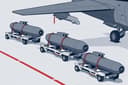 Next Generation Jammer Low Band & Viper ShieldPods that hang under Navy jets and drown out enemy radar. The low-band jammer won a $587M development award in 2024 and is ramping now; government auditors warned in July 2026 that the Navy's other priorities could delay it.
Pods that hang under Navy jets and drown out enemy radar. The low-band jammer won a $587M development award in 2024 and is ramping now; government auditors warned in July 2026 that the Navy's other priorities could delay it.
In plain English
Radar finds an aircraft by bouncing radio waves off it and listening for the echo. A jamming pod — a smooth container bolted under a wing — floods those same frequencies with noise, so the screen back on the ground fills with nothing useful. Low band names the stretch of the radio dial this pod covers; a different company builds the mid-band pod for the same aircraft.
Payment arrives in stages. First a contract to design the pod and prove it works, then, if the Navy commits, orders for production sets — two per aircraft. So the risk here is the schedule rather than the requirement.
Competes with NGJ Mid Band pod (Raytheon (RTX)) · Fighter self-protection suites (BAE Systems) · Airborne electronic-attack systems (Northrop Grumman)
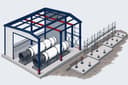 Missile Solutions (AXYV)Motors, seekers and guidance for every major US interceptor, up about 16% in the first half. Across the whole company $42.0B of work sits under contract; the September 2026 Patriot motor deal alone runs $4.7B over seven years, its terms still being settled. The stock listing slipped to mid-2027.
Motors, seekers and guidance for every major US interceptor, up about 16% in the first half. Across the whole company $42.0B of work sits under contract; the September 2026 Patriot motor deal alone runs $4.7B over seven years, its terms still being settled. The stock listing slipped to mid-2027.
In plain English
Strip a missile down and much of it is a tube packed with rubbery fuel that burns once, for seconds, and cannot be throttled or switched off. L3Harris is one of the two established American makers of those motors, and also builds the seekers and steering that aim what the motor pushes.
It is usually not the missile's lead contractor. Lockheed Martin builds Patriot and THAAD; L3Harris supplies the propulsion underneath and is paid as it delivers. Capacity is going up before the orders are signed — about $2B into roughly sixty new buildings — and the Department of War bought $1B of stock in the business itself, about a tenth of it, ahead of the planned listing.
Competes with Propulsion Systems rocket motors (Northrop Grumman) · Solid rocket motors (Anduril) · 2.75-inch extended-range motors (Ursa Major)
 Missile warning and tracking satellitesSmall satellites flying in low orbit that spot missile launches and follow what comes off the pad. L3Harris has taken a share of every round of tracking-satellite orders so far, including $955M in July 2026 for eighteen. Funding rides on the Golden Dome effort.
Small satellites flying in low orbit that spot missile launches and follow what comes off the pad. L3Harris has taken a share of every round of tracking-satellite orders so far, including $955M in July 2026 for eighteen. Funding rides on the Golden Dome effort.
In plain English
The Space Development Agency does not buy one enormous satellite. It buys dozens of small ones flying low and working as a single net, each watching for missile launches and tracking what follows, including weapons that fly at extreme speed. L3Harris builds them in batches — eighteen ordered in December 2025, eighteen more in July 2026.
Constellations wear out and get replaced, so the orders recur rather than arriving once. But this is one buyer's programme, paid for only as long as Congress funds the Golden Dome missile-defence push, and four companies split the last big round between them.
Competes with Tranche 3 tracking satellites (Lockheed Martin) · Accelerated tracking satellites (Sierra Space) · Tranche 3 tracking satellites (Rocket Lab)
 Special-mission aircraftBusiness jets stripped and rebuilt into flying radar and surveillance aircraft — more than a hundred delivered in a decade, twenty on the line now. South Korea's order, over $2.26B, beat Boeing and Saab; a NATO ally's followed at over $2.2B.
Business jets stripped and rebuilt into flying radar and surveillance aircraft — more than a hundred delivered in a decade, twenty on the line now. South Korea's order, over $2.26B, beat Boeing and Saab; a NATO ally's followed at over $2.2B.
In plain English
Buy a business jet, take out the seats, cut into the airframe and fit a radar, aerials and operator consoles. What comes out the other end is an aircraft whose job is to see other aircraft long before they arrive. The base jets are Bombardier Global-class; the radar comes from an outside supplier, IAI ELTA.
A country pays roughly a couple of hundred million dollars per aircraft, judging by those orders, and waits years for delivery — so a single win books a long stream of work. The sales argument is that a business jet now does a job air forces used to need a much larger aircraft for, which is how Korea's contest was won.
Competes with E-7 Wedgetail (Boeing) · GlobalEye (Saab) · Special-mission conversions (Sierra Nevada)
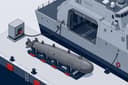 Maritime and naval systemsThe power, wiring and control systems inside warships, plus uncrewed boats and undersea vessels. Revenue follows hulls, not orders — and this is the weak spot: poor performance on maritime work pulled one unit's margin down about 2.7 points in late FY2025.
The power, wiring and control systems inside warships, plus uncrewed boats and undersea vessels. Revenue follows hulls, not orders — and this is the weak spot: poor performance on maritime work pulled one unit's margin down about 2.7 points in late FY2025.
In plain English
Below a warship's deck sits a small town's worth of electrical plant — switchboards, power conversion, the panels a crew uses to run the ship — and all of it has to keep working at sea. L3Harris builds that, along with underwater listening gear and optical systems, and increasingly boats and submersibles that operate with nobody aboard.
The customer is the US Navy's shipbuilding budget, and the catch is timing: the money comes as hulls actually get built, not when contracts are signed, so a shipyard's slippage lands on L3Harris too. A new maritime plant opened in Providence in August 2026.
Competes with Naval power and propulsion systems (Leonardo DRS) · Unmanned maritime systems (HII Mission Technologies) · Dive-XL / Ghost Shark (Anduril)
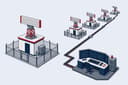 FAA Airspace Surveillance ModernizationThe network that tracks aircraft across the United States — more than 700 ground stations feeding every tower and control centre. L3Harris already operates it and, since July 2026, is modernising it under a contract management sizes at about $4B running to 2045.
The network that tracks aircraft across the United States — more than 700 ground stations feeding every tower and control centre. L3Harris already operates it and, since July 2026, is modernising it under a contract management sizes at about $4B running to 2045.
In plain English
Air traffic control only works if somebody knows where every aircraft is. That knowledge comes from radars and receivers scattered across the country and wired back to towers and control centres — plumbing rather than gadgetry, and L3Harris already runs that plumbing for the Federal Aviation Administration.
In July 2026 the agency also hired it to replace and upgrade the equipment, through 2045. Spread across two decades, the upgrade is worth roughly $200M a year on top of what the company already earns for operating the network. So: not a growth spurt, but a very long, very steady civil contract inside a company otherwise paid by the military.
Competes with Air traffic management systems (Raytheon (RTX)) · Air traffic solutions (Leidos) · TopSky air traffic management (Thales)
Named in filings, launches and programs
- VAMPIRE and RateShieldProduct · RampingLauncher pairing laser-guided rockets with a camera to knock down small drones, plus a jamming app for Falcon radios; $100M Army award, $500M of orders targeted.
- NGC2 manpack radio (AN/PRC-158C)Customer program · RampingA US Army programme buying the backpack Falcon radio — $24M to start, $84M more ordered in July 2026.
- Link 16 and tactical data linksProduct lineSoftware-defined terminals for the standard military links that let aircraft and ships swap information; sold alongside the radios.
- RS-25 engine and space launch propulsionProduct lineLarge rocket engines for NASA launches, deliberately kept out of the August 2026 sale of the commercial space businesses; 100-plus subsystems fly on Artemis II.
- NGI and Glide Phase Interceptor motorsProduct line · Pre-revenuePropulsion for two next-generation interceptors still in development; a second-stage motor was fired on the test stand in August 2026.
- HypersonicsProduct · Pre-revenueVery-high-speed flight work, also held back from the August 2026 sale; no revenue of its own is disclosed.
- HBTSSProductA tracking sensor launched in February 2024 and proven in orbit against extremely fast weapons; the basis for a follow-on bid.
- Nancy Grace Roman telescope assemblyProductBuilt the 2.4-metre optical telescope assembly for NASA's Nancy Grace Roman space telescope, launched 30 August 2026.
- F-35 avionicsProduct lineCore computers for the F-35 fighter. FY2025 was the low point as an earlier upgrade wound down; volumes are recovering.
- Intelligence and cyber programsServiceClassified intelligence and cyber work, named as a growth driver for the old space and airborne unit through FY2025; details not disclosed.
- Public safety communicationsProduct lineRadios and networks for emergency services — the civilian cousin of the military radio line, and a named product family.
- Position, navigation and timingProduct lineEquipment that establishes where a user is and what the precise time is; a named product family with no revenue disclosed.
- Space electronic warfareProduct lineElectronic-warfare systems aimed at space communications, including the Counter-Communications System; a small named line with no revenue disclosed.
- Shield Capital funds I and IIEcosystemTwo venture funds of about $50M each — the first mostly invested, the second barely started. Marginal to what the company earns.
VAMPIRE and RateShieldProduct · Ramping
Launcher pairing laser-guided rockets with a camera to knock down small drones, plus a jamming app for Falcon radios; $100M Army award, $500M of orders targeted.
NGC2 manpack radio (AN/PRC-158C)Customer program · Ramping
A US Army programme buying the backpack Falcon radio — $24M to start, $84M more ordered in July 2026.
Link 16 and tactical data linksProduct line
Software-defined terminals for the standard military links that let aircraft and ships swap information; sold alongside the radios.
RS-25 engine and space launch propulsionProduct line
Large rocket engines for NASA launches, deliberately kept out of the August 2026 sale of the commercial space businesses; 100-plus subsystems fly on Artemis II.
NGI and Glide Phase Interceptor motorsProduct line · Pre-revenue
Propulsion for two next-generation interceptors still in development; a second-stage motor was fired on the test stand in August 2026.
HypersonicsProduct · Pre-revenue
Very-high-speed flight work, also held back from the August 2026 sale; no revenue of its own is disclosed.
HBTSSProduct
A tracking sensor launched in February 2024 and proven in orbit against extremely fast weapons; the basis for a follow-on bid.
Nancy Grace Roman telescope assemblyProduct
Built the 2.4-metre optical telescope assembly for NASA's Nancy Grace Roman space telescope, launched 30 August 2026.
F-35 avionicsProduct line
Core computers for the F-35 fighter. FY2025 was the low point as an earlier upgrade wound down; volumes are recovering.
Intelligence and cyber programsService
Classified intelligence and cyber work, named as a growth driver for the old space and airborne unit through FY2025; details not disclosed.
Public safety communicationsProduct line
Radios and networks for emergency services — the civilian cousin of the military radio line, and a named product family.
Position, navigation and timingProduct line
Equipment that establishes where a user is and what the precise time is; a named product family with no revenue disclosed.
Space electronic warfareProduct line
Electronic-warfare systems aimed at space communications, including the Counter-Communications System; a small named line with no revenue disclosed.
Shield Capital funds I and IIEcosystem
Two venture funds of about $50M each — the first mostly invested, the second barely started. Marginal to what the company earns.