
Northrop Grumman (NOC)
Defense prime for stealth aircraft, strategic missiles, mission electronics, and space systems.
Something off on this page? Send us feedback.
Northrop Grumman builds military aircraft, sensors, missiles, satellites and rocket motors for governments. Its center of gravity is shifting toward a bomber build-out and a much larger missile-and-strategic-defense pipeline, while space works through older program wind-downs. Public budgets still hold the whole machine up, with the United States government as the dominant buyer.
Item facts: FY2025 · year ended Dec 31, 2025, from filings, earnings calls and company pages.
Judgment weights, not filed revenue
The band summarizes business focus and direction. ~ marks estimates.
8 in detail · 14 more below
Defense Systems
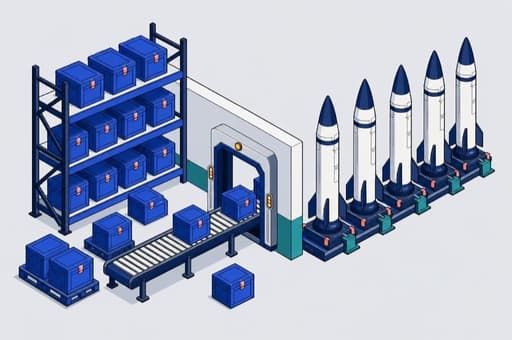
This is the missiles, land-based nuclear defense and battlefield-control arm. Northrop's work promised across all businesses but not yet delivered reached $104.69B in June 2026; the watchpoint here is turning that promise into output without fresh cost setbacks.
Competes with C2BMC/C2BMC-Next (Lockheed Martin) · Aerojet Rocketdyne motors (L3Harris)
In plain English
The job here is to connect warning, decision and response: spot a threat, decide what to do, and supply the missile or ammunition that carries it out. Northrop also helps replace the land-based nuclear missiles meant to discourage an attack in the first place.
Governments pay through years of design, testing and factory work, then for delivered equipment and support. Some contracts repay allowed costs plus a fee; others set the price ahead of time, leaving Northrop to absorb overruns. Factory capacity, successful testing and government funding determine how quickly promised work becomes sales.
Solid Rocket Motors
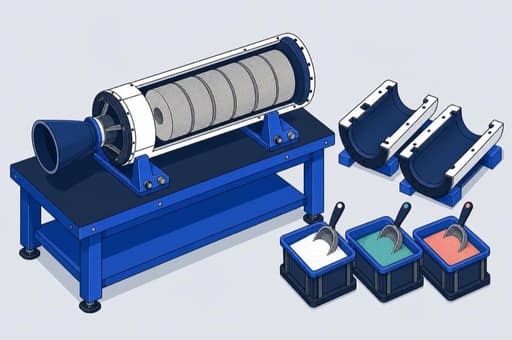
One-use engines push missiles and launch vehicles. New missile-interceptor agreements cover more than $3B; the constraint is getting materials approved and expanding factories fast enough to deliver.
Competes with Aerojet Rocketdyne motors (L3Harris) · X-Bow motors (X-Bow Systems)
In plain English
A solid rocket motor is the tightly packed engine inside a missile or launch booster. Light it and the fuel burns in one controlled burst, much like a carefully engineered firework that must work perfectly on the first try.
Northrop sells motors, ignition devices and related parts into larger missile and space programs. The U.S. government and missile maker Lockheed Martin pay for development and then repeated production. More missile demand means more units, but each material, casing and design must pass strict tests before the factory can speed up.
Sentinel
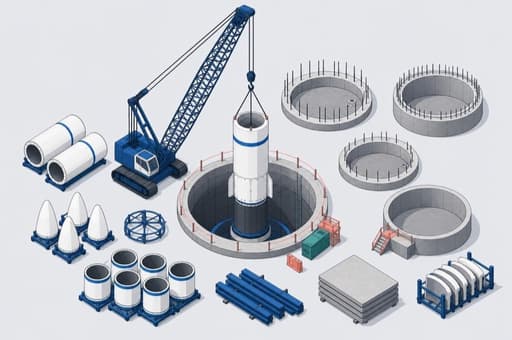
Sentinel replaces America's aging land-based nuclear missile system. Newly approved work added $7.6B to Defense Systems' June 2026 workload; the watchpoint is whether the reshaped effort clears testing, construction and funding hurdles.
Competes with Ground Based Strategic Deterrent proposal (Boeing) · Trident II D5 (Lockheed Martin)
In plain English
Sentinel is not just a new missile. It is a replacement for an entire land-based nuclear system, including underground launch sites, command equipment and the links between them. Its purpose is to make an enemy believe an attack would bring an unavoidable response.
The Air Force pays Northrop back for allowed development costs and adds a fee, reducing the company's risk while designs are still changing. Production has not yet been priced. Northrop earns as engineers, tests and construction advance, but the schedule depends on design approval, flight tests, rebuilt facilities and continued funding.
Integrated Battle Command System (IBCS)
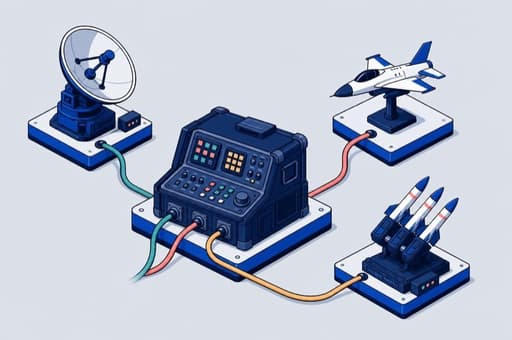
IBCS is the Army's control system for air and missile defense. New awards added $153M of FY2025 sales from a modest base; wider adoption depends on overseas approvals and smooth connections to other makers' equipment.
Competes with C2BMC/C2BMC-Next (Lockheed Martin) · Legacy Patriot command-and-control (RTX)
In plain English
Imagine an air-traffic controller for incoming threats. IBCS collects what different radars and aircraft see, builds one shared picture, then helps choose which launcher should respond. It lets equipment from different manufacturers work together instead of staying in separate islands.
The U.S. Army and Poland pay Northrop for the control software, computer hardware, connections, field installation and support. Each new country or added radar creates more integration work. That also makes approval to export, protection against hacking and reliable links to partner equipment central to whether a proposed sale becomes real.
Space Systems
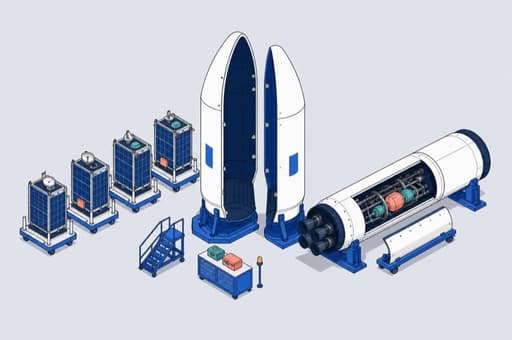
Satellites, missile-warning payloads, interceptors and launch boosters make this a broad space business. Sales fell 8% in FY2025 and stayed flat in the first half of FY2026; new security programs must outrun older work ending and booster redesign costs.
Competes with Tranche 3 spacecraft (Lockheed Martin) · Tranche 3 spacecraft (L3Harris) · Tranche 3 spacecraft (Rocket Lab)
In plain English
Up here, Northrop makes the machines sent into orbit and much of what keeps them useful from the ground. That includes satellites that spot missiles or carry data, ground control equipment, interceptors, cargo craft and strap-on boosters that help rockets lift off.
Space agencies and defense customers pay for design, manufacturing, launches and years of support. The rhythm is uneven: a large satellite batch can fill factories, while a delayed launch or a program ending leaves a hole. Fresh military-space awards are the recovery engine; component supply, successful motor testing and launch timing decide when the money arrives.
Aeronautics Systems
This is the largest single segment: bombers, surveillance aircraft and Northrop-built parts for other companies' jets. The U.S. government supplied 84% of companywide FY2025 sales, so public funding and supplier delivery set the pace.
Competes with F-47 (Boeing) · YFQ-42A (General Atomics) · YFQ-44A (Anduril)
In plain English
From a flying-wing bomber to high-altitude aircraft that watch the sea, Aeronautics covers complete military planes and major pieces fitted into another contractor's plane. Northrop designs them, builds them and keeps them working after delivery.
The Air Force and Navy fund development, buy aircraft as production advances, then pay for upgrades and maintenance over long lives. Lockheed Martin also buys Northrop work for the F-35 program. The coming growth rests mainly on making more B-21 bombers and E-130J command aircraft, while completed F/A-18 production no longer provides the same factory volume.
B-21 Raider
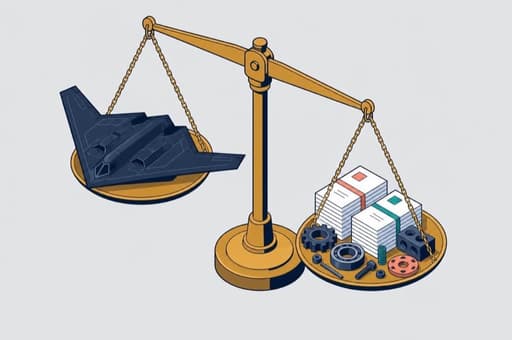
The Air Force's new bomber is the main aircraft growth engine, but early production batches had accumulated about $2.0B of losses by June 2026. Higher factory output matters only if Northrop avoids repeating those overruns.
Competes with B-52J modernization (Boeing) · F-47 (Boeing)
In plain English
The B-21 is a bomber shaped to fly through heavily defended airspace and deliver long-range strikes. Northrop is taking it from design and flight testing into repeated production for one buyer, the U.S. Air Force.
Early development mostly repays Northrop's allowed costs plus a fee. The first production batches work differently: the price was largely agreed in advance, so Northrop bears extra costs when parts, labor or schedules run over plan. The Air Force is helping fund more capacity, and Northrop earns as work progresses, but making each aircraft more predictably is the economic test.
Mission Systems
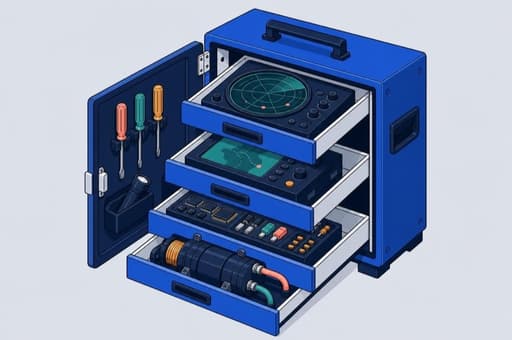
Sensors and electronics sit inside aircraft, ships and submarines across many programs. Naval work is growing while one fighter-radar line has softened; schedules for the vehicles carrying them, secure chip supply and export approvals determine the mix.
Competes with AN/SPY-6 (RTX) · AN/SPY-7 (Lockheed Martin)
In plain English
Think of Mission Systems as the eyes, ears and nerves fitted inside larger military machines. Its radars find objects, navigation gear tells vehicles where they are, signal equipment detects or blocks enemy transmissions, and tiny specialized chips make those systems work. It also supplies power machinery for submarines.
Customers pay for design, each unit installed, later upgrades and support. Some equipment goes straight to defense agencies; some rides inside aircraft built by Lockheed Martin or Boeing. That makes Northrop dependent on those larger programs' schedules as well as its own ability to obtain trusted chips and win permission for overseas sales.


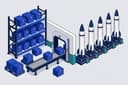 Defense SystemsThis is the missiles, land-based nuclear defense and battlefield-control arm. Northrop's work promised across all businesses but not yet delivered reached $104.69B in June 2026; the watchpoint here is turning that promise into output without fresh cost setbacks.
This is the missiles, land-based nuclear defense and battlefield-control arm. Northrop's work promised across all businesses but not yet delivered reached $104.69B in June 2026; the watchpoint here is turning that promise into output without fresh cost setbacks.
In plain English
The job here is to connect warning, decision and response: spot a threat, decide what to do, and supply the missile or ammunition that carries it out. Northrop also helps replace the land-based nuclear missiles meant to discourage an attack in the first place.
Governments pay through years of design, testing and factory work, then for delivered equipment and support. Some contracts repay allowed costs plus a fee; others set the price ahead of time, leaving Northrop to absorb overruns. Factory capacity, successful testing and government funding determine how quickly promised work becomes sales.
Competes with C2BMC/C2BMC-Next (Lockheed Martin) · Aerojet Rocketdyne motors (L3Harris)
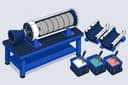 Solid Rocket MotorsOne-use engines push missiles and launch vehicles. New missile-interceptor agreements cover more than $3B; the constraint is getting materials approved and expanding factories fast enough to deliver.
One-use engines push missiles and launch vehicles. New missile-interceptor agreements cover more than $3B; the constraint is getting materials approved and expanding factories fast enough to deliver.
In plain English
A solid rocket motor is the tightly packed engine inside a missile or launch booster. Light it and the fuel burns in one controlled burst, much like a carefully engineered firework that must work perfectly on the first try.
Northrop sells motors, ignition devices and related parts into larger missile and space programs. The U.S. government and missile maker Lockheed Martin pay for development and then repeated production. More missile demand means more units, but each material, casing and design must pass strict tests before the factory can speed up.
Competes with Aerojet Rocketdyne motors (L3Harris) · X-Bow motors (X-Bow Systems)
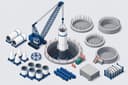 SentinelSentinel replaces America's aging land-based nuclear missile system. Newly approved work added $7.6B to Defense Systems' June 2026 workload; the watchpoint is whether the reshaped effort clears testing, construction and funding hurdles.
Sentinel replaces America's aging land-based nuclear missile system. Newly approved work added $7.6B to Defense Systems' June 2026 workload; the watchpoint is whether the reshaped effort clears testing, construction and funding hurdles.
In plain English
Sentinel is not just a new missile. It is a replacement for an entire land-based nuclear system, including underground launch sites, command equipment and the links between them. Its purpose is to make an enemy believe an attack would bring an unavoidable response.
The Air Force pays Northrop back for allowed development costs and adds a fee, reducing the company's risk while designs are still changing. Production has not yet been priced. Northrop earns as engineers, tests and construction advance, but the schedule depends on design approval, flight tests, rebuilt facilities and continued funding.
Competes with Ground Based Strategic Deterrent proposal (Boeing) · Trident II D5 (Lockheed Martin)
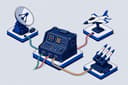 Integrated Battle Command System (IBCS)IBCS is the Army's control system for air and missile defense. New awards added $153M of FY2025 sales from a modest base; wider adoption depends on overseas approvals and smooth connections to other makers' equipment.
IBCS is the Army's control system for air and missile defense. New awards added $153M of FY2025 sales from a modest base; wider adoption depends on overseas approvals and smooth connections to other makers' equipment.
In plain English
Imagine an air-traffic controller for incoming threats. IBCS collects what different radars and aircraft see, builds one shared picture, then helps choose which launcher should respond. It lets equipment from different manufacturers work together instead of staying in separate islands.
The U.S. Army and Poland pay Northrop for the control software, computer hardware, connections, field installation and support. Each new country or added radar creates more integration work. That also makes approval to export, protection against hacking and reliable links to partner equipment central to whether a proposed sale becomes real.
Competes with C2BMC/C2BMC-Next (Lockheed Martin) · Legacy Patriot command-and-control (RTX)
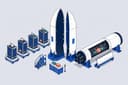 Space SystemsSatellites, missile-warning payloads, interceptors and launch boosters make this a broad space business. Sales fell 8% in FY2025 and stayed flat in the first half of FY2026; new security programs must outrun older work ending and booster redesign costs.
Satellites, missile-warning payloads, interceptors and launch boosters make this a broad space business. Sales fell 8% in FY2025 and stayed flat in the first half of FY2026; new security programs must outrun older work ending and booster redesign costs.
In plain English
Up here, Northrop makes the machines sent into orbit and much of what keeps them useful from the ground. That includes satellites that spot missiles or carry data, ground control equipment, interceptors, cargo craft and strap-on boosters that help rockets lift off.
Space agencies and defense customers pay for design, manufacturing, launches and years of support. The rhythm is uneven: a large satellite batch can fill factories, while a delayed launch or a program ending leaves a hole. Fresh military-space awards are the recovery engine; component supply, successful motor testing and launch timing decide when the money arrives.
Competes with Tranche 3 spacecraft (Lockheed Martin) · Tranche 3 spacecraft (L3Harris) · Tranche 3 spacecraft (Rocket Lab)
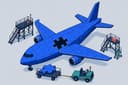 Aeronautics SystemsThis is the largest single segment: bombers, surveillance aircraft and Northrop-built parts for other companies' jets. The U.S. government supplied 84% of companywide FY2025 sales, so public funding and supplier delivery set the pace.
This is the largest single segment: bombers, surveillance aircraft and Northrop-built parts for other companies' jets. The U.S. government supplied 84% of companywide FY2025 sales, so public funding and supplier delivery set the pace.
In plain English
From a flying-wing bomber to high-altitude aircraft that watch the sea, Aeronautics covers complete military planes and major pieces fitted into another contractor's plane. Northrop designs them, builds them and keeps them working after delivery.
The Air Force and Navy fund development, buy aircraft as production advances, then pay for upgrades and maintenance over long lives. Lockheed Martin also buys Northrop work for the F-35 program. The coming growth rests mainly on making more B-21 bombers and E-130J command aircraft, while completed F/A-18 production no longer provides the same factory volume.
Competes with F-47 (Boeing) · YFQ-42A (General Atomics) · YFQ-44A (Anduril)
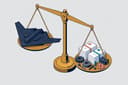 B-21 RaiderThe Air Force's new bomber is the main aircraft growth engine, but early production batches had accumulated about $2.0B of losses by June 2026. Higher factory output matters only if Northrop avoids repeating those overruns.
The Air Force's new bomber is the main aircraft growth engine, but early production batches had accumulated about $2.0B of losses by June 2026. Higher factory output matters only if Northrop avoids repeating those overruns.
In plain English
The B-21 is a bomber shaped to fly through heavily defended airspace and deliver long-range strikes. Northrop is taking it from design and flight testing into repeated production for one buyer, the U.S. Air Force.
Early development mostly repays Northrop's allowed costs plus a fee. The first production batches work differently: the price was largely agreed in advance, so Northrop bears extra costs when parts, labor or schedules run over plan. The Air Force is helping fund more capacity, and Northrop earns as work progresses, but making each aircraft more predictably is the economic test.
Competes with B-52J modernization (Boeing) · F-47 (Boeing)
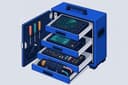 Mission SystemsSensors and electronics sit inside aircraft, ships and submarines across many programs. Naval work is growing while one fighter-radar line has softened; schedules for the vehicles carrying them, secure chip supply and export approvals determine the mix.
Sensors and electronics sit inside aircraft, ships and submarines across many programs. Naval work is growing while one fighter-radar line has softened; schedules for the vehicles carrying them, secure chip supply and export approvals determine the mix.
In plain English
Think of Mission Systems as the eyes, ears and nerves fitted inside larger military machines. Its radars find objects, navigation gear tells vehicles where they are, signal equipment detects or blocks enemy transmissions, and tiny specialized chips make those systems work. It also supplies power machinery for submarines.
Customers pay for design, each unit installed, later upgrades and support. Some equipment goes straight to defense agencies; some rides inside aircraft built by Lockheed Martin or Boeing. That makes Northrop dependent on those larger programs' schedules as well as its own ability to obtain trusted chips and win permission for overseas sales.
Competes with AN/SPY-6 (RTX) · AN/SPY-7 (Lockheed Martin)
Named in filings, launches and programs
- Restricted programsCustomer programSecret work spans aircraft, electronics and space; customer names stay undisclosed, and these programs account for substantial portions of all three businesses.
- F-35 Lightning II content and sustainmentProduct lineNorthrop supplies fuselage work, radar, sensing and communications equipment, then supports those systems after the fighter enters service.
- E-130J Phoenix II / TACAMOCustomer program · RampingA Navy aircraft for directing nuclear forces; rising work made it a meaningful contributor to first-half FY2026 aircraft growth.
- E-2D Advanced HawkeyePlatformA carrier-based aircraft that watches the sky and coordinates responses for the U.S. Navy, Japan and France.
- MQ-4C TritonPlatformAn uncrewed, high-flying aircraft that watches wide stretches of ocean for the U.S. Navy and Australia.
- RQ-4 Global HawkPlatformA land-focused, high-flying surveillance aircraft with U.S., Japanese and South Korean customers and continuing support work.
- Multi-role Electronically Scanned Array (MESA)Product lineAn airborne early-warning radar line that secured a $0.7B award in the second quarter of FY2026.
- SDA Tracking and Transport LayersCustomer programGroups of military satellites that spot missiles and move data; the latest tracking award covers 18 spacecraft.
- Glide Phase Interceptor (GPI)Customer program · RampingA missile being developed to stop fast gliding weapons during flight, backed by a $0.8B FY2026 second-quarter award.
- Ground-based Midcourse Defense Weapon SystemCustomer programA missile-defense program covering interceptors, test targets, control computers and boosters; FY2025 awards included $1.8B.
- Cygnus / Commercial Resupply ServicesPlatformCargo spacecraft carry supplies to the International Space Station and can also raise the station's orbit.
- GEM 63 / GEM 63XLProduct line · RampingStrap-on boosters for rockets launched by ULA; a large award supports demand, while redesign costs have hurt Space Systems' profit.
- Mission Robotic Vehicle and Mission Extension PodsPlatform · Pre-revenueA robotic satellite-servicing craft launched with three add-on pods in July 2026; operations are expected in 2027.
- Beacon / Model 437 VanguardProduct · AnnouncedAn internally funded test aircraft for pairing partner-built flying software with the Model 437 Vanguard; announced, not yet a revenue line.
Restricted programsCustomer program
Secret work spans aircraft, electronics and space; customer names stay undisclosed, and these programs account for substantial portions of all three businesses.
F-35 Lightning II content and sustainmentProduct line
Northrop supplies fuselage work, radar, sensing and communications equipment, then supports those systems after the fighter enters service.
E-130J Phoenix II / TACAMOCustomer program · Ramping
A Navy aircraft for directing nuclear forces; rising work made it a meaningful contributor to first-half FY2026 aircraft growth.
E-2D Advanced HawkeyePlatform
A carrier-based aircraft that watches the sky and coordinates responses for the U.S. Navy, Japan and France.
MQ-4C TritonPlatform
An uncrewed, high-flying aircraft that watches wide stretches of ocean for the U.S. Navy and Australia.
RQ-4 Global HawkPlatform
A land-focused, high-flying surveillance aircraft with U.S., Japanese and South Korean customers and continuing support work.
Multi-role Electronically Scanned Array (MESA)Product line
An airborne early-warning radar line that secured a $0.7B award in the second quarter of FY2026.
SDA Tracking and Transport LayersCustomer program
Groups of military satellites that spot missiles and move data; the latest tracking award covers 18 spacecraft.
Glide Phase Interceptor (GPI)Customer program · Ramping
A missile being developed to stop fast gliding weapons during flight, backed by a $0.8B FY2026 second-quarter award.
Ground-based Midcourse Defense Weapon SystemCustomer program
A missile-defense program covering interceptors, test targets, control computers and boosters; FY2025 awards included $1.8B.
Cygnus / Commercial Resupply ServicesPlatform
Cargo spacecraft carry supplies to the International Space Station and can also raise the station's orbit.
GEM 63 / GEM 63XLProduct line · Ramping
Strap-on boosters for rockets launched by ULA; a large award supports demand, while redesign costs have hurt Space Systems' profit.
Mission Robotic Vehicle and Mission Extension PodsPlatform · Pre-revenue
A robotic satellite-servicing craft launched with three add-on pods in July 2026; operations are expected in 2027.
Beacon / Model 437 VanguardProduct · Announced
An internally funded test aircraft for pairing partner-built flying software with the Model 437 Vanguard; announced, not yet a revenue line.