
Redwire (RDW)
Builds spacecraft infrastructure, uncrewed aircraft, sensors, and mission payloads for space and defense.
Something off on this page? Send us feedback.
Redwire builds spacecraft hardware — roll-out solar wings, satellite bodies, star-spotting cameras — and, since buying the drone maker Edge Autonomy, small military scout drones that take off straight up. The space side has stalled while drone orders climb, so the defense business now outsells space. The company still loses money and has leaned on selling new shares to fund itself.
Item facts: Four quarters to June 30, 2026 · FY2025 + H1 2026 filings, from filings, earnings calls and company pages.
Judgment weights, not filed revenue
The band summarizes business focus and direction. ~ marks estimates.
7 in detail · 11 more below
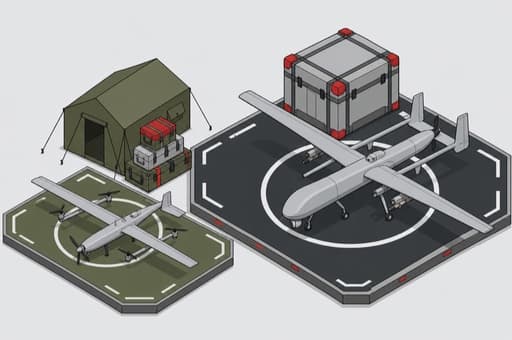
Stalker
Likely Redwire's largest product line: a U.S.-built scout drone that rises straight up, then flies like a plane. The Marines ordered $41.5M of follow-ons in the first half of 2026, but the Army's first long-range production order went to AeroVironment's P550.
Competes with P550 (AeroVironment) · V-BAT (Shield AI) · JUMP 20-X (AeroVironment)
In plain English
Picture a small unmanned plane that lifts off straight up like a helicopter, then spends hours circling with a camera, watching the ground for the soldiers below. That is Stalker, built in the U.S. and flown for more than three hundred thousand hours.
The money comes from military program offices. Once a service makes a drone its standard pick — the Marines and Britain's defence ministry both have — follow-on orders keep arriving; the Marines placed two in the first half of 2026. A newer version aims to stay up eighteen hours or more on Redwire's own fuel cells, devices that turn fuel into electricity.

Penguin (Mk2.5, Mk3)
Latvian-built drones sold to European militaries, Ukraine and Taiwan's coast guard. A spring 2026 multi-year Mk3 deal with an unnamed NATO ally runs to the "high eight figures" — tens of millions of dollars. Watch whether European rearmament keeps the orders coming.
Competes with Vector / Trinity (Quantum-Systems) · Fixed-wing drones (UKRSPECSYSTEMS) · Camcopter S-100 (Schiebel)
In plain English
Built in Riga, Latvia, Penguin is a fixed-wing drone family; the newest Mk3 version can stay aloft for up to fourteen hours. Being made inside the EU is part of Redwire's pitch to NATO buyers.
Customers are defence ministries, coast guards and border patrols. More than two hundred went to Ukraine's armed forces by late 2025, Croatia's border patrol bought some, and Taiwan's coast guard ordered a first batch through a local partner, Taiwan Color Optics. Many sales also carry one of Redwire's own Octopus cameras, so one airframe sold can pull a second product along with it.
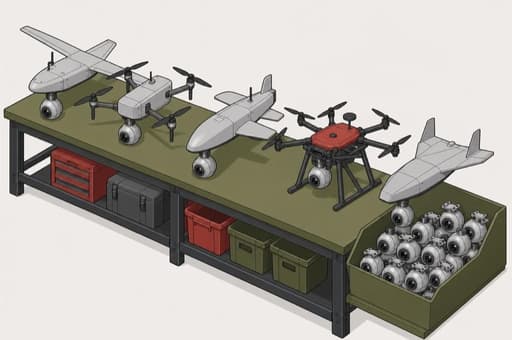
Octopus ISR and Optics Payloads
Steadied drone cameras sold with Redwire's own aircraft and to other drone makers. Nearly 200 shipped in 2026 through early August, about 15% more than a year earlier; new heat-sensing models began shipping in the spring.
Competes with HD59 gimbal (Trillium Engineering) · Kestrel gimbal (Gremsy)
In plain English
A drone is only as useful as what it can see. Octopus is the eye: a small ball-shaped camera that hangs under the aircraft and holds its picture steady while the drone bumps through the wind, with one lens for daylight and one that sees heat at night.
Redwire sells it bolted onto its own Stalker and Penguin, and also to companies that build other drones, which widens demand beyond Redwire's planes. More than four hundred went to Ukraine's armed forces by late 2025.
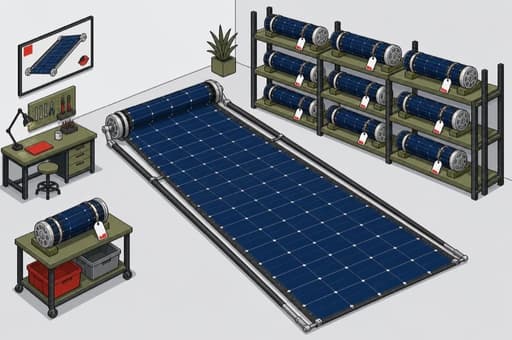
ROSA and ELSA Solar Arrays
Roll-out solar wings for spacecraft, from space-station size down to small satellites. A ~$50M follow-on production order and ELSA's first sale, $12.8M to Moog, both landed in early 2026; watch whether small-satellite volume follows.
Competes with UltraFlex / MegaFlex arrays (Northrop Grumman) · Sparkwing arrays (Airbus) · Space solar panels (Rocket Lab)
In plain English
Satellites run on sunlight, and the panels that catch it have to fit inside a rocket first. ROSA solves that like a window blind: the solar panel is a thin, flexible sheet rolled up tight, and springy booms straighten in orbit and pull it open.
It has flown on the International Space Station and NASA's DART mission, and a pair of 60-kilowatt wings is due to fly on a NASA mission in 2028. ELSA, launched in 2026, is a lighter version for small satellites built in bigger batches. Buyers are satellite makers and the contractors behind space-agency missions, and Redwire earns as each build progresses.
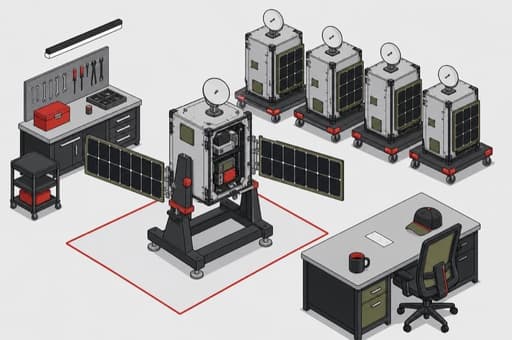
Spacecraft Platforms (Hammerhead, Phantom, SabreSat, Mako)
Satellite bodies for European and U.S. government missions, including a $44M DARPA craft for very low orbit. Space work is still most of Redwire's $542.1M order book, but new space orders in spring 2026 covered only about a third of what shipped.
Competes with VLEO satellite platform (Albedo) · Millennium Space spacecraft (Boeing) · Andromeda spacecraft bids (True Anomaly)
In plain English
Every satellite needs a body: the frame, power, steering and computer that a mission's instruments bolt onto, much like a truck chassis waiting for its cargo box. Redwire builds four models in Belgium and the U.S., from craft that skim very low above Earth to Mako, a refuelable one meant for high orbit that has not earned revenue yet.
Buyers are few and large — Europe's space agency, Belgium's defence ministry, DARPA, the Air Force's research lab — on multi-year contracts, often at a fixed price, so when a build runs over budget Redwire's profit shrinks. Across the whole company, two customers Redwire does not name made up 38.5% of 2025 revenue.
Space Sensors and RF Systems
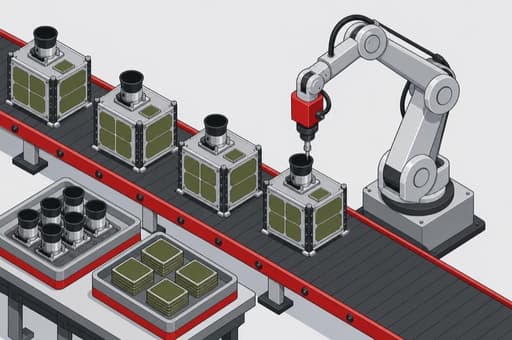
Star trackers, space cameras and military satellite antennas. On its own this line brought in $48.8M in 2024 and has not clearly grown since; watch whether the coming wave of satellite launches and a new antenna push lift it.
Competes with Star trackers (Sodern) · Star trackers (Jena-Optronik) · Star trackers (Leonardo)
In plain English
Before the drones arrived, this was already Redwire's defence corner: small parts that tell a satellite which way it is pointing and let it talk. A star tracker is a tiny camera that photographs the stars and matches them to a map, the way sailors once steered by the night sky. Redwire's space cameras flew on NASA's Artemis I and II, and its radio antennas ride on military satellite networks.
Satellite builders buy these as parts, so demand tracks how many satellites get built; management cites roughly seventy thousand expected over five years. In August 2026 Redwire put its own money into making flat, electronically steered antennas in Colorado.

SpaceMD and PIL-BOX
Drug-crystal experiments flown to the space station, with royalties as the hoped-for payoff — one deal signed with ExesaLibero Pharma, work under way with Bristol-Myers Squibb. Small today; the 2028 SpaceX Starfall flight carrying up to 32 PIL-BOXes is the milestone.
Competes with In-orbit drug-crystal capsule (Varda Space Industries) · ISS biomanufacturing platform (Space Tango) · In-space pharma platform (Space Pharma)
In plain English
A long bet with a pharmacy at the end. PIL-BOX is a small lab kit that rides to the International Space Station and grows drug crystals in weightlessness; more than fifty had flown by August 2026, crystallizing 45 different compounds.
Today it earns from flying research, partly paid for by NASA under a five-year contract worth up to $25M. The bigger idea, run through a subsidiary called SpaceMD, is to sell or license seed crystals to drugmakers and collect royalties, like a songwriter paid each time a song plays. That takes years: SpaceMD has booked an entire SpaceX Starfall mission for 2028.


 StalkerLikely Redwire's largest product line: a U.S.-built scout drone that rises straight up, then flies like a plane. The Marines ordered $41.5M of follow-ons in the first half of 2026, but the Army's first long-range production order went to AeroVironment's P550.
Likely Redwire's largest product line: a U.S.-built scout drone that rises straight up, then flies like a plane. The Marines ordered $41.5M of follow-ons in the first half of 2026, but the Army's first long-range production order went to AeroVironment's P550.
In plain English
Picture a small unmanned plane that lifts off straight up like a helicopter, then spends hours circling with a camera, watching the ground for the soldiers below. That is Stalker, built in the U.S. and flown for more than three hundred thousand hours.
The money comes from military program offices. Once a service makes a drone its standard pick — the Marines and Britain's defence ministry both have — follow-on orders keep arriving; the Marines placed two in the first half of 2026. A newer version aims to stay up eighteen hours or more on Redwire's own fuel cells, devices that turn fuel into electricity.
Competes with P550 (AeroVironment) · V-BAT (Shield AI) · JUMP 20-X (AeroVironment)
 Penguin (Mk2.5, Mk3)Latvian-built drones sold to European militaries, Ukraine and Taiwan's coast guard. A spring 2026 multi-year Mk3 deal with an unnamed NATO ally runs to the "high eight figures" — tens of millions of dollars. Watch whether European rearmament keeps the orders coming.
Latvian-built drones sold to European militaries, Ukraine and Taiwan's coast guard. A spring 2026 multi-year Mk3 deal with an unnamed NATO ally runs to the "high eight figures" — tens of millions of dollars. Watch whether European rearmament keeps the orders coming.
In plain English
Built in Riga, Latvia, Penguin is a fixed-wing drone family; the newest Mk3 version can stay aloft for up to fourteen hours. Being made inside the EU is part of Redwire's pitch to NATO buyers.
Customers are defence ministries, coast guards and border patrols. More than two hundred went to Ukraine's armed forces by late 2025, Croatia's border patrol bought some, and Taiwan's coast guard ordered a first batch through a local partner, Taiwan Color Optics. Many sales also carry one of Redwire's own Octopus cameras, so one airframe sold can pull a second product along with it.
Competes with Vector / Trinity (Quantum-Systems) · Fixed-wing drones (UKRSPECSYSTEMS) · Camcopter S-100 (Schiebel)
 Octopus ISR and Optics PayloadsSteadied drone cameras sold with Redwire's own aircraft and to other drone makers. Nearly 200 shipped in 2026 through early August, about 15% more than a year earlier; new heat-sensing models began shipping in the spring.
Steadied drone cameras sold with Redwire's own aircraft and to other drone makers. Nearly 200 shipped in 2026 through early August, about 15% more than a year earlier; new heat-sensing models began shipping in the spring.
In plain English
A drone is only as useful as what it can see. Octopus is the eye: a small ball-shaped camera that hangs under the aircraft and holds its picture steady while the drone bumps through the wind, with one lens for daylight and one that sees heat at night.
Redwire sells it bolted onto its own Stalker and Penguin, and also to companies that build other drones, which widens demand beyond Redwire's planes. More than four hundred went to Ukraine's armed forces by late 2025.
Competes with HD59 gimbal (Trillium Engineering) · Kestrel gimbal (Gremsy)
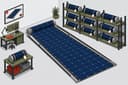 ROSA and ELSA Solar ArraysRoll-out solar wings for spacecraft, from space-station size down to small satellites. A ~$50M follow-on production order and ELSA's first sale, $12.8M to Moog, both landed in early 2026; watch whether small-satellite volume follows.
Roll-out solar wings for spacecraft, from space-station size down to small satellites. A ~$50M follow-on production order and ELSA's first sale, $12.8M to Moog, both landed in early 2026; watch whether small-satellite volume follows.
In plain English
Satellites run on sunlight, and the panels that catch it have to fit inside a rocket first. ROSA solves that like a window blind: the solar panel is a thin, flexible sheet rolled up tight, and springy booms straighten in orbit and pull it open.
It has flown on the International Space Station and NASA's DART mission, and a pair of 60-kilowatt wings is due to fly on a NASA mission in 2028. ELSA, launched in 2026, is a lighter version for small satellites built in bigger batches. Buyers are satellite makers and the contractors behind space-agency missions, and Redwire earns as each build progresses.
Competes with UltraFlex / MegaFlex arrays (Northrop Grumman) · Sparkwing arrays (Airbus) · Space solar panels (Rocket Lab)
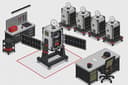 Spacecraft Platforms (Hammerhead, Phantom, SabreSat, Mako)Satellite bodies for European and U.S. government missions, including a $44M DARPA craft for very low orbit. Space work is still most of Redwire's $542.1M order book, but new space orders in spring 2026 covered only about a third of what shipped.
Satellite bodies for European and U.S. government missions, including a $44M DARPA craft for very low orbit. Space work is still most of Redwire's $542.1M order book, but new space orders in spring 2026 covered only about a third of what shipped.
In plain English
Every satellite needs a body: the frame, power, steering and computer that a mission's instruments bolt onto, much like a truck chassis waiting for its cargo box. Redwire builds four models in Belgium and the U.S., from craft that skim very low above Earth to Mako, a refuelable one meant for high orbit that has not earned revenue yet.
Buyers are few and large — Europe's space agency, Belgium's defence ministry, DARPA, the Air Force's research lab — on multi-year contracts, often at a fixed price, so when a build runs over budget Redwire's profit shrinks. Across the whole company, two customers Redwire does not name made up 38.5% of 2025 revenue.
Competes with VLEO satellite platform (Albedo) · Millennium Space spacecraft (Boeing) · Andromeda spacecraft bids (True Anomaly)
 Space Sensors and RF SystemsStar trackers, space cameras and military satellite antennas. On its own this line brought in $48.8M in 2024 and has not clearly grown since; watch whether the coming wave of satellite launches and a new antenna push lift it.
Star trackers, space cameras and military satellite antennas. On its own this line brought in $48.8M in 2024 and has not clearly grown since; watch whether the coming wave of satellite launches and a new antenna push lift it.
In plain English
Before the drones arrived, this was already Redwire's defence corner: small parts that tell a satellite which way it is pointing and let it talk. A star tracker is a tiny camera that photographs the stars and matches them to a map, the way sailors once steered by the night sky. Redwire's space cameras flew on NASA's Artemis I and II, and its radio antennas ride on military satellite networks.
Satellite builders buy these as parts, so demand tracks how many satellites get built; management cites roughly seventy thousand expected over five years. In August 2026 Redwire put its own money into making flat, electronically steered antennas in Colorado.
Competes with Star trackers (Sodern) · Star trackers (Jena-Optronik) · Star trackers (Leonardo)
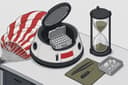 SpaceMD and PIL-BOXDrug-crystal experiments flown to the space station, with royalties as the hoped-for payoff — one deal signed with ExesaLibero Pharma, work under way with Bristol-Myers Squibb. Small today; the 2028 SpaceX Starfall flight carrying up to 32 PIL-BOXes is the milestone.
Drug-crystal experiments flown to the space station, with royalties as the hoped-for payoff — one deal signed with ExesaLibero Pharma, work under way with Bristol-Myers Squibb. Small today; the 2028 SpaceX Starfall flight carrying up to 32 PIL-BOXes is the milestone.
In plain English
A long bet with a pharmacy at the end. PIL-BOX is a small lab kit that rides to the International Space Station and grows drug crystals in weightlessness; more than fifty had flown by August 2026, crystallizing 45 different compounds.
Today it earns from flying research, partly paid for by NASA under a five-year contract worth up to $25M. The bigger idea, run through a subsidiary called SpaceMD, is to sell or license seed crystals to drugmakers and collect royalties, like a songwriter paid each time a song plays. That takes years: SpaceMD has booked an entire SpaceX Starfall mission for 2028.
Competes with In-orbit drug-crystal capsule (Varda Space Industries) · ISS biomanufacturing platform (Space Tango) · In-space pharma platform (Space Pharma)
Named in filings, launches and programs
- IBDM docking systemProductBelgian-built mechanism that lets spacecraft dock; four ordered for ESA's Lunar I-Hab module and two for The Exploration Company's Nyx capsule.
- Energy Systems (solid-oxide fuel cells)Product line · RampingFuel cells — devices that turn fuel into electricity — made at an Ann Arbor plant opened in late 2025; they power Stalker.
- Structures, Mechanisms and Launch AccommodationsProduct lineFold-out booms, a robotic arm and the adapters that hold payloads on the rocket — workaday spacecraft hardware.
- Engineering Services and Digital EngineeringServicePaid engineering work and computer models of space missions, including very-low-orbit work for DeepSat.
- Bioprinting and in-space farming payloadsProductSpace-station research kits for printing living tissue and growing plants in orbit — a small line beyond PIL-BOX.
- Lunar programs (CLPS prime, Mason)Product · AnnouncedA prime seat on NASA's moon-delivery contract, capped at $2.6B through 2028, and Mason lunar tools that passed a key design review in June 2025.
- Andromeda contract seatCustomer program · AnnouncedOne of 14 companies cleared to bid on Space Force satellite-watching jobs, with a shared ceiling rising to $6.24B; no job announced yet.
- NITE-STAR and SHIELD contract seatsCustomer program · AnnouncedSeats on two shared contracts — Space Force's $981M NITE-STAR and the Missile Defense Agency's $151B SHIELD — that let Redwire compete for future orders.
- ESA and Belgian missionsCustomer programΣYNDEO-3 (launching late 2026), QKDSat with a Honeywell payload, SkimSat and Belgium's first national-security satellite.
- AFRL $45M contractCustomer programA $45M Air Force Research Laboratory contract served from Redwire's Albuquerque site.
- Kanematsu teamingCustomer program · AnnouncedCommercial partnership announced August 2026 with Kanematsu to sell into Japan's space sector.
IBDM docking systemProduct
Belgian-built mechanism that lets spacecraft dock; four ordered for ESA's Lunar I-Hab module and two for The Exploration Company's Nyx capsule.
Energy Systems (solid-oxide fuel cells)Product line · Ramping
Fuel cells — devices that turn fuel into electricity — made at an Ann Arbor plant opened in late 2025; they power Stalker.
Structures, Mechanisms and Launch AccommodationsProduct line
Fold-out booms, a robotic arm and the adapters that hold payloads on the rocket — workaday spacecraft hardware.
Engineering Services and Digital EngineeringService
Paid engineering work and computer models of space missions, including very-low-orbit work for DeepSat.
Bioprinting and in-space farming payloadsProduct
Space-station research kits for printing living tissue and growing plants in orbit — a small line beyond PIL-BOX.
Lunar programs (CLPS prime, Mason)Product · Announced
A prime seat on NASA's moon-delivery contract, capped at $2.6B through 2028, and Mason lunar tools that passed a key design review in June 2025.
Andromeda contract seatCustomer program · Announced
One of 14 companies cleared to bid on Space Force satellite-watching jobs, with a shared ceiling rising to $6.24B; no job announced yet.
NITE-STAR and SHIELD contract seatsCustomer program · Announced
Seats on two shared contracts — Space Force's $981M NITE-STAR and the Missile Defense Agency's $151B SHIELD — that let Redwire compete for future orders.
ESA and Belgian missionsCustomer program
ΣYNDEO-3 (launching late 2026), QKDSat with a Honeywell payload, SkimSat and Belgium's first national-security satellite.
AFRL $45M contractCustomer program
A $45M Air Force Research Laboratory contract served from Redwire's Albuquerque site.
Kanematsu teamingCustomer program · Announced
Commercial partnership announced August 2026 with Kanematsu to sell into Japan's space sector.