
Raymond James Financial (RJF)
Advisor-led wealth management supported by capital markets, asset management, and banking.
Something off on this page? Send us feedback.
Raymond James is a network of financial advisors who look after other people's savings, wrapped in a firm that supplies the brand, the back office and the bank. Most of what it earns is a slice of the money those advisors watch over, so it grows by markets rising and by hiring advisors away from rivals. Lending to its own clients and buying small fund managers are how it is widening that base.
Item facts: FY2025 · year ended Sept 30, 2025, from filings, earnings calls and company pages.
Judgment weights, not filed revenue
The band summarizes business focus and direction. ~ marks estimates.
7 in detail · 11 more below

Private Client Group
About 9,000 advisors looking after $1.86 trillion of client money by mid-2026 — roughly seven of every ten revenue dollars. Recruiting from rivals is at record levels; watch the margin, since June-quarter revenue rose 14% while pre-tax profit rose 3%.
Competes with Independent advisor platform (LPL Financial) · Franchisee and employee advisor channels (Ameriprise) · Wealth Management (Stifel)
In plain English
Picture a firm that rents out its name, its computers and its paperwork to financial advisors, who bring their own clients. Some of those advisors are salaried employees; more of them run their own small shops and simply plug in.
Households hand over savings, the advisor builds a plan, and Raymond James charges a slice of whatever sits in the account each quarter, plus a commission when something is bought or sold. Because the fee is a slice of the pot, there are only two ways to grow it: markets go up, or advisors bring their clients over from another firm. Both have been happening.

Raymond James Bank and TriState Capital Bank
Two banks lending mostly to the wealth firm's own clients — a record $56.2B of loans by mid-2026, most of it backed by clients' portfolios or their homes. Revenue has been flat for a year while profit climbed on mix and low losses.
Competes with Portfolio Loan Account (Morgan Stanley) · Loan Management Account (Merrill / Bank of America) · Private bank lending against portfolios (J.P. Morgan)
In plain English
A bank bolted onto the side of the wealth business. Its customers are already Raymond James clients, and its favourite loan is one secured against a client's own investment account — pledge the portfolio, borrow the cash, leave the investments where they are.
The bank earns the gap between what it pays for deposits and what it charges borrowers. Loans reached a record in mid-2026, those portfolio-backed loans the largest slice and home mortgages next, with troubled loans a rounding error. It is not out winning new households, though: it is selling more to the ones its own advisors already brought in, and corporate borrowers have stayed quiet.
Bank Deposit Program and Enhanced Savings Program
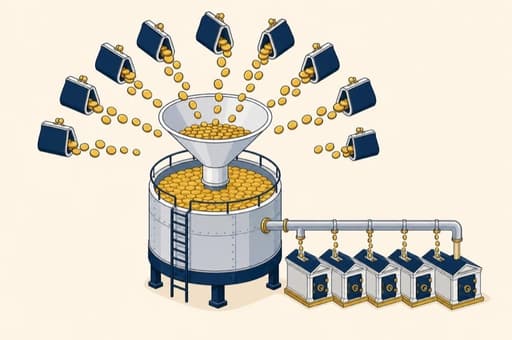
The idle cash inside client accounts, gathered up and parked — $58.8B by mid-2026. With the loan book it funds it is worth close to a fifth of revenue, money that already shows up in the advisor and bank lines.
Competes with Bank Deposit Program and E*TRADE sweep (Morgan Stanley) · Client cash sweep program (LPL Financial) · Bank Sweep (Charles Schwab)
In plain English
Every brokerage account carries some cash sitting idle between decisions — a few thousand here, a few hundred thousand there. Raymond James gathers all of it into one pile and parks it, either on its own bank's books or out at other banks that pay a fee to hold it.
The client gets a modest rate; the firm keeps the difference. Add what that cash earns to the interest on the loans it funds and you reach close to a fifth of revenue, without anyone selling anything. Rates set the size of it, not management. And these cash programs are being sued — Raymond James and roughly a dozen other firms face the same claims.

Investment banking
About 140 senior bankers advising mid-sized companies on being sold, merging or raising money — $1,069M in FY2025, with selling companies much the biggest piece. Fees only arrive when deals close, so quarters swing hard.
Competes with Middle-market M&A advisory (Stifel) · M&A advisory and capital markets (Piper Sandler) · M&A advisory (Houlihan Lokey)
In plain English
Mid-sized companies — the kind with a few hundred employees rather than a few hundred thousand — now and then need to be sold, to buy someone, or to raise money by issuing shares or bonds. When that happens they hire bankers to run the process.
Raymond James keeps a stable of roughly 140 senior bankers for exactly this work, and gets paid when the deal actually closes. That is why the line lurches: it is the bigger half of the markets business, and in the December-2025 quarter that whole segment barely cleared breakeven. Management's read in mid-2026 was an encouraging pipeline but activity still below normal.

Fixed income and equity brokerage
Trading desks serving banks, insurers and local-government issuers, plus the research behind them — $565M in FY2025. Steadier than the deal side: bond trading held near $99–100M a quarter while deal fees swung about a third.
Competes with Fixed income sales, trading and public finance (Stifel) · Fixed income and public finance (Piper Sandler) · Equity sales, trading and research (Baird)
In plain English
The desk side of the markets business, and the quiet one. Banks, savings institutions, insurers and local-government issuers need somewhere to buy bonds and somewhere to sell them, and analysts who can explain a mid-sized company's shares. Raymond James staffs those desks.
It takes a commission or a small markup on each trade. What makes it useful inside the group is timing: when interest rates jolt around, companies put off raising money — bad for the deal bankers — while bond trading gets busier. So the two halves of the markets business lean on each other, and this half barely moved through a year in which deal fees lurched.

Asset Management
$345B of client money run in-house by mid-2026. The smallest of the four businesses and the one being pushed hardest: fees were guided up 11% for the September-2026 quarter, after steps of about 1% earlier in the year.
Competes with Model portfolios (Goldman Sachs Asset Management) · Unified managed account platform (Envestnet)
In plain English
Raymond James does not only give the advice, it also runs the money. One half is a menu of ready-made investment portfolios sold through its own advisors; the other is a collection of small investment firms it owns outright — Eagle, Reams, Chartwell and a few more — each left under its own name with its own investment team.
They charge a yearly percentage of whatever they look after, so revenue tracks the size of the pot. Most of the new money walks in through Raymond James' own advisors rather than from outside, which is both what makes the arrangement work and what caps it.

Clark Capital Management Group
A model-portfolio specialist bought in April 2026, adding about $36B to the money managed and nearer $46–47B counting accounts it only advises. Kept as its own brand; its first full quarter sits behind that guided fee jump.
Competes with Model portfolios (Goldman Sachs Asset Management) · Envestnet PMC model management (Envestnet) · Ready-made model portfolios (Dimensional)
In plain English
Plenty of advisors would rather not pick investments themselves. They buy a ready-made recipe instead — a model portfolio — from a specialist, then apply it across their clients' accounts. Clark Capital, a Philadelphia firm doing this since the 1980s, is one of those specialists.
Raymond James bought it in the spring of 2026 and left it standing: same name, same leadership, same outside advisors buying its models. What the deal adds is reach, since those recipes can now be put in front of Raymond James' own nine thousand advisors too. The purchase costs are why reported and adjusted profit have drifted apart.


 Private Client GroupAbout 9,000 advisors looking after $1.86 trillion of client money by mid-2026 — roughly seven of every ten revenue dollars. Recruiting from rivals is at record levels; watch the margin, since June-quarter revenue rose 14% while pre-tax profit rose 3%.
About 9,000 advisors looking after $1.86 trillion of client money by mid-2026 — roughly seven of every ten revenue dollars. Recruiting from rivals is at record levels; watch the margin, since June-quarter revenue rose 14% while pre-tax profit rose 3%.
In plain English
Picture a firm that rents out its name, its computers and its paperwork to financial advisors, who bring their own clients. Some of those advisors are salaried employees; more of them run their own small shops and simply plug in.
Households hand over savings, the advisor builds a plan, and Raymond James charges a slice of whatever sits in the account each quarter, plus a commission when something is bought or sold. Because the fee is a slice of the pot, there are only two ways to grow it: markets go up, or advisors bring their clients over from another firm. Both have been happening.
Competes with Independent advisor platform (LPL Financial) · Franchisee and employee advisor channels (Ameriprise) · Wealth Management (Stifel)
 Raymond James Bank and TriState Capital BankTwo banks lending mostly to the wealth firm's own clients — a record $56.2B of loans by mid-2026, most of it backed by clients' portfolios or their homes. Revenue has been flat for a year while profit climbed on mix and low losses.
Two banks lending mostly to the wealth firm's own clients — a record $56.2B of loans by mid-2026, most of it backed by clients' portfolios or their homes. Revenue has been flat for a year while profit climbed on mix and low losses.
In plain English
A bank bolted onto the side of the wealth business. Its customers are already Raymond James clients, and its favourite loan is one secured against a client's own investment account — pledge the portfolio, borrow the cash, leave the investments where they are.
The bank earns the gap between what it pays for deposits and what it charges borrowers. Loans reached a record in mid-2026, those portfolio-backed loans the largest slice and home mortgages next, with troubled loans a rounding error. It is not out winning new households, though: it is selling more to the ones its own advisors already brought in, and corporate borrowers have stayed quiet.
Competes with Portfolio Loan Account (Morgan Stanley) · Loan Management Account (Merrill / Bank of America) · Private bank lending against portfolios (J.P. Morgan)
 Bank Deposit Program and Enhanced Savings ProgramThe idle cash inside client accounts, gathered up and parked — $58.8B by mid-2026. With the loan book it funds it is worth close to a fifth of revenue, money that already shows up in the advisor and bank lines.
The idle cash inside client accounts, gathered up and parked — $58.8B by mid-2026. With the loan book it funds it is worth close to a fifth of revenue, money that already shows up in the advisor and bank lines.
In plain English
Every brokerage account carries some cash sitting idle between decisions — a few thousand here, a few hundred thousand there. Raymond James gathers all of it into one pile and parks it, either on its own bank's books or out at other banks that pay a fee to hold it.
The client gets a modest rate; the firm keeps the difference. Add what that cash earns to the interest on the loans it funds and you reach close to a fifth of revenue, without anyone selling anything. Rates set the size of it, not management. And these cash programs are being sued — Raymond James and roughly a dozen other firms face the same claims.
Competes with Bank Deposit Program and E*TRADE sweep (Morgan Stanley) · Client cash sweep program (LPL Financial) · Bank Sweep (Charles Schwab)
 Investment bankingAbout 140 senior bankers advising mid-sized companies on being sold, merging or raising money — $1,069M in FY2025, with selling companies much the biggest piece. Fees only arrive when deals close, so quarters swing hard.
About 140 senior bankers advising mid-sized companies on being sold, merging or raising money — $1,069M in FY2025, with selling companies much the biggest piece. Fees only arrive when deals close, so quarters swing hard.
In plain English
Mid-sized companies — the kind with a few hundred employees rather than a few hundred thousand — now and then need to be sold, to buy someone, or to raise money by issuing shares or bonds. When that happens they hire bankers to run the process.
Raymond James keeps a stable of roughly 140 senior bankers for exactly this work, and gets paid when the deal actually closes. That is why the line lurches: it is the bigger half of the markets business, and in the December-2025 quarter that whole segment barely cleared breakeven. Management's read in mid-2026 was an encouraging pipeline but activity still below normal.
Competes with Middle-market M&A advisory (Stifel) · M&A advisory and capital markets (Piper Sandler) · M&A advisory (Houlihan Lokey)
 Fixed income and equity brokerageTrading desks serving banks, insurers and local-government issuers, plus the research behind them — $565M in FY2025. Steadier than the deal side: bond trading held near $99–100M a quarter while deal fees swung about a third.
Trading desks serving banks, insurers and local-government issuers, plus the research behind them — $565M in FY2025. Steadier than the deal side: bond trading held near $99–100M a quarter while deal fees swung about a third.
In plain English
The desk side of the markets business, and the quiet one. Banks, savings institutions, insurers and local-government issuers need somewhere to buy bonds and somewhere to sell them, and analysts who can explain a mid-sized company's shares. Raymond James staffs those desks.
It takes a commission or a small markup on each trade. What makes it useful inside the group is timing: when interest rates jolt around, companies put off raising money — bad for the deal bankers — while bond trading gets busier. So the two halves of the markets business lean on each other, and this half barely moved through a year in which deal fees lurched.
Competes with Fixed income sales, trading and public finance (Stifel) · Fixed income and public finance (Piper Sandler) · Equity sales, trading and research (Baird)
 Asset Management$345B of client money run in-house by mid-2026. The smallest of the four businesses and the one being pushed hardest: fees were guided up 11% for the September-2026 quarter, after steps of about 1% earlier in the year.
$345B of client money run in-house by mid-2026. The smallest of the four businesses and the one being pushed hardest: fees were guided up 11% for the September-2026 quarter, after steps of about 1% earlier in the year.
In plain English
Raymond James does not only give the advice, it also runs the money. One half is a menu of ready-made investment portfolios sold through its own advisors; the other is a collection of small investment firms it owns outright — Eagle, Reams, Chartwell and a few more — each left under its own name with its own investment team.
They charge a yearly percentage of whatever they look after, so revenue tracks the size of the pot. Most of the new money walks in through Raymond James' own advisors rather than from outside, which is both what makes the arrangement work and what caps it.
Competes with Model portfolios (Goldman Sachs Asset Management) · Unified managed account platform (Envestnet)
 Clark Capital Management GroupA model-portfolio specialist bought in April 2026, adding about $36B to the money managed and nearer $46–47B counting accounts it only advises. Kept as its own brand; its first full quarter sits behind that guided fee jump.
A model-portfolio specialist bought in April 2026, adding about $36B to the money managed and nearer $46–47B counting accounts it only advises. Kept as its own brand; its first full quarter sits behind that guided fee jump.
In plain English
Plenty of advisors would rather not pick investments themselves. They buy a ready-made recipe instead — a model portfolio — from a specialist, then apply it across their clients' accounts. Clark Capital, a Philadelphia firm doing this since the 1980s, is one of those specialists.
Raymond James bought it in the spring of 2026 and left it standing: same name, same leadership, same outside advisors buying its models. What the deal adds is reach, since those recipes can now be put in front of Raymond James' own nine thousand advisors too. The purchase costs are why reported and adjusted profit have drifted apart.
Competes with Model portfolios (Goldman Sachs Asset Management) · Envestnet PMC model management (Envestnet) · Ready-made model portfolios (Dimensional)
Named in filings, launches and programs
- Raymond James Affordable Housing InvestmentsServiceRaises money from banks wanting affordable-housing tax credits and places it into housing partnerships — $140M in FY2025; credit pricing has softened.
- GreensLedge HoldingsBrandA boutique that packages loans into bonds for investors, majority-bought in March 2026 with Sumitomo Mitsui Trust keeping a minority stake; its work feeds the deal bankers.
- RIA & Custody ServicesPlatformFor advisors who want their own firm but someone else to hold the accounts. Roughly $190B held at end-2024, and not sized publicly since.
- Raymond James Ltd.BrandThe Canadian wealth and capital-markets arm — $645M of revenue in FY2025, a small but steady slice of the business outside the US.
- Raymond James Wealth Management (UK)BrandThe UK wealth business, now under the Raymond James name, with roughly £49bn of client money and about 230 wealth managers; Europe brought $549M in FY2025.
- Charles Stanley DirectBrandThe UK do-it-yourself investing platform for people without an advisor, keeping its own name while the rest of the UK business rebrands.
- RJ Investment Management boutiquesBrandChartwell, ClariVest, Cougar Global, Eagle, Reams and Scout — six investment firms owned outright but run under their own names and teams.
- "Raymond" AI assistantPlatformAn in-house AI helper for advisors, rolled out firm-wide in July 2026. It earns nothing directly and sits inside technology spending above $1.1B a year.
- Raymond James trust companiesBrandTwo trust companies inside the group, named alongside the banks in the September-2026 leadership announcement.
- Public finance / municipal underwritingProduct lineSelling bonds for local-government issuers — part of the fixed income desk, its leadership traced back to the 2012 Morgan Keegan purchase.
- "Other" segmentSegmentCorporate leftovers plus private-equity holdings — $46M of revenue in FY2025 against a $146M pre-tax loss.
Raymond James Affordable Housing InvestmentsService
Raises money from banks wanting affordable-housing tax credits and places it into housing partnerships — $140M in FY2025; credit pricing has softened.
GreensLedge HoldingsBrand
A boutique that packages loans into bonds for investors, majority-bought in March 2026 with Sumitomo Mitsui Trust keeping a minority stake; its work feeds the deal bankers.
RIA & Custody ServicesPlatform
For advisors who want their own firm but someone else to hold the accounts. Roughly $190B held at end-2024, and not sized publicly since.
Raymond James Ltd.Brand
The Canadian wealth and capital-markets arm — $645M of revenue in FY2025, a small but steady slice of the business outside the US.
Raymond James Wealth Management (UK)Brand
The UK wealth business, now under the Raymond James name, with roughly £49bn of client money and about 230 wealth managers; Europe brought $549M in FY2025.
Charles Stanley DirectBrand
The UK do-it-yourself investing platform for people without an advisor, keeping its own name while the rest of the UK business rebrands.
RJ Investment Management boutiquesBrand
Chartwell, ClariVest, Cougar Global, Eagle, Reams and Scout — six investment firms owned outright but run under their own names and teams.
"Raymond" AI assistantPlatform
An in-house AI helper for advisors, rolled out firm-wide in July 2026. It earns nothing directly and sits inside technology spending above $1.1B a year.
Raymond James trust companiesBrand
Two trust companies inside the group, named alongside the banks in the September-2026 leadership announcement.
Public finance / municipal underwritingProduct line
Selling bonds for local-government issuers — part of the fixed income desk, its leadership traced back to the 2012 Morgan Keegan purchase.
"Other" segmentSegment
Corporate leftovers plus private-equity holdings — $46M of revenue in FY2025 against a $146M pre-tax loss.