
Citizens Financial Group (CFG)
Regional bank pairing broad consumer banking with private wealth and corporate finance.
Something off on this page? Send us feedback.
Citizens is a regional bank. It gathers deposits from households and small firms through a thousand-odd branches, then lends that money to homeowners and mid-sized companies; the gap between what it pays savers and earns on borrowers pays most of the bills. Newer growth sits elsewhere — a private bank built after rival lenders failed, and an arm advising company owners on deals — while loan books it stopped writing run off.
Item facts: FY2025 · year ended December 31, 2025, from filings, earnings calls and company pages.
Judgment weights, not filed revenue
The band summarizes business focus and direction. ~ marks estimates.
8 in detail · 16 more below

Deposits & the branch network
The money-gathering engine: $183.3B of deposits at the end of 2025, about a fifth of it sitting in accounts that pay no interest at all, and spread so thinly that no single depositor comes near a tenth of the pile.
Competes with Consumer & Regional Banking (Huntington) · Consumer Bank (KeyCorp)
In plain English
Think of a bank as a shop that buys money and sells it. It buys from savers — current accounts, savings, fixed-term certificates — paying little or nothing on the everyday balances, and sells to borrowers at a higher rate.
Across the whole bank, that gap between what savers are paid and what borrowers pay is about seven of every ten revenue dollars. Branches, cash machines and the phone app are how the cheap money gets in the door. The catch is that savers can be bid away: Citizens says it competes on the mix of accounts rather than on price, and is now closing the small branches it runs inside other stores while trying to keep the deposits.

Middle market & corporate lending
Loans and credit lines for companies with roughly $10M to $1B of sales. The book grew $6.7B in 2025 to $49.2B — the clearly expanding part of the commercial side — and 2026's growth came from borrowers drawing more on lines they already had.
Competes with Commercial Middle Market Banking (Fifth Third) · Middle-market and financial sponsors banking (KeyCorp) · Direct lending funds (Private credit firms)
In plain English
A mid-sized manufacturer needs cash before its customers pay, or a loan to buy a rival. Citizens is the lender on the other side of that conversation: a banker assigned to the relationship, and a credit line the company draws on when it needs to.
The money is interest on what is actually drawn, plus fees for arranging the facility. Two things decide how good a year it is — whether companies feel like borrowing, and whether they pay it back. The competition has changed shape, too: investment funds now lend directly to these companies without a bank's deposits behind them.

Commercial Real Estate
Loans against offices, apartment blocks and other commercial buildings — $24.6B at the end of 2025 and deliberately shrinking. It is also the subject management gets asked about more than any other on earnings calls.
Competes with Commercial Middle Market Banking (Fifth Third) · Direct lending funds (Private credit firms)
In plain English
Somebody builds an office tower or an apartment block and borrows most of the cost, expecting the rent to cover the payments. Citizens holds a large pile of those loans, earns interest while they behave, and takes the loss if the owner stops paying.
This is the part the bank is making smaller on purpose. Office loans, and apartment loans that arrived with an earlier acquisition, are being allowed to mature without replacement, so the balance falls year by year — management has said it leans towards shrinking here rather than writing more.

Citizens Private Bank
Built from a standing start in 2023 by hiring bankers out of the collapsed First Republic. By mid-2026 it held $17.8B of deposits and threw off 11.5% of the quarter's pretax profit — but client investments of $11.2B badly missed the $16–20B guided for the year.
Competes with J.P. Morgan Private Bank (J.P. Morgan) · Bank of America Private Bank (Bank of America) · Private banking on the former SVB franchise (First Citizens BancShares)
In plain English
When First Republic failed in 2023, its bankers — and the wealthy families, founders and investment firms they looked after — needed somewhere to go. Citizens hired about fifty of them and built a bank-within-the-bank around them, now roughly ten offices in California, Florida, New York and Massachusetts.
Rich clients park large deposits the bank can lend on; they also borrow, and they pay for investment advice. Citizens earns around four percentage points between what those deposits cost and what the loans yield, and the loans written so far have not lost money in three years. Gathering the clients' investments is the piece running behind plan.

Wealth Management
Advice and money management sold through branches and the private bank: $360M of fees in 2025, up 22%, against $61.9B of client assets. Most of it comes from ordinary well-off branch customers, and the fees rise and fall with markets.
Competes with Merrill (Bank of America) · Morgan Stanley Wealth Management (Morgan Stanley)
In plain English
Not the very rich — the comfortable. A branch customer with a decent nest egg is handed an adviser, a retirement account and a portfolio somebody else manages. Citizens keeps a slice of that money each year, so the fee grows when the client saves more and also when share prices simply go up.
About 55% of the managed money and 60% of the fees come from that branch-sourced crowd, whose managed money grew 15% in 2025. The cost is people: salaries went up partly on hiring advisers for the private bank and private wealth build-out.
Home Lending
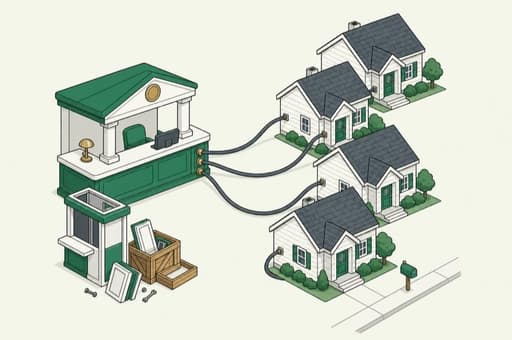
Mortgages ($35.0B) and home equity lines ($19.1B), the retail lending that kept growing while other consumer books shrank. The lending is fine; the fee side is not — $233M in 2025, then $42M in the second quarter of 2026 against $73M a year earlier.
Competes with Rocket Mortgage (Rocket) · Home equity lending (Huntington) · Home equity lending (Fifth Third)
In plain English
Two products, one house. A mortgage buys it; a home equity line lets the owner borrow against the part they already own, usually for a renovation or to clear pricier debt.
Citizens gets paid twice. There is interest on the loan, which is the steady half — both books grew in 2025 while car and student loan balances fell. Then there is the fee side, which in 2025 leaned on the contracts Citizens keeps to collect payments on loans it has sold on. That second half has gone the other way, with the quarterly fee take running at not much more than half of what it was a year earlier.

Capital Markets and Advisory
The deal desk: advising owners on selling their company, then arranging the borrowing and share sales that pay for it. $511M of fees in 2025, and a record second quarter of 2026 at $153M, up 46% on a strong year for takeovers.
Competes with KeyBanc Capital Markets with Cain Brothers (KeyCorp) · Truist Securities (Truist) · Middle-market M&A advisory (Capstone Partners)
In plain English
The owner of a mid-sized business decides to sell. Somebody has to find the buyer, price the thing and line up the borrowing — Citizens does that work for a fee, and has been buying small specialist firms to do more of it, most recently Matrix, whose bankers know fuel-and-convenience retail, car parts, and boats and outdoor gear.
The fee only lands when a deal actually closes, so the line swings with the deal calendar. Among banks arranging the financing for private-equity-backed mid-sized deals, Citizens ranks second by number of deals.

Treasury payments & card services
The plumbing fees: running business customers' money — collections, payments, company cards — plus a slice of every consumer card purchase. Account and service charges of $444M grew 6% in 2025 while card fees of $346M fell 6%.
Competes with Treasury Management (PNC) · Commercial card and payments (Fifth Third) · Commercial payments (KeyBank)
In plain English
Every business needs somewhere for money to arrive and leave: invoices collected, suppliers paid, payroll funded, and a daily view of what is actually in the account. Citizens sells that service and bills for it month after month, with company credit cards bolted on top.
The consumer half is simpler. When a Citizens card is tapped at a shop till, a small slice of the purchase comes back to Citizens. Both halves follow how much customers buy and sell rather than interest rates, which makes them steady but hard to grow — the dollars have barely moved in two years, so gains have to come from winning new clients.


 Deposits & the branch networkThe money-gathering engine: $183.3B of deposits at the end of 2025, about a fifth of it sitting in accounts that pay no interest at all, and spread so thinly that no single depositor comes near a tenth of the pile.
The money-gathering engine: $183.3B of deposits at the end of 2025, about a fifth of it sitting in accounts that pay no interest at all, and spread so thinly that no single depositor comes near a tenth of the pile.
In plain English
Think of a bank as a shop that buys money and sells it. It buys from savers — current accounts, savings, fixed-term certificates — paying little or nothing on the everyday balances, and sells to borrowers at a higher rate.
Across the whole bank, that gap between what savers are paid and what borrowers pay is about seven of every ten revenue dollars. Branches, cash machines and the phone app are how the cheap money gets in the door. The catch is that savers can be bid away: Citizens says it competes on the mix of accounts rather than on price, and is now closing the small branches it runs inside other stores while trying to keep the deposits.
Competes with Consumer & Regional Banking (Huntington) · Consumer Bank (KeyCorp)
 Middle market & corporate lendingLoans and credit lines for companies with roughly $10M to $1B of sales. The book grew $6.7B in 2025 to $49.2B — the clearly expanding part of the commercial side — and 2026's growth came from borrowers drawing more on lines they already had.
Loans and credit lines for companies with roughly $10M to $1B of sales. The book grew $6.7B in 2025 to $49.2B — the clearly expanding part of the commercial side — and 2026's growth came from borrowers drawing more on lines they already had.
In plain English
A mid-sized manufacturer needs cash before its customers pay, or a loan to buy a rival. Citizens is the lender on the other side of that conversation: a banker assigned to the relationship, and a credit line the company draws on when it needs to.
The money is interest on what is actually drawn, plus fees for arranging the facility. Two things decide how good a year it is — whether companies feel like borrowing, and whether they pay it back. The competition has changed shape, too: investment funds now lend directly to these companies without a bank's deposits behind them.
Competes with Commercial Middle Market Banking (Fifth Third) · Middle-market and financial sponsors banking (KeyCorp) · Direct lending funds (Private credit firms)
 Commercial Real EstateLoans against offices, apartment blocks and other commercial buildings — $24.6B at the end of 2025 and deliberately shrinking. It is also the subject management gets asked about more than any other on earnings calls.
Loans against offices, apartment blocks and other commercial buildings — $24.6B at the end of 2025 and deliberately shrinking. It is also the subject management gets asked about more than any other on earnings calls.
In plain English
Somebody builds an office tower or an apartment block and borrows most of the cost, expecting the rent to cover the payments. Citizens holds a large pile of those loans, earns interest while they behave, and takes the loss if the owner stops paying.
This is the part the bank is making smaller on purpose. Office loans, and apartment loans that arrived with an earlier acquisition, are being allowed to mature without replacement, so the balance falls year by year — management has said it leans towards shrinking here rather than writing more.
Competes with Commercial Middle Market Banking (Fifth Third) · Direct lending funds (Private credit firms)
 Citizens Private BankBuilt from a standing start in 2023 by hiring bankers out of the collapsed First Republic. By mid-2026 it held $17.8B of deposits and threw off 11.5% of the quarter's pretax profit — but client investments of $11.2B badly missed the $16–20B guided for the year.
Built from a standing start in 2023 by hiring bankers out of the collapsed First Republic. By mid-2026 it held $17.8B of deposits and threw off 11.5% of the quarter's pretax profit — but client investments of $11.2B badly missed the $16–20B guided for the year.
In plain English
When First Republic failed in 2023, its bankers — and the wealthy families, founders and investment firms they looked after — needed somewhere to go. Citizens hired about fifty of them and built a bank-within-the-bank around them, now roughly ten offices in California, Florida, New York and Massachusetts.
Rich clients park large deposits the bank can lend on; they also borrow, and they pay for investment advice. Citizens earns around four percentage points between what those deposits cost and what the loans yield, and the loans written so far have not lost money in three years. Gathering the clients' investments is the piece running behind plan.
Competes with J.P. Morgan Private Bank (J.P. Morgan) · Bank of America Private Bank (Bank of America) · Private banking on the former SVB franchise (First Citizens BancShares)
 Wealth ManagementAdvice and money management sold through branches and the private bank: $360M of fees in 2025, up 22%, against $61.9B of client assets. Most of it comes from ordinary well-off branch customers, and the fees rise and fall with markets.
Advice and money management sold through branches and the private bank: $360M of fees in 2025, up 22%, against $61.9B of client assets. Most of it comes from ordinary well-off branch customers, and the fees rise and fall with markets.
In plain English
Not the very rich — the comfortable. A branch customer with a decent nest egg is handed an adviser, a retirement account and a portfolio somebody else manages. Citizens keeps a slice of that money each year, so the fee grows when the client saves more and also when share prices simply go up.
About 55% of the managed money and 60% of the fees come from that branch-sourced crowd, whose managed money grew 15% in 2025. The cost is people: salaries went up partly on hiring advisers for the private bank and private wealth build-out.
Competes with Merrill (Bank of America) · Morgan Stanley Wealth Management (Morgan Stanley)
 Home LendingMortgages ($35.0B) and home equity lines ($19.1B), the retail lending that kept growing while other consumer books shrank. The lending is fine; the fee side is not — $233M in 2025, then $42M in the second quarter of 2026 against $73M a year earlier.
Mortgages ($35.0B) and home equity lines ($19.1B), the retail lending that kept growing while other consumer books shrank. The lending is fine; the fee side is not — $233M in 2025, then $42M in the second quarter of 2026 against $73M a year earlier.
In plain English
Two products, one house. A mortgage buys it; a home equity line lets the owner borrow against the part they already own, usually for a renovation or to clear pricier debt.
Citizens gets paid twice. There is interest on the loan, which is the steady half — both books grew in 2025 while car and student loan balances fell. Then there is the fee side, which in 2025 leaned on the contracts Citizens keeps to collect payments on loans it has sold on. That second half has gone the other way, with the quarterly fee take running at not much more than half of what it was a year earlier.
Competes with Rocket Mortgage (Rocket) · Home equity lending (Huntington) · Home equity lending (Fifth Third)
 Capital Markets and AdvisoryThe deal desk: advising owners on selling their company, then arranging the borrowing and share sales that pay for it. $511M of fees in 2025, and a record second quarter of 2026 at $153M, up 46% on a strong year for takeovers.
The deal desk: advising owners on selling their company, then arranging the borrowing and share sales that pay for it. $511M of fees in 2025, and a record second quarter of 2026 at $153M, up 46% on a strong year for takeovers.
In plain English
The owner of a mid-sized business decides to sell. Somebody has to find the buyer, price the thing and line up the borrowing — Citizens does that work for a fee, and has been buying small specialist firms to do more of it, most recently Matrix, whose bankers know fuel-and-convenience retail, car parts, and boats and outdoor gear.
The fee only lands when a deal actually closes, so the line swings with the deal calendar. Among banks arranging the financing for private-equity-backed mid-sized deals, Citizens ranks second by number of deals.
Competes with KeyBanc Capital Markets with Cain Brothers (KeyCorp) · Truist Securities (Truist) · Middle-market M&A advisory (Capstone Partners)
 Treasury payments & card servicesThe plumbing fees: running business customers' money — collections, payments, company cards — plus a slice of every consumer card purchase. Account and service charges of $444M grew 6% in 2025 while card fees of $346M fell 6%.
The plumbing fees: running business customers' money — collections, payments, company cards — plus a slice of every consumer card purchase. Account and service charges of $444M grew 6% in 2025 while card fees of $346M fell 6%.
In plain English
Every business needs somewhere for money to arrive and leave: invoices collected, suppliers paid, payroll funded, and a daily view of what is actually in the account. Citizens sells that service and bills for it month after month, with company credit cards bolted on top.
The consumer half is simpler. When a Citizens card is tapped at a shop till, a small slice of the purchase comes back to Citizens. Both halves follow how much customers buy and sell rather than interest rates, which makes them steady but hard to grow — the dollars have barely moved in two years, so gains have to come from winning new clients.
Competes with Treasury Management (PNC) · Commercial card and payments (Fifth Third) · Commercial payments (KeyBank)
Named in filings, launches and programs
- Reimagine the BankCustomer program · RampingTechnology and simplification drive management says should be worth about $450M a year of pretax benefit by the end of 2028.
- NEXTCustomer program · AnnouncedAnnounced July 2026: close roughly 100–120 of the branches run inside other stores, add advisory and business-banking branches with in-branch specialists, and launch a new consumer phone app.
- Citizens Bank, N.A.BrandThe single banking subsidiary that carries all the revenue, supervised by the national bank regulator; in September 2026 it lifted the benchmark rate it charges its strongest borrowers to 7.00%.
- Citizens JMP SecuritiesBrandSan Francisco investment bank covering emerging technology, healthcare, property companies and financial firms.
- Matrix Capital Markets GroupBrandBought February 2026 for an undisclosed sum; advises owners of fuel-and-convenience retail, car-parts and marine businesses, and now runs inside Citizens JMP Securities.
- DH CapitalBrandSmall advisory firm for digital and data infrastructure companies, one of the sector franchises feeding the deal desk.
- Clarfeld Financial AdvisorsBrandRegistered investment adviser inside the wealth arm — one of the three outfits Citizens sells advice and money management through.
- Citizens SecuritiesBrandThe licensed arm that buys and sells shares and funds for ordinary customers, sold to them through the branches.
- Citizens Trust Company of DelawareBrandThe Delaware trust company in that same wealth line-up, beside the investment-selling arm and the advisory firm.
- Global MarketsServiceHelps business clients hedge currency, interest-rate and commodity moves; $156M of fees in 2025 and $47M in the second quarter of 2026.
- Letter of credit and loan feesServiceCharges for guaranteeing a customer's payment and for arranging credit facilities — $186M in 2025, $52M in the second quarter of 2026.
- Citizens PayProduct lineThe merchant-facing brand for pay-over-time lending offered at checkout; nationwide, but Citizens discloses no revenue for it.
- Education lendingProduct line$8.4B of student loans at the end of 2025, down 22% as purchased portfolios run off while new lending continues.
- Small Business BankingServiceDeposits, loans and advice for small firms inside the consumer bank; publishes a quarterly Business Pulse survey of owners.
- Citizens Asset FinanceBrandWhere equipment leasing sits — financing the machines and vehicles business customers use rather than lending them the cash.
- Treasury and balance-sheet operationsSegmentHead-office investing, funding and community development, which together subtracted roughly $750M from 2025 revenue rather than adding to it.
Reimagine the BankCustomer program · Ramping
Technology and simplification drive management says should be worth about $450M a year of pretax benefit by the end of 2028.
NEXTCustomer program · Announced
Announced July 2026: close roughly 100–120 of the branches run inside other stores, add advisory and business-banking branches with in-branch specialists, and launch a new consumer phone app.
Citizens Bank, N.A.Brand
The single banking subsidiary that carries all the revenue, supervised by the national bank regulator; in September 2026 it lifted the benchmark rate it charges its strongest borrowers to 7.00%.
Citizens JMP SecuritiesBrand
San Francisco investment bank covering emerging technology, healthcare, property companies and financial firms.
Matrix Capital Markets GroupBrand
Bought February 2026 for an undisclosed sum; advises owners of fuel-and-convenience retail, car-parts and marine businesses, and now runs inside Citizens JMP Securities.
DH CapitalBrand
Small advisory firm for digital and data infrastructure companies, one of the sector franchises feeding the deal desk.
Clarfeld Financial AdvisorsBrand
Registered investment adviser inside the wealth arm — one of the three outfits Citizens sells advice and money management through.
Citizens SecuritiesBrand
The licensed arm that buys and sells shares and funds for ordinary customers, sold to them through the branches.
Citizens Trust Company of DelawareBrand
The Delaware trust company in that same wealth line-up, beside the investment-selling arm and the advisory firm.
Global MarketsService
Helps business clients hedge currency, interest-rate and commodity moves; $156M of fees in 2025 and $47M in the second quarter of 2026.
Letter of credit and loan feesService
Charges for guaranteeing a customer's payment and for arranging credit facilities — $186M in 2025, $52M in the second quarter of 2026.
Citizens PayProduct line
The merchant-facing brand for pay-over-time lending offered at checkout; nationwide, but Citizens discloses no revenue for it.
Education lendingProduct line
$8.4B of student loans at the end of 2025, down 22% as purchased portfolios run off while new lending continues.
Small Business BankingService
Deposits, loans and advice for small firms inside the consumer bank; publishes a quarterly Business Pulse survey of owners.
Citizens Asset FinanceBrand
Where equipment leasing sits — financing the machines and vehicles business customers use rather than lending them the cash.
Treasury and balance-sheet operationsSegment
Head-office investing, funding and community development, which together subtracted roughly $750M from 2025 revenue rather than adding to it.