
Eos Energy Enterprises (EOSE)
Builds zinc-based battery systems and controls for multi-hour grid and industrial storage.
Something off on this page? Send us feedback.
Eos makes large zinc batteries in western Pennsylvania for utilities and other big buyers that need to store electricity for hours. Sales have jumped, but each battery still costs more to make than it sells for. About half its orders now go to a project company controlled by its lender, Cerberus, and part-owned by Eos — so the story hangs on a new factory reaching full speed and that one buyer getting its projects built.
Item facts: H1 2026 · six months to June 30, 2026, from filings, earnings calls and company pages.
Judgment weights, not filed revenue
The band summarizes business focus and direction. ~ marks estimates.
7 in detail · 11 more below
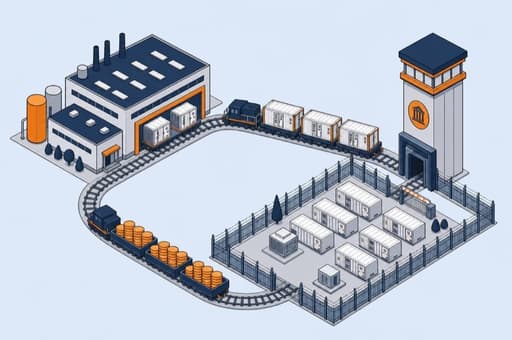
Frontier Power USA (FPUSA)
A storage-project company controlled by Cerberus and part-owned by Eos, holding a 2 GWh battery reservation. A $55.0M contract headed its way was 80% of Q2 revenue — with one other buyer, 97.7% of the quarter. First projects are due online by Q3 2027.
Competes with Texas grid storage fleet (Plus Power) · Texas grid storage fleet (Jupiter Power) · Texas storage portfolio (ENGIE)
In plain English
Think of a bakery that co-owns the café buying most of its bread. FPUSA is that café: a company formed in May 2026 to build and own big battery projects, controlled by Cerberus — the investment firm that also lends Eos money — with Eos holding a minority stake.
FPUSA has reserved 2 GWh of Eos batteries and accounts for about half of the order book by volume. Eos gets paid for the equipment, hopes to add long service contracts, and takes a share of FPUSA's profit as part-owner. The loop is tight: Eos raised money from investors to pay for its stake, then FPUSA placed a $100M battery order. Each project still needs borrowed money before it can be built.
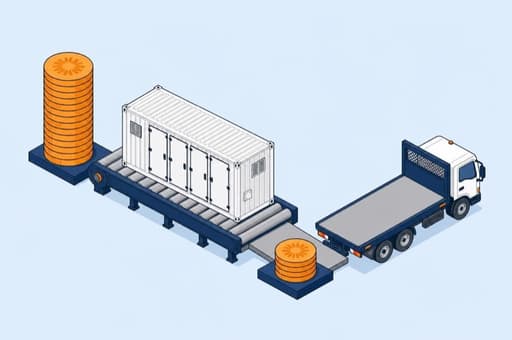
Eos Z3 battery module and Eos Cube systems
Eos's single battery platform: zinc modules packed into container-sized Cubes, sold to utilities, developers and FPUSA. In Q2 it cost about $1.71 to make each $1 of revenue; management's date for fixing that has moved four times.
Competes with Megapack 3 (Tesla) · Gridstack Pro (Fluence) · Iron-flow battery (ESS Tech) · Zinc-ion battery (Enerpoly)
In plain English
Picture a rechargeable battery the size of a shipping container. Inside sit stacks of Eos's Z3 modules, which hold electricity using zinc and a water-based liquid instead of lithium, so they are not flammable. The full container, called a Cube, takes in power and hands it back later, over anywhere from a few hours to about fourteen.
Utilities, power producers, data-center developers and defense agencies pay by the amount of storage delivered — roughly $237 per kilowatt-hour, the unit on a home power bill (a GWh is a million of them). The pitch: dearer to buy than lithium-ion, cheaper to run over its life. The catch: right now Eos spends more making each one than buyers pay for it.
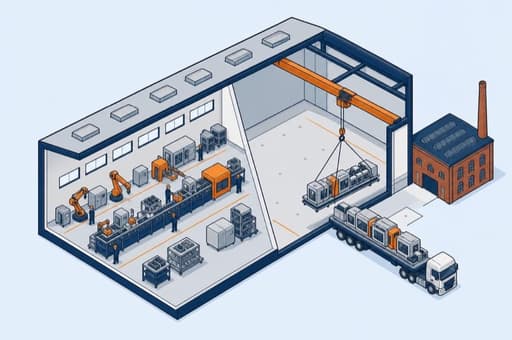
Thorn Hill manufacturing platform (Project AMAZE)
The western Pennsylvania plant that sets how many batteries Eos can ship. A new line began in June but made just 1% of Q2 output, and moving the older line in is why the 2026 sales goal was trimmed to $300–350M.
Competes with Megapack factories (Tesla) · Lansing LFP cell plant (LG Energy Solution) · West Virginia iron-air factory (Form Energy)
In plain English
A factory works like a funnel: however many orders pile up at the top, only so many batteries come out the bottom. Thorn Hill, a 432,000-square-foot plant in Warrendale, Pennsylvania, is where Eos is gathering all its battery-making. One new production line started in June; the older line is moving in from Eos's Turtle Creek site, which keeps Cube assembly.
It sells nothing itself. Its job is to turn more orders into shipments and make each battery cheaper — management expects 10–15% lower costs for turning parts into batteries from 2027. A US Department of Energy loan of up to $303.5M covers 80% of eligible plant costs; about $178M has been drawn.
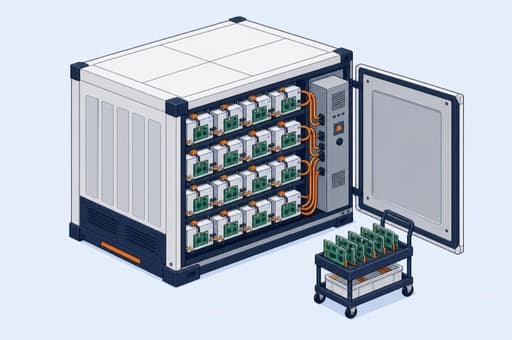
Eos DawnOS
Eos's own control software, going into new systems and retrofitted into old ones. Management says units now return about three-quarters of the power stored, up from under half — but the switch raised parts costs and field retrofit costs this year.
Competes with Megapack built-in controls (Tesla) · Integrated system controls (Fluence) · Intellect Operate plant software (WATTMORE)
In plain English
Software that watches every module. The old controls, borrowed from lithium batteries, managed each long string of modules as one lump; DawnOS tracks and steers each module on its own — a teacher grading every student rather than just the class average.
Nobody pays for it separately; it comes inside the Cube. Its payoff is performance that lenders can count on: management says units now give back about three-quarters of the electricity put in, up from well under half, and behave far more alike. The cost is real too — pricier parts, plus crews fitting new boards and sometimes new wiring into older Cubes already in the field.
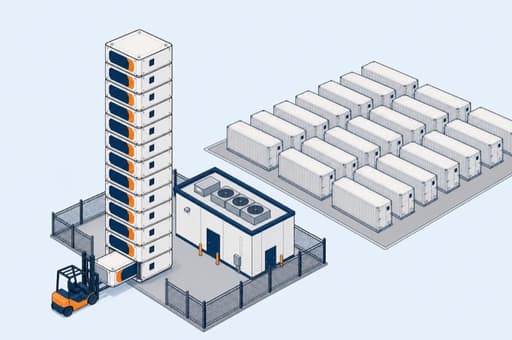
Eos Indensity
A stackable version of the battery, built to fit far more storage on a small plot. Launched in February 2026 with first shipments guided for the second half of the year, it went unmentioned on the August earnings call.
Competes with Megapack 3 (Tesla) · Iron-air system (Form Energy) · Fuel-cell power (Bloom Energy)
In plain English
Lego for power storage. Instead of lining containers across a field, Indensity packs Z3 modules and DawnOS into blocks called Cores that stack up to twelve high, and a forklift can swap any one out. Eos claims about four times the site density of most incumbent technologies.
It earns money the same way Cubes do — buyers pay for storage delivered — but aims at crowded sites where land is scarce. TURBINE-X, which pairs gas power with storage for data centers, plans up to 2 GWh over three years with first installs in 2027, and CAPAC will offer it in German-speaking Europe. Management had tied the top of its 2026 sales range partly to first Indensity shipments; until they happen, it is a promise.
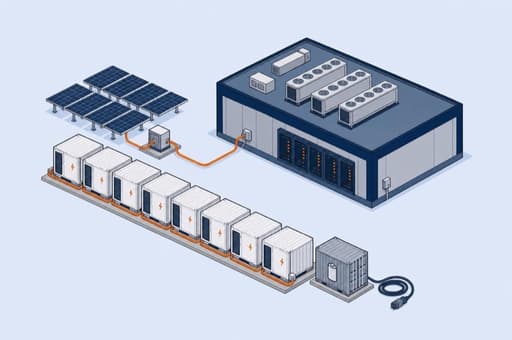
Data-center power programs (MN8 Energy/Google, Talen Energy)
Storage deals with power companies that serve data centers: MN8 Energy's 750 MWh supply agreement and a Talen Energy collaboration. Data centers are now about a third of Eos's sales pipeline, but the first zinc block at MN8's Google-linked site starts in 2030.
Competes with Lithium-ion block at Mammoth Solar (Unnamed supplier) · Fuel-cell power (Bloom Energy) · Iron-air system (Form Energy)
In plain English
Some of Eos's newest prospects are power companies selling electricity to data centers. The first real example is Mammoth Solar in West Virginia, from MN8 Energy, a power producer, with Google buying its output: a solar farm, a big lithium-ion battery, and a much smaller Eos zinc battery — roughly a third the lithium one's size.
Talen Energy is working with Eos on multi-GWh storage at its Pennsylvania sites; Eos says Talen filed over 3 GWh of long-lasting storage projects into the regional grid operator's waiting line for new connections. For now this is a pipeline, not revenue — and on the one site already named, lithium-ion won the bigger share.
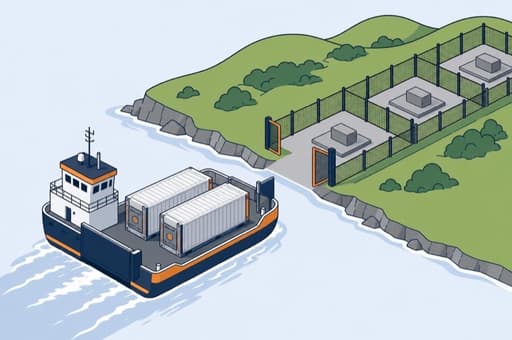
European programs (Frontier Power UK, CAPAC Energy)
A UK framework for up to 5 GWh with Frontier Power, whose storage arm is part-owned by Cerberus affiliates, and a binding 750 MWh deal with CAPAC, Eos's sole distributor in German-speaking Europe. Revenue so far is tiny; UK regulator decisions come next.
Competes with 16.75-hour lithium-ion portfolio (Field) · Vanadium-flow batteries (Invinity) · LFP storage systems (BYD)
In plain English
Britain's energy regulator, Ofgem, is choosing which power-storage projects get backing under a support scheme open only to systems that can run for at least eight hours. Frontier Power, a UK storage company, signed a framework for up to 5 GWh of Eos batteries, placed a first 228 MWh order, and entered Eos-based bids; at least one of its projects expects a provisional yes. Lithium-ion is in the race too: rival developer Field has five projects on the same early list.
In Germany, Austria and Switzerland, CAPAC Energy is Eos's only distributor through 2031, committed to 750 MWh and able to grow to 2 GWh. Either way, Eos is paid per battery delivered.


 Frontier Power USA (FPUSA)A storage-project company controlled by Cerberus and part-owned by Eos, holding a 2 GWh battery reservation. A $55.0M contract headed its way was 80% of Q2 revenue — with one other buyer, 97.7% of the quarter. First projects are due online by Q3 2027.
A storage-project company controlled by Cerberus and part-owned by Eos, holding a 2 GWh battery reservation. A $55.0M contract headed its way was 80% of Q2 revenue — with one other buyer, 97.7% of the quarter. First projects are due online by Q3 2027.
In plain English
Think of a bakery that co-owns the café buying most of its bread. FPUSA is that café: a company formed in May 2026 to build and own big battery projects, controlled by Cerberus — the investment firm that also lends Eos money — with Eos holding a minority stake.
FPUSA has reserved 2 GWh of Eos batteries and accounts for about half of the order book by volume. Eos gets paid for the equipment, hopes to add long service contracts, and takes a share of FPUSA's profit as part-owner. The loop is tight: Eos raised money from investors to pay for its stake, then FPUSA placed a $100M battery order. Each project still needs borrowed money before it can be built.
Competes with Texas grid storage fleet (Plus Power) · Texas grid storage fleet (Jupiter Power) · Texas storage portfolio (ENGIE)
 Eos Z3 battery module and Eos Cube systemsEos's single battery platform: zinc modules packed into container-sized Cubes, sold to utilities, developers and FPUSA. In Q2 it cost about $1.71 to make each $1 of revenue; management's date for fixing that has moved four times.
Eos's single battery platform: zinc modules packed into container-sized Cubes, sold to utilities, developers and FPUSA. In Q2 it cost about $1.71 to make each $1 of revenue; management's date for fixing that has moved four times.
In plain English
Picture a rechargeable battery the size of a shipping container. Inside sit stacks of Eos's Z3 modules, which hold electricity using zinc and a water-based liquid instead of lithium, so they are not flammable. The full container, called a Cube, takes in power and hands it back later, over anywhere from a few hours to about fourteen.
Utilities, power producers, data-center developers and defense agencies pay by the amount of storage delivered — roughly $237 per kilowatt-hour, the unit on a home power bill (a GWh is a million of them). The pitch: dearer to buy than lithium-ion, cheaper to run over its life. The catch: right now Eos spends more making each one than buyers pay for it.
Competes with Megapack 3 (Tesla) · Gridstack Pro (Fluence) · Iron-flow battery (ESS Tech) · Zinc-ion battery (Enerpoly)
 Thorn Hill manufacturing platform (Project AMAZE)The western Pennsylvania plant that sets how many batteries Eos can ship. A new line began in June but made just 1% of Q2 output, and moving the older line in is why the 2026 sales goal was trimmed to $300–350M.
The western Pennsylvania plant that sets how many batteries Eos can ship. A new line began in June but made just 1% of Q2 output, and moving the older line in is why the 2026 sales goal was trimmed to $300–350M.
In plain English
A factory works like a funnel: however many orders pile up at the top, only so many batteries come out the bottom. Thorn Hill, a 432,000-square-foot plant in Warrendale, Pennsylvania, is where Eos is gathering all its battery-making. One new production line started in June; the older line is moving in from Eos's Turtle Creek site, which keeps Cube assembly.
It sells nothing itself. Its job is to turn more orders into shipments and make each battery cheaper — management expects 10–15% lower costs for turning parts into batteries from 2027. A US Department of Energy loan of up to $303.5M covers 80% of eligible plant costs; about $178M has been drawn.
Competes with Megapack factories (Tesla) · Lansing LFP cell plant (LG Energy Solution) · West Virginia iron-air factory (Form Energy)
 Eos DawnOSEos's own control software, going into new systems and retrofitted into old ones. Management says units now return about three-quarters of the power stored, up from under half — but the switch raised parts costs and field retrofit costs this year.
Eos's own control software, going into new systems and retrofitted into old ones. Management says units now return about three-quarters of the power stored, up from under half — but the switch raised parts costs and field retrofit costs this year.
In plain English
Software that watches every module. The old controls, borrowed from lithium batteries, managed each long string of modules as one lump; DawnOS tracks and steers each module on its own — a teacher grading every student rather than just the class average.
Nobody pays for it separately; it comes inside the Cube. Its payoff is performance that lenders can count on: management says units now give back about three-quarters of the electricity put in, up from well under half, and behave far more alike. The cost is real too — pricier parts, plus crews fitting new boards and sometimes new wiring into older Cubes already in the field.
Competes with Megapack built-in controls (Tesla) · Integrated system controls (Fluence) · Intellect Operate plant software (WATTMORE)
 Eos IndensityA stackable version of the battery, built to fit far more storage on a small plot. Launched in February 2026 with first shipments guided for the second half of the year, it went unmentioned on the August earnings call.
A stackable version of the battery, built to fit far more storage on a small plot. Launched in February 2026 with first shipments guided for the second half of the year, it went unmentioned on the August earnings call.
In plain English
Lego for power storage. Instead of lining containers across a field, Indensity packs Z3 modules and DawnOS into blocks called Cores that stack up to twelve high, and a forklift can swap any one out. Eos claims about four times the site density of most incumbent technologies.
It earns money the same way Cubes do — buyers pay for storage delivered — but aims at crowded sites where land is scarce. TURBINE-X, which pairs gas power with storage for data centers, plans up to 2 GWh over three years with first installs in 2027, and CAPAC will offer it in German-speaking Europe. Management had tied the top of its 2026 sales range partly to first Indensity shipments; until they happen, it is a promise.
Competes with Megapack 3 (Tesla) · Iron-air system (Form Energy) · Fuel-cell power (Bloom Energy)
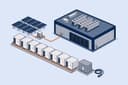 Data-center power programs (MN8 Energy/Google, Talen Energy)Storage deals with power companies that serve data centers: MN8 Energy's 750 MWh supply agreement and a Talen Energy collaboration. Data centers are now about a third of Eos's sales pipeline, but the first zinc block at MN8's Google-linked site starts in 2030.
Storage deals with power companies that serve data centers: MN8 Energy's 750 MWh supply agreement and a Talen Energy collaboration. Data centers are now about a third of Eos's sales pipeline, but the first zinc block at MN8's Google-linked site starts in 2030.
In plain English
Some of Eos's newest prospects are power companies selling electricity to data centers. The first real example is Mammoth Solar in West Virginia, from MN8 Energy, a power producer, with Google buying its output: a solar farm, a big lithium-ion battery, and a much smaller Eos zinc battery — roughly a third the lithium one's size.
Talen Energy is working with Eos on multi-GWh storage at its Pennsylvania sites; Eos says Talen filed over 3 GWh of long-lasting storage projects into the regional grid operator's waiting line for new connections. For now this is a pipeline, not revenue — and on the one site already named, lithium-ion won the bigger share.
Competes with Lithium-ion block at Mammoth Solar (Unnamed supplier) · Fuel-cell power (Bloom Energy) · Iron-air system (Form Energy)
 European programs (Frontier Power UK, CAPAC Energy)A UK framework for up to 5 GWh with Frontier Power, whose storage arm is part-owned by Cerberus affiliates, and a binding 750 MWh deal with CAPAC, Eos's sole distributor in German-speaking Europe. Revenue so far is tiny; UK regulator decisions come next.
A UK framework for up to 5 GWh with Frontier Power, whose storage arm is part-owned by Cerberus affiliates, and a binding 750 MWh deal with CAPAC, Eos's sole distributor in German-speaking Europe. Revenue so far is tiny; UK regulator decisions come next.
In plain English
Britain's energy regulator, Ofgem, is choosing which power-storage projects get backing under a support scheme open only to systems that can run for at least eight hours. Frontier Power, a UK storage company, signed a framework for up to 5 GWh of Eos batteries, placed a first 228 MWh order, and entered Eos-based bids; at least one of its projects expects a provisional yes. Lithium-ion is in the race too: rival developer Field has five projects on the same early list.
In Germany, Austria and Switzerland, CAPAC Energy is Eos's only distributor through 2031, committed to 750 MWh and able to grow to 2 GWh. Either way, Eos is paid per battery delivered.
Competes with 16.75-hour lithium-ion portfolio (Field) · Vanadium-flow batteries (Invinity) · LFP storage systems (BYD)
Named in filings, launches and programs
- Eos ServicesServiceSetup, warranties stretchable to five or ten years, and long service deals — about 1% of revenue today; management hopes FPUSA projects add twenty-year contracts.
- Golden Dome for America contractCustomer program · AnnouncedA "multi-million-dollar" Department of War prototype award from July 2026; its value is undisclosed.
- Naval Base San Diego orderCustomer programA March 2025 order for a Navy base, funded by the California Energy Commission.
- Tobyhanna Army Depot projectCustomer program · AnnouncedSelected in September 2026 — an FPUSA partnership with the U.S. Army.
- City Utilities of Springfield, MissouriCustomer programA Missouri utility's order for 216 MWh of six-hour storage, worth about $73M, signed in November 2024.
- Southeast regulated utility (unnamed)Customer programSmall self-contained power systems at Florida schools; one project is being stretched from four hours to ten.
- Bimergen Energy: Redbird and WildfireCustomer program · RampingTwo Texas-grid projects of 400 MWh each — Redbird ordered directly in Q2 2026, Wildfire routed through FPUSA.
- Stella Energy Solutions portfolioCustomer program · RampingBlanquilla, Aransas Pass, Nash and Wallis — projects moving through FPUSA; Blanquilla alone is 800 MWh.
- ComEd distributed-generation developer agreementCustomer programA 50 MWh deal with a developer of small local power projects, helped by a $250-per-kWh rebate.
- WATTMORECustomer programA repeat buyer of small local power systems whose plant-control software Eos agreed in August 2026 to use on select projects.
- FlexGen teaming agreementEcosystemA December 2024 pact pairing Eos batteries with FlexGen's plant software as one American-made system.
Eos ServicesService
Setup, warranties stretchable to five or ten years, and long service deals — about 1% of revenue today; management hopes FPUSA projects add twenty-year contracts.
Golden Dome for America contractCustomer program · Announced
A "multi-million-dollar" Department of War prototype award from July 2026; its value is undisclosed.
Naval Base San Diego orderCustomer program
A March 2025 order for a Navy base, funded by the California Energy Commission.
Tobyhanna Army Depot projectCustomer program · Announced
Selected in September 2026 — an FPUSA partnership with the U.S. Army.
City Utilities of Springfield, MissouriCustomer program
A Missouri utility's order for 216 MWh of six-hour storage, worth about $73M, signed in November 2024.
Southeast regulated utility (unnamed)Customer program
Small self-contained power systems at Florida schools; one project is being stretched from four hours to ten.
Bimergen Energy: Redbird and WildfireCustomer program · Ramping
Two Texas-grid projects of 400 MWh each — Redbird ordered directly in Q2 2026, Wildfire routed through FPUSA.
Stella Energy Solutions portfolioCustomer program · Ramping
Blanquilla, Aransas Pass, Nash and Wallis — projects moving through FPUSA; Blanquilla alone is 800 MWh.
ComEd distributed-generation developer agreementCustomer program
A 50 MWh deal with a developer of small local power projects, helped by a $250-per-kWh rebate.
WATTMORECustomer program
A repeat buyer of small local power systems whose plant-control software Eos agreed in August 2026 to use on select projects.
FlexGen teaming agreementEcosystem
A December 2024 pact pairing Eos batteries with FlexGen's plant software as one American-made system.