
MasTec (MTZ)
Engineers, builds and maintains communications, clean-energy, power-delivery and pipeline infrastructure.
Something off on this page? Send us feedback.
MasTec builds the physical things that carry power, fuel and data across North America — transmission lines, power plants, solar farms, pipelines, fiber. It sells crews and know-how by the project or on standing contracts, for more than a thousand customers rather than a few giant ones. The telecom work that recently drove growth has cooled; the money is moving toward the grid, gas-fired power and data centers.
Item facts: FY2025 · year ended Dec 31, 2025, from filings, earnings calls and company pages.
Judgment weights, not filed revenue
The band summarizes business focus and direction. ~ marks estimates.
7 in detail · 11 more below
Clean Energy and Infrastructure
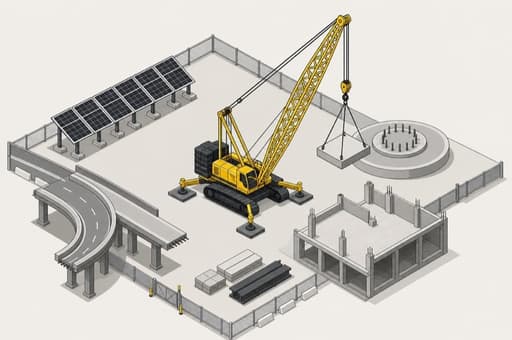
MasTec's biggest business: solar and wind farms, gas-fired power plants, heavy civil work, large buildings. Revenue $4.70B in 2025, up 14.8%, and $6.5B of the company's record $19.0B of booked work — an order book that reached $21.4B by mid-2026.
Competes with Energy segment (Primoris Services) · Electric Infrastructure Solutions (Quanta Services) · E-Infrastructure (Sterling Infrastructure)
In plain English
Four crews under one roof. One builds solar and wind farms, one builds power plants that burn gas, one does heavy civil work like roads and airport terminals, and one puts up large buildings.
A developer, utility or government agency decides to build something, hires MasTec to do the actual construction, and pays as the work gets done — so revenue only moves once panels, turbines and transformers show up on site and crews install them. The reward for finishing on schedule is thin: roughly seven cents on the dollar before interest, taxes and wear on equipment, and head-office costs come out of that.
Renewables group
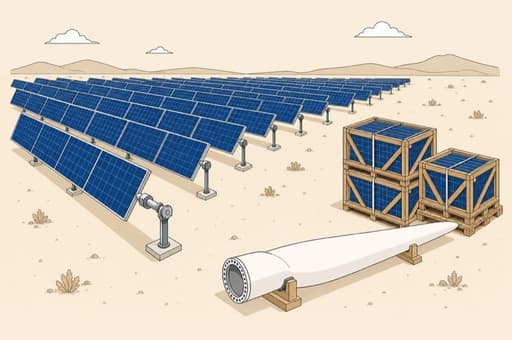
Utility-scale solar, wind and battery sites — the largest of the segment's four crews, with over $3B booked inside the eighteen-month window at the end of 2025 and more than $4B committed beyond it. Revenue grew over 60% in early 2026.
Competes with Energy segment (Primoris Services) · Electric Infrastructure Solutions (Quanta Services)
In plain English
Panels on steel racks, turbines on towers, rows of battery cabinets — assembled on open land for the companies that will own and run them.
The buyer is usually a developer or an independent power producer. It hires MasTec to build the site and pays as the racks go into the ground. Two things set the pace: whether the developer still qualifies for the tax breaks that make its project worth doing, and whether panels, trackers, turbines and batteries arrive when promised. Solar is now the bigger half of this work, and wind orders still run into 2027.
Turnkey data center program
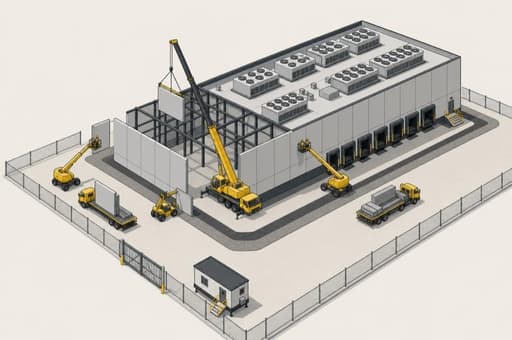
MasTec's first job running an entire data-center site for one owner, awarded in late 2025 alongside nearly $1B of data-center work entering the order book. Most of it goes to subcontractors: mid-single-digit margins, but little of MasTec's own money tied up.
Competes with E-Infrastructure (Sterling Infrastructure) · US construction segments (EMCOR Group)
In plain English
Somebody has to sign for the whole data-center site — one company that promises the owner a finished building and then hires the specialists who pour the concrete, run the conduit and hang the steel.
MasTec took that job for the first time in late 2025, in the buildings crew of its clean energy segment. It keeps a slice of every dollar that passes through, a thinner slice than it earns swinging its own hammers, but it barely has to buy equipment to earn it. It wants to do more of the work itself on later sites, and more awards are expected. Local officials decide where such sites get built at all.
Power Delivery
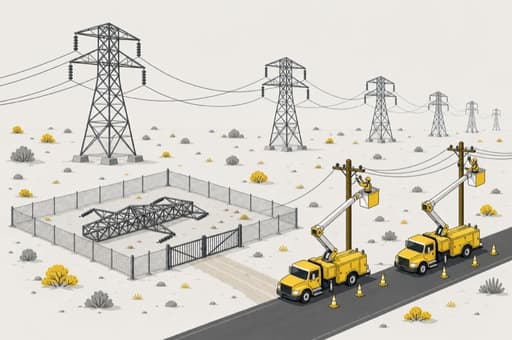
Transmission towers, substations and the everyday repair of neighborhood power lines. Revenue $4.18B in 2025, up 15.6%, with $5.6B booked at year-end; on the giant lines it is permits, not demand, that set the pace.
Competes with Electric Infrastructure Solutions (Quanta Services) · Utilities segment (Primoris Services)
In plain English
The wires. Not the power stations — the steel towers, the substations and the poles down your street, built and then looked after for the utilities that own them.
Much of it runs on a standing arrangement: a utility agrees that MasTec handles a territory's work for years and calls the crews in as needed. That is the steady half. The lumpy half is the giant transmission line, which pays well and stalls whenever a permit fails to land on time. Across MasTec as a whole the ten largest customers come to about a third of revenue, so no single client can sink the company.
The Superior Group
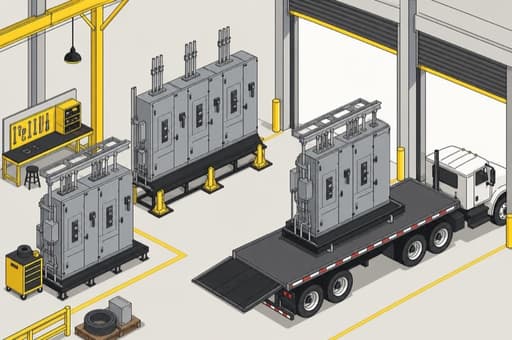
A century-old Ohio electrical contractor bought in July 2026 for about $1.65B, the largest deal in MasTec's history. It wires data centers and other buildings that cannot afford to go dark, at roughly 14 cents of margin per dollar against MasTec's 8.
Competes with US electrical construction (EMCOR Group) · Power Solutions (Dycom Industries) · E-Infrastructure (Sterling Infrastructure)
In plain English
When a data center goes up, somebody has to run every wire and electrical panel inside it. Superior does that work, and has since 1925 — about three thousand people, headquartered in Columbus, Ohio.
It designs the electrical systems, builds much of the gear in its own shops, then trucks finished modules to site, so a good deal of the building happens indoors before it ever reaches the job. Hyperscale data-center owners, developers and general contractors pay for it, and so do healthcare, entertainment and industrial owners. The margin runs well above MasTec's average, and the work now reports inside Power Delivery as its own operating group.
Communications
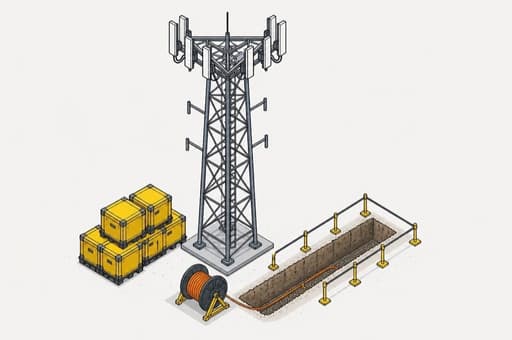
Building and maintaining phone, wireless and fiber networks. 2025 was its best year at $3.34B, up 32.3%, with $5.5B booked — then 2026 was guided down to about $3.25B as new wireless gear runs late and rural fiber work finishes.
Competes with Communications segment (Dycom Industries) · Utilities segment (Primoris Services)
In plain English
Crews with trenchers and bucket trucks, hired by the companies whose names sit on your phone bill. They pull fiber down streets, hang antennas on towers, and keep both working afterwards.
AT&T is the largest wireless account. The work arrives in waves and MasTec is caught between two of them: equipment for carriers' newly bought airwaves is not available until next year, a federal program that paid for rural internet lines is winding up, and replacement jobs have been slow to start. A larger federal broadband program, $42B, began its first builds in 2026 and is expected to peak in 2027 and 2028 — this demand is late rather than gone.
Pipeline Infrastructure
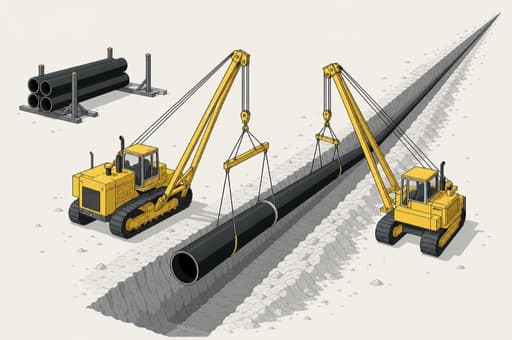
Welding in large gas, water and carbon-dioxide lines — the smallest business and the most profitable, at about 15 cents of margin per dollar on $2.14B in 2025. Lumpy too: revenue was flat for the year, then nearly doubled in early 2026.
Competes with Energy segment (Primoris Services) · Underground Utility and Infrastructure Solutions (Quanta Services)
In plain English
Long steel pipe, welded end to end and buried. Gas from where it comes out of the ground to where it gets burned, plus water lines and lines carrying captured carbon dioxide.
An owner commits to a route, and crews spend a year or two putting it in, which is why this business lurches — two or three very large jobs can make the year. It earns more per dollar than anything else MasTec does, and the newest reason customers commit to lines is gas-fired electricity for data centers. In mid-2026 the segment signed about $1.70 of fresh work for every dollar it billed.


 Clean Energy and InfrastructureMasTec's biggest business: solar and wind farms, gas-fired power plants, heavy civil work, large buildings. Revenue $4.70B in 2025, up 14.8%, and $6.5B of the company's record $19.0B of booked work — an order book that reached $21.4B by mid-2026.
MasTec's biggest business: solar and wind farms, gas-fired power plants, heavy civil work, large buildings. Revenue $4.70B in 2025, up 14.8%, and $6.5B of the company's record $19.0B of booked work — an order book that reached $21.4B by mid-2026.
In plain English
Four crews under one roof. One builds solar and wind farms, one builds power plants that burn gas, one does heavy civil work like roads and airport terminals, and one puts up large buildings.
A developer, utility or government agency decides to build something, hires MasTec to do the actual construction, and pays as the work gets done — so revenue only moves once panels, turbines and transformers show up on site and crews install them. The reward for finishing on schedule is thin: roughly seven cents on the dollar before interest, taxes and wear on equipment, and head-office costs come out of that.
Competes with Energy segment (Primoris Services) · Electric Infrastructure Solutions (Quanta Services) · E-Infrastructure (Sterling Infrastructure)
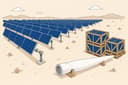 Renewables groupUtility-scale solar, wind and battery sites — the largest of the segment's four crews, with over $3B booked inside the eighteen-month window at the end of 2025 and more than $4B committed beyond it. Revenue grew over 60% in early 2026.
Utility-scale solar, wind and battery sites — the largest of the segment's four crews, with over $3B booked inside the eighteen-month window at the end of 2025 and more than $4B committed beyond it. Revenue grew over 60% in early 2026.
In plain English
Panels on steel racks, turbines on towers, rows of battery cabinets — assembled on open land for the companies that will own and run them.
The buyer is usually a developer or an independent power producer. It hires MasTec to build the site and pays as the racks go into the ground. Two things set the pace: whether the developer still qualifies for the tax breaks that make its project worth doing, and whether panels, trackers, turbines and batteries arrive when promised. Solar is now the bigger half of this work, and wind orders still run into 2027.
Competes with Energy segment (Primoris Services) · Electric Infrastructure Solutions (Quanta Services)
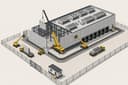 Turnkey data center programMasTec's first job running an entire data-center site for one owner, awarded in late 2025 alongside nearly $1B of data-center work entering the order book. Most of it goes to subcontractors: mid-single-digit margins, but little of MasTec's own money tied up.
MasTec's first job running an entire data-center site for one owner, awarded in late 2025 alongside nearly $1B of data-center work entering the order book. Most of it goes to subcontractors: mid-single-digit margins, but little of MasTec's own money tied up.
In plain English
Somebody has to sign for the whole data-center site — one company that promises the owner a finished building and then hires the specialists who pour the concrete, run the conduit and hang the steel.
MasTec took that job for the first time in late 2025, in the buildings crew of its clean energy segment. It keeps a slice of every dollar that passes through, a thinner slice than it earns swinging its own hammers, but it barely has to buy equipment to earn it. It wants to do more of the work itself on later sites, and more awards are expected. Local officials decide where such sites get built at all.
Competes with E-Infrastructure (Sterling Infrastructure) · US construction segments (EMCOR Group)
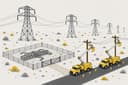 Power DeliveryTransmission towers, substations and the everyday repair of neighborhood power lines. Revenue $4.18B in 2025, up 15.6%, with $5.6B booked at year-end; on the giant lines it is permits, not demand, that set the pace.
Transmission towers, substations and the everyday repair of neighborhood power lines. Revenue $4.18B in 2025, up 15.6%, with $5.6B booked at year-end; on the giant lines it is permits, not demand, that set the pace.
In plain English
The wires. Not the power stations — the steel towers, the substations and the poles down your street, built and then looked after for the utilities that own them.
Much of it runs on a standing arrangement: a utility agrees that MasTec handles a territory's work for years and calls the crews in as needed. That is the steady half. The lumpy half is the giant transmission line, which pays well and stalls whenever a permit fails to land on time. Across MasTec as a whole the ten largest customers come to about a third of revenue, so no single client can sink the company.
Competes with Electric Infrastructure Solutions (Quanta Services) · Utilities segment (Primoris Services)
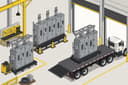 The Superior GroupA century-old Ohio electrical contractor bought in July 2026 for about $1.65B, the largest deal in MasTec's history. It wires data centers and other buildings that cannot afford to go dark, at roughly 14 cents of margin per dollar against MasTec's 8.
A century-old Ohio electrical contractor bought in July 2026 for about $1.65B, the largest deal in MasTec's history. It wires data centers and other buildings that cannot afford to go dark, at roughly 14 cents of margin per dollar against MasTec's 8.
In plain English
When a data center goes up, somebody has to run every wire and electrical panel inside it. Superior does that work, and has since 1925 — about three thousand people, headquartered in Columbus, Ohio.
It designs the electrical systems, builds much of the gear in its own shops, then trucks finished modules to site, so a good deal of the building happens indoors before it ever reaches the job. Hyperscale data-center owners, developers and general contractors pay for it, and so do healthcare, entertainment and industrial owners. The margin runs well above MasTec's average, and the work now reports inside Power Delivery as its own operating group.
Competes with US electrical construction (EMCOR Group) · Power Solutions (Dycom Industries) · E-Infrastructure (Sterling Infrastructure)
 CommunicationsBuilding and maintaining phone, wireless and fiber networks. 2025 was its best year at $3.34B, up 32.3%, with $5.5B booked — then 2026 was guided down to about $3.25B as new wireless gear runs late and rural fiber work finishes.
Building and maintaining phone, wireless and fiber networks. 2025 was its best year at $3.34B, up 32.3%, with $5.5B booked — then 2026 was guided down to about $3.25B as new wireless gear runs late and rural fiber work finishes.
In plain English
Crews with trenchers and bucket trucks, hired by the companies whose names sit on your phone bill. They pull fiber down streets, hang antennas on towers, and keep both working afterwards.
AT&T is the largest wireless account. The work arrives in waves and MasTec is caught between two of them: equipment for carriers' newly bought airwaves is not available until next year, a federal program that paid for rural internet lines is winding up, and replacement jobs have been slow to start. A larger federal broadband program, $42B, began its first builds in 2026 and is expected to peak in 2027 and 2028 — this demand is late rather than gone.
Competes with Communications segment (Dycom Industries) · Utilities segment (Primoris Services)
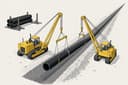 Pipeline InfrastructureWelding in large gas, water and carbon-dioxide lines — the smallest business and the most profitable, at about 15 cents of margin per dollar on $2.14B in 2025. Lumpy too: revenue was flat for the year, then nearly doubled in early 2026.
Welding in large gas, water and carbon-dioxide lines — the smallest business and the most profitable, at about 15 cents of margin per dollar on $2.14B in 2025. Lumpy too: revenue was flat for the year, then nearly doubled in early 2026.
In plain English
Long steel pipe, welded end to end and buried. Gas from where it comes out of the ground to where it gets burned, plus water lines and lines carrying captured carbon dioxide.
An owner commits to a route, and crews spend a year or two putting it in, which is why this business lurches — two or three very large jobs can make the year. It earns more per dollar than anything else MasTec does, and the newest reason customers commit to lines is gas-fired electricity for data centers. In mid-2026 the segment signed about $1.70 of fresh work for every dollar it billed.
Competes with Energy segment (Primoris Services) · Underground Utility and Infrastructure Solutions (Quanta Services)
Named in filings, launches and programs
- Greenlink transmission programCustomer programNV Energy's roughly $4 billion high-voltage line across Nevada — MasTec's largest power-delivery job; permit delays cut late-2025 volume before the stalled stretch restarted in early 2026.
- Second-largest transmission & substation projectCustomer program · RampingAn award disclosed in late 2025 — the second biggest that crew has ever taken — with the customer unnamed and construction starting mid-2026.
- Hugh Brinson pipeline programCustomer programEnergy Transfer's roughly $2.7 billion, 400-mile Permian gas line; it entered MasTec's order book in late 2025 and began service in 2026.
- NV2A GroupBrandConstruction-management firm bought in late 2025; MasTec's former partner on a $600 million Miami airport package, first phase of a roughly $9 billion program.
- McKee Utility ContractorsBrandWater-infrastructure contractor acquired in early 2026; management describes the integration as going well.
- Industrial groupServiceThe crew that builds conventional generation inside the clean energy segment — simple-cycle gas turbines and engine-driven generating units.
- Infrastructure groupServiceHeavy civil work — roads, bridges, airport terminals — run inside the clean energy segment.
- General Buildings groupService · RampingThe buildings crew of the clean energy segment, where the data-center work sits; its revenue grew 166% year over year in early 2026.
- Wireless constructionServiceAT&T-anchored cell-site work; the next growth wave waits on equipment for newly licensed airwaves, which carriers say arrives next year.
- Wireline / fiber constructionServiceFiber to homes and the routes between towns, including federally funded rural builds; management calls it the communications segment's greatest opportunity.
- Hyperscaler connectivity pursuitsCustomer program · Pre-revenueBillions of dollars of network work being chased for large cloud operators — described as opportunities, with nothing booked yet.
Greenlink transmission programCustomer program
NV Energy's roughly $4 billion high-voltage line across Nevada — MasTec's largest power-delivery job; permit delays cut late-2025 volume before the stalled stretch restarted in early 2026.
Second-largest transmission & substation projectCustomer program · Ramping
An award disclosed in late 2025 — the second biggest that crew has ever taken — with the customer unnamed and construction starting mid-2026.
Hugh Brinson pipeline programCustomer program
Energy Transfer's roughly $2.7 billion, 400-mile Permian gas line; it entered MasTec's order book in late 2025 and began service in 2026.
NV2A GroupBrand
Construction-management firm bought in late 2025; MasTec's former partner on a $600 million Miami airport package, first phase of a roughly $9 billion program.
McKee Utility ContractorsBrand
Water-infrastructure contractor acquired in early 2026; management describes the integration as going well.
Industrial groupService
The crew that builds conventional generation inside the clean energy segment — simple-cycle gas turbines and engine-driven generating units.
Infrastructure groupService
Heavy civil work — roads, bridges, airport terminals — run inside the clean energy segment.
General Buildings groupService · Ramping
The buildings crew of the clean energy segment, where the data-center work sits; its revenue grew 166% year over year in early 2026.
Wireless constructionService
AT&T-anchored cell-site work; the next growth wave waits on equipment for newly licensed airwaves, which carriers say arrives next year.
Wireline / fiber constructionService
Fiber to homes and the routes between towns, including federally funded rural builds; management calls it the communications segment's greatest opportunity.
Hyperscaler connectivity pursuitsCustomer program · Pre-revenue
Billions of dollars of network work being chased for large cloud operators — described as opportunities, with nothing booked yet.