
SiTime (SITM)
Builds programmable MEMS oscillators, clock ICs, resonators, and embedded synchronization software.
Something off on this page? Send us feedback.
SiTime makes the tiny parts that give other chips their heartbeat — the timekeepers inside network switches, phones, cars and satellites. For years the money came from consumer gadgets; now most of it comes from AI data centers, where a rack of machines is worth far more to it than a phone. This summer it bought Renesas' clock-chip business and roughly doubled itself overnight.
Item facts: FY2026 full-year basis · Q2 2026 filed, TPD added July 1, from filings, earnings calls and company pages.
Judgment weights, not filed revenue
The band summarizes business focus and direction. ~ marks estimates.
7 in detail · 11 more below
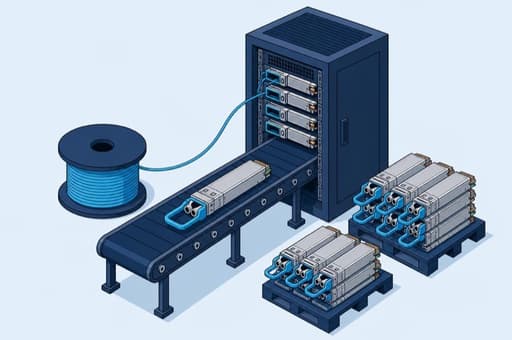
Communications, Enterprise and Data Center
The AI-infrastructure unit and the engine of the company: $101M in the June quarter, nearly triple a year earlier, its ninth straight quarter of triple-digit growth. Watch the move to faster optical links, which doubles what each cable carries.
Competes with Si53xx clocks and jitter attenuators (Skyworks Solutions) · DSC6000 MEMS oscillators (Microchip Technology) · Quartz TCXO and OCXO oscillators (Seiko Epson)
In plain English
Every chip inside a computer needs something to tell it when to take its next step, the way a drummer keeps a band together. SiTime sells that drummer: a speck of silicon that vibrates at a fixed rate.
Inside an AI data center, whole racks of machines have to stay in step with each other, and the cables between them now push data so fast that a sloppy beat corrupts it. So the switch makers, the optical-module makers and the builders of AI accelerator boards buy more of these parts, and better ones, for every rack they ship. SiTime is paid per part, and customers now order a year or more ahead.
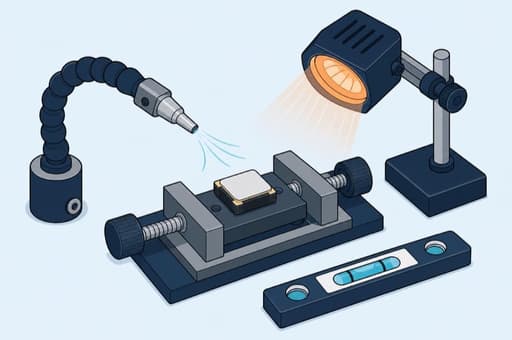
Elite Platform oscillators
SiTime's top-end oscillators, the ones that hold a steady beat while a rack heats up. Management says they add several hundred dollars of content to every AI rack, and the newer version claims up to three times better synchronization.
Competes with SG-series quartz oscillators (Seiko Epson) · DSC6000 MEMS oscillators (Microchip Technology) · Quartz temperature-compensated oscillators (Kyocera)
In plain English
The hard part of keeping time is not the ticking. It is ticking at exactly the same rate when the air around the board swings from cold to scalding and a fan is rattling everything on it.
These parts sense their own temperature and correct for it, so they hold steady under moving air and sudden heat. That steadiness is what a rack of AI machines pays up for, and it is why the price per part has been climbing rather than falling. Hardened versions of the same family go into cars, for driver-assistance systems and satellite positioning.
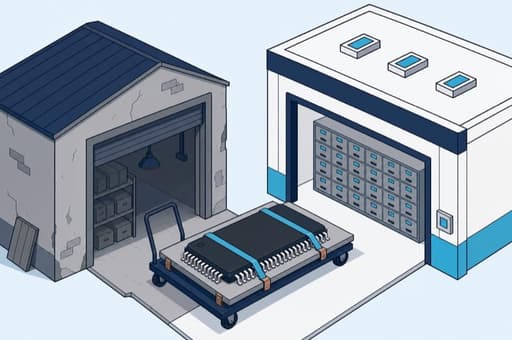
Timing Products Division
The clock-chip business bought from Renesas and renamed, closed July 1: about $300M of revenue expected in its first year here, with roughly seventy cents of each sales dollar left after the parts are made. Watch the handover from Renesas, due to finish late this year.
Competes with Jitter attenuators and clock generators (Skyworks Solutions) · LMK clock and jitter-cleaner families (Texas Instruments) · Clock chips (Analog Devices)
In plain English
Renesas, a big chipmaker, spent decades building up a line of clock chips — parts that take one steady beat and fan it out across a circuit board, cleaning and dividing it along the way. In July SiTime bought the whole line, and Renesas left the business.
It arrived with more than ten thousand customers already buying, roughly seven of every ten dollars from communications and data center gear, and it multiplied SiTime's own clock catalogue about tenfold. SiTime paid $1.5B in cash plus shares, most of it raised in May by borrowing from investors who can swap the debt for stock later.
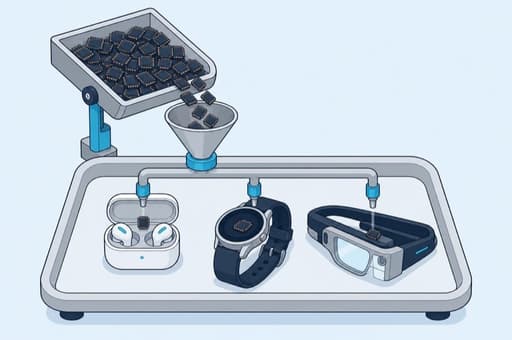
Mobile, IoT and Consumer
Phones, wearables and small connected gadgets — once the company's main engine, now its smallest piece. Revenue jumped to $31.4M in the June quarter on one big consumer customer's ramp, after a year of going nowhere. Lowest prices, thinnest margins.
Competes with Quartz oscillators and low-power crystals (NDK) · DSC6000 MEMS oscillators (Microchip Technology) · Quartz crystals for consumer devices (Daishinku)
In plain English
Start with the smallest, cheapest version of the product: a timing part small enough to vanish inside an earbud, a watch, a phone. Millions ship, and each one earns very little.
This is the business SiTime grew up on, and it still matters, because winning a slot in a device that sells by the tens of millions is steady work. It is also where cheap quartz crystals still put up the best fight, especially in the low-power corners, and where the first quarter of each year is reliably the weak one. The next wave management is chasing here: smart glasses, health trackers, pocket AI devices.
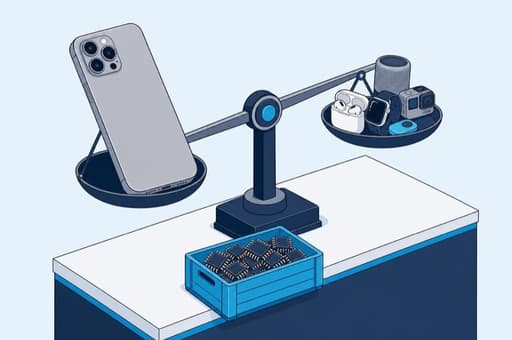
Apple end-customer program
Apple is SiTime's largest end customer — 17% of revenue in 2025, down from 22% the year before as the rest of the business grew around it. SiTime bills distributors, not Apple. No long-term volume commitment is disclosed.
Competes with Quartz oscillators in handset sockets (TXC) · Quartz oscillators and resonators (Seiko Epson) · DSC MEMS oscillators (Microchip Technology)
In plain English
SiTime does not sell to Apple directly. It ships parts to two middlemen, Pernas and Quantek — distributors that resell electronic components — and most of what those two buy ends up inside Apple products. SiTime knows because it follows where the parts go.
That made Apple about a sixth of last year's sales, the single biggest buyer of its parts once you look past the distributors. The share has been shrinking, and not because Apple buys less: the data center side is simply growing faster around it. Nothing locks in future volume, so each new product generation has to be won again.
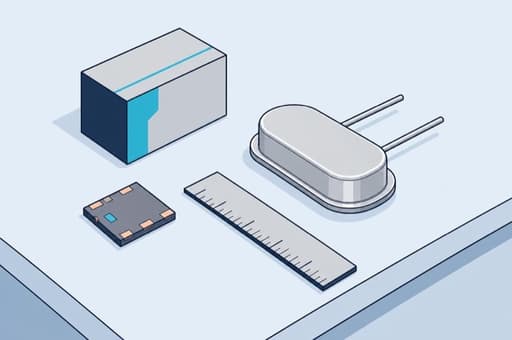
Titan Platform
SiTime's newest line sells the vibrating part on its own, to chipmakers who today buy quartz crystals. Launched September 2025 into a slice management sizes at $400M now and $1B by 2028. Almost no revenue yet.
Competes with Quartz crystal resonators (TXC) · Quartz crystal units (Kyocera) · Miniature quartz crystals (Murata)
In plain English
A change of customer, not just a change of product. Until now SiTime sold finished timing parts; this line sells the bare vibrating chip from inside them to companies that build their own processors and would otherwise solder on a little metal quartz can.
Those buyers get something several times smaller than the crystal it replaces. SiTime gets a lower price per part, because a bare component is worth less than a finished one, in exchange for reaching designs it never sold into before. The catch is patience: getting written into someone else's chip layout takes several quarters, so the money shows up long after the win does.
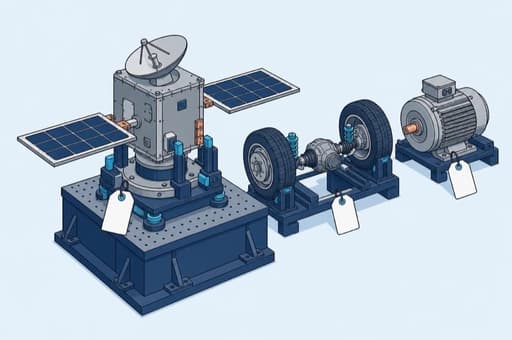
Automotive, Industrial and Aerospace/Defense
Cars, factory equipment, satellites and defense systems — $24.8M in the June quarter, up about half from a year earlier. Growing in dollars while shrinking as a share. Each low-orbit satellite can carry up to $2,000 of SiTime parts.
Competes with Quartz oscillators for space and defense (Rakon) · Timing and synchronization products (Microchip Technology) · Quartz oscillators for telecom holdover (NDK)
In plain English
Same components, much harsher homes. A timing part going into a car, a factory machine or a satellite has to pass long qualification testing before anyone will design it in — slow work, which is why this side grows in steady steps rather than jumps.
The most interesting corner is space and defense. A satellite in low orbit can carry up to two thousand dollars of SiTime parts, and thousands of launches are expected over the next three years. There is also demand for timing that keeps working when satellite navigation signals are jammed — a market management puts at four hundred million dollars, with older equipment to retrofit.


 Communications, Enterprise and Data CenterThe AI-infrastructure unit and the engine of the company: $101M in the June quarter, nearly triple a year earlier, its ninth straight quarter of triple-digit growth. Watch the move to faster optical links, which doubles what each cable carries.
The AI-infrastructure unit and the engine of the company: $101M in the June quarter, nearly triple a year earlier, its ninth straight quarter of triple-digit growth. Watch the move to faster optical links, which doubles what each cable carries.
In plain English
Every chip inside a computer needs something to tell it when to take its next step, the way a drummer keeps a band together. SiTime sells that drummer: a speck of silicon that vibrates at a fixed rate.
Inside an AI data center, whole racks of machines have to stay in step with each other, and the cables between them now push data so fast that a sloppy beat corrupts it. So the switch makers, the optical-module makers and the builders of AI accelerator boards buy more of these parts, and better ones, for every rack they ship. SiTime is paid per part, and customers now order a year or more ahead.
Competes with Si53xx clocks and jitter attenuators (Skyworks Solutions) · DSC6000 MEMS oscillators (Microchip Technology) · Quartz TCXO and OCXO oscillators (Seiko Epson)
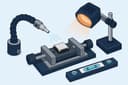 Elite Platform oscillatorsSiTime's top-end oscillators, the ones that hold a steady beat while a rack heats up. Management says they add several hundred dollars of content to every AI rack, and the newer version claims up to three times better synchronization.
SiTime's top-end oscillators, the ones that hold a steady beat while a rack heats up. Management says they add several hundred dollars of content to every AI rack, and the newer version claims up to three times better synchronization.
In plain English
The hard part of keeping time is not the ticking. It is ticking at exactly the same rate when the air around the board swings from cold to scalding and a fan is rattling everything on it.
These parts sense their own temperature and correct for it, so they hold steady under moving air and sudden heat. That steadiness is what a rack of AI machines pays up for, and it is why the price per part has been climbing rather than falling. Hardened versions of the same family go into cars, for driver-assistance systems and satellite positioning.
Competes with SG-series quartz oscillators (Seiko Epson) · DSC6000 MEMS oscillators (Microchip Technology) · Quartz temperature-compensated oscillators (Kyocera)
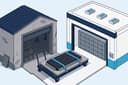 Timing Products DivisionThe clock-chip business bought from Renesas and renamed, closed July 1: about $300M of revenue expected in its first year here, with roughly seventy cents of each sales dollar left after the parts are made. Watch the handover from Renesas, due to finish late this year.
The clock-chip business bought from Renesas and renamed, closed July 1: about $300M of revenue expected in its first year here, with roughly seventy cents of each sales dollar left after the parts are made. Watch the handover from Renesas, due to finish late this year.
In plain English
Renesas, a big chipmaker, spent decades building up a line of clock chips — parts that take one steady beat and fan it out across a circuit board, cleaning and dividing it along the way. In July SiTime bought the whole line, and Renesas left the business.
It arrived with more than ten thousand customers already buying, roughly seven of every ten dollars from communications and data center gear, and it multiplied SiTime's own clock catalogue about tenfold. SiTime paid $1.5B in cash plus shares, most of it raised in May by borrowing from investors who can swap the debt for stock later.
Competes with Jitter attenuators and clock generators (Skyworks Solutions) · LMK clock and jitter-cleaner families (Texas Instruments) · Clock chips (Analog Devices)
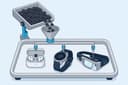 Mobile, IoT and ConsumerPhones, wearables and small connected gadgets — once the company's main engine, now its smallest piece. Revenue jumped to $31.4M in the June quarter on one big consumer customer's ramp, after a year of going nowhere. Lowest prices, thinnest margins.
Phones, wearables and small connected gadgets — once the company's main engine, now its smallest piece. Revenue jumped to $31.4M in the June quarter on one big consumer customer's ramp, after a year of going nowhere. Lowest prices, thinnest margins.
In plain English
Start with the smallest, cheapest version of the product: a timing part small enough to vanish inside an earbud, a watch, a phone. Millions ship, and each one earns very little.
This is the business SiTime grew up on, and it still matters, because winning a slot in a device that sells by the tens of millions is steady work. It is also where cheap quartz crystals still put up the best fight, especially in the low-power corners, and where the first quarter of each year is reliably the weak one. The next wave management is chasing here: smart glasses, health trackers, pocket AI devices.
Competes with Quartz oscillators and low-power crystals (NDK) · DSC6000 MEMS oscillators (Microchip Technology) · Quartz crystals for consumer devices (Daishinku)
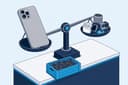 Apple end-customer programApple is SiTime's largest end customer — 17% of revenue in 2025, down from 22% the year before as the rest of the business grew around it. SiTime bills distributors, not Apple. No long-term volume commitment is disclosed.
Apple is SiTime's largest end customer — 17% of revenue in 2025, down from 22% the year before as the rest of the business grew around it. SiTime bills distributors, not Apple. No long-term volume commitment is disclosed.
In plain English
SiTime does not sell to Apple directly. It ships parts to two middlemen, Pernas and Quantek — distributors that resell electronic components — and most of what those two buy ends up inside Apple products. SiTime knows because it follows where the parts go.
That made Apple about a sixth of last year's sales, the single biggest buyer of its parts once you look past the distributors. The share has been shrinking, and not because Apple buys less: the data center side is simply growing faster around it. Nothing locks in future volume, so each new product generation has to be won again.
Competes with Quartz oscillators in handset sockets (TXC) · Quartz oscillators and resonators (Seiko Epson) · DSC MEMS oscillators (Microchip Technology)
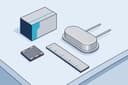 Titan PlatformSiTime's newest line sells the vibrating part on its own, to chipmakers who today buy quartz crystals. Launched September 2025 into a slice management sizes at $400M now and $1B by 2028. Almost no revenue yet.
SiTime's newest line sells the vibrating part on its own, to chipmakers who today buy quartz crystals. Launched September 2025 into a slice management sizes at $400M now and $1B by 2028. Almost no revenue yet.
In plain English
A change of customer, not just a change of product. Until now SiTime sold finished timing parts; this line sells the bare vibrating chip from inside them to companies that build their own processors and would otherwise solder on a little metal quartz can.
Those buyers get something several times smaller than the crystal it replaces. SiTime gets a lower price per part, because a bare component is worth less than a finished one, in exchange for reaching designs it never sold into before. The catch is patience: getting written into someone else's chip layout takes several quarters, so the money shows up long after the win does.
Competes with Quartz crystal resonators (TXC) · Quartz crystal units (Kyocera) · Miniature quartz crystals (Murata)
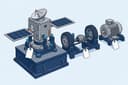 Automotive, Industrial and Aerospace/DefenseCars, factory equipment, satellites and defense systems — $24.8M in the June quarter, up about half from a year earlier. Growing in dollars while shrinking as a share. Each low-orbit satellite can carry up to $2,000 of SiTime parts.
Cars, factory equipment, satellites and defense systems — $24.8M in the June quarter, up about half from a year earlier. Growing in dollars while shrinking as a share. Each low-orbit satellite can carry up to $2,000 of SiTime parts.
In plain English
Same components, much harsher homes. A timing part going into a car, a factory machine or a satellite has to pass long qualification testing before anyone will design it in — slow work, which is why this side grows in steady steps rather than jumps.
The most interesting corner is space and defense. A satellite in low orbit can carry up to two thousand dollars of SiTime parts, and thousands of launches are expected over the next three years. There is also demand for timing that keeps working when satellite navigation signals are jammed — a market management puts at four hundred million dollars, with older equipment to retrofit.
Competes with Quartz oscillators for space and defense (Rakon) · Timing and synchronization products (Microchip Technology) · Quartz oscillators for telecom holdover (NDK)
Named in filings, launches and programs
- CascadeProduct lineThe most complex clocking part SiTime makes, grown out of a 2023 purchase of Aura Semiconductor's clock products; it goes into switches, optical modules and 5G radios.
- ChorusProduct lineA single chip combining clock, oscillator and resonator, launched in 2024 for AI data centers; its volume has actually come from driver-assistance and robotaxi designs.
- SymphonicProduct lineA clock chip with several outputs, built for high-band 5G consumer devices, asset trackers and satellite-positioning receivers.
- EpochProduct lineAn oven-heated oscillator for 5G base stations — it holds its own tiny furnace at a constant temperature; management expected sales to begin in 2026.
- EnduraProduct lineRuggedized oscillators for drones, robotics and defense systems that must keep time when satellite positioning signals are unavailable.
- TimeFabricPlatformSynchronization software released in June 2025; SiTime uses it to charge more for oscillator-plus-clock bundles rather than selling it on its own.
- FemtoClockProduct lineA clock family with a twenty-year record for steadiness, inherited with the Renesas purchase and now sold alongside SiTime's own parts.
- VersaClockProduct lineA twenty-five-year-old programmable clock family from the Renesas purchase, used in data center gear and industrial equipment.
- TPD clock buffersProduct lineMore than $100M of the acquired line's revenue sits in these copy-and-pass-along clock chips, sold broadly; management calls them its least differentiated parts.
- TPD quartz oscillatorsProduct lineA small quartz business that came with the deal, off SiTime's own technology; management will let it grow or not, without pushing it.
- Chiplet roadmapProduct · AnnouncedAn announced plan to sell timing as a building block inside a customer's own chip package, which management says adds $2.5B of data center market by 2030.
CascadeProduct line
The most complex clocking part SiTime makes, grown out of a 2023 purchase of Aura Semiconductor's clock products; it goes into switches, optical modules and 5G radios.
ChorusProduct line
A single chip combining clock, oscillator and resonator, launched in 2024 for AI data centers; its volume has actually come from driver-assistance and robotaxi designs.
SymphonicProduct line
A clock chip with several outputs, built for high-band 5G consumer devices, asset trackers and satellite-positioning receivers.
EpochProduct line
An oven-heated oscillator for 5G base stations — it holds its own tiny furnace at a constant temperature; management expected sales to begin in 2026.
EnduraProduct line
Ruggedized oscillators for drones, robotics and defense systems that must keep time when satellite positioning signals are unavailable.
TimeFabricPlatform
Synchronization software released in June 2025; SiTime uses it to charge more for oscillator-plus-clock bundles rather than selling it on its own.
FemtoClockProduct line
A clock family with a twenty-year record for steadiness, inherited with the Renesas purchase and now sold alongside SiTime's own parts.
VersaClockProduct line
A twenty-five-year-old programmable clock family from the Renesas purchase, used in data center gear and industrial equipment.
TPD clock buffersProduct line
More than $100M of the acquired line's revenue sits in these copy-and-pass-along clock chips, sold broadly; management calls them its least differentiated parts.
TPD quartz oscillatorsProduct line
A small quartz business that came with the deal, off SiTime's own technology; management will let it grow or not, without pushing it.
Chiplet roadmapProduct · Announced
An announced plan to sell timing as a building block inside a customer's own chip package, which management says adds $2.5B of data center market by 2030.