
Wabtec (WAB)
Builds rail locomotives, transit systems and recurring aftermarket services worldwide.
Something off on this page? Send us feedback.
Wabtec makes the brakes, engines and electronics that let freight trains and metro cars move and stop safely, then sells the parts, rebuilds and software that keep them working for decades. The steady repair-and-rebuild half pays the bills; the surge is in new locomotives for railroads abroad and in recently bought sensing and inspection businesses. No single customer is even a tenth of sales.
Item facts: FY2025 · year ended Dec 31, 2025, from filings, earnings calls and company pages.
Judgment weights, not filed revenue
The band summarizes business focus and direction. ~ marks estimates.
8 in detail · 17 more below
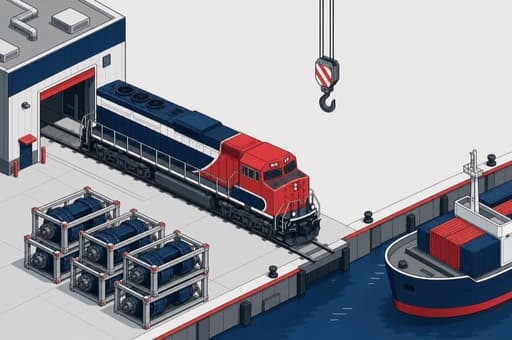
Equipment — locomotives & mining drives
New freight locomotives, plus the electric drive systems inside the largest mining haul trucks. Sales grew 12% in 2025 and far faster through the first half of 2026; the multi-year order book passed $30 billion by mid-2026, up 42% in a year.
Competes with SD70ACe-T4 locomotives (Progress Rail (Caterpillar)) · Export locomotives (CRRC) · Ultra-class haul truck drive systems (Komatsu)
In plain English
A freight locomotive is the pulling machine at the head of a heavy train — a diesel engine that makes electricity, and electric motors that turn that into grip at the wheels. Wabtec builds them in Texas, Pennsylvania, Brazil and India, and sells the same drive technology to mining companies for their biggest haul trucks.
Railroads order years ahead and pay as units are handed over, so the revenue showing up now was agreed long ago. Much of the recent buying sits outside North America — Kazakhstan, Brazil, India, Australia — and delivery talks already stretch to 2028. Tariffs on imported parts and chip supply are the things that can spoil a build slot.
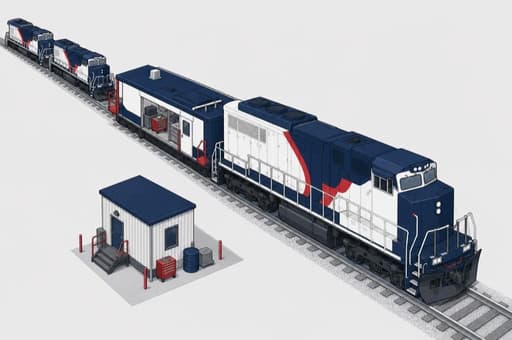
KTZ Locomotive & Service Program
Kazakhstan's national railway ordered $4.2 billion of locomotives plus years of fleet maintenance in September 2025 — the largest order in Wabtec's history. Sales to the region actually fell in 2025, so almost all of this money is still ahead.
Competes with Locomotive exports (CRRC) · Regional fleet supply (Transmashholding) · EMD export platform (Progress Rail)
In plain English
One order, larger than anything in the company's past. Kazakhstan's state railway — the operator carrying traffic on the Trans-Caspian trade route — agreed to buy Evolution Series locomotives and to have Wabtec look after them for years afterwards.
The cash arrives slowly. A contract like this pays out as units roll off the line and as maintenance hours get worked, spread across several delivery years, with some fabrication and assembly done locally in Kazakhstan while the engine controls stay with Wabtec. It is also business that leans on one government's budget and one region's politics holding steady.
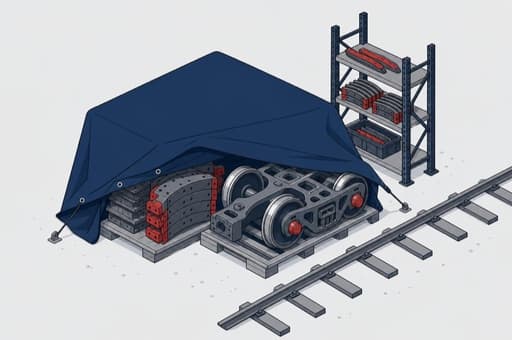
Freight Components
Brakes, wheel trucks, couplers and heat exchangers sold to the builders of new freight wagons. Revenue barely moved in 2025 at $1.59 billion, and the North American wagon build is expected down roughly a fifth again in 2026 — the cyclical soft spot.
Competes with Freight car brakes and trucks (Amsted Rail) · New York Air Brake freight braking (Knorr-Bremse) · Couplers and draft gear (Voith)
In plain English
Every freight wagon behind a locomotive needs brakes that clamp, a steel frame on wheels underneath, and a coupler holding it to the next wagon. Wabtec makes those parts and sells them to the factories assembling new wagons and to railroads replacing worn ones.
So this line rises and falls with how many wagons North America decides to build — and that number dropped hard in 2025 with another decline expected in 2026. Wabtec is also deliberately walking away from low-margin products here, which subtracts sales but leaves a better mix behind. Selling engines and parts to industrial and power plants takes up some of the slack.
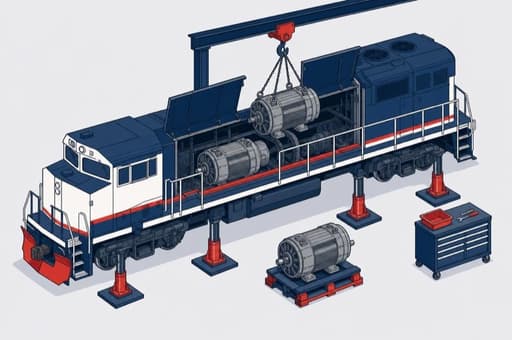
Locomotive Services & Modernizations
The single biggest line: parts, overhauls, maintenance contracts and full rebuilds of locomotives railroads already own. It grew just 1.2% in 2025 as rebuild deliveries slipped, and management expects it back to growth in the second half of 2026.
Competes with Locomotive modernization (Progress Rail (Caterpillar)) · In-house back shops (Class I railroads) · Brake component overhaul (Knorr-Bremse)
In plain English
Rebuilding a locomotive is like re-engining and re-wiring an old truck instead of buying a new one: the frame stays, the tired guts come out, and the machine goes back to work for another long stretch at a fraction of the price. Wabtec does that work, and sells the brake shoes, spare parts and long-term maintenance deals that keep fleets moving in between.
The demand is already sitting on the tracks — more than a quarter of North America's working locomotives are over twenty years old. Railroads pay per programme; Union Pacific's latest runs to about $1.2 billion. Wabtec does not win them all: Norfolk Southern sent thirty-three units its way and ninety-six to a rival.
Transit Aftermarket
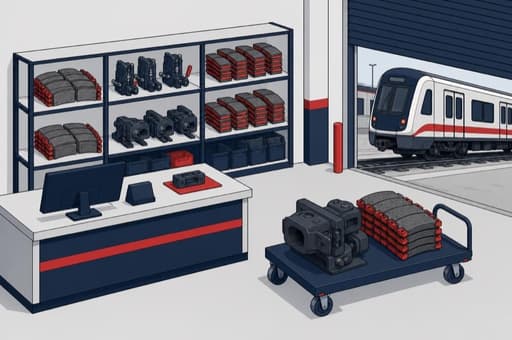
Spare parts and overhauls for passenger vehicles — metro cars, commuter and high-speed trains, light rail, buses. $1.74 billion in 2025 and the faster-growing half of the passenger business, rising and falling with public transport budgets.
Competes with Rail Vehicle Systems aftermarket (Knorr-Bremse) · Fleet services & maintenance (Alstom) · Aftermarket parts and service (CRRC)
In plain English
Passenger trains wear out on a predictable clock: brake pads thin, door mechanisms stiffen, couplers need rebuilding. A transit authority either keeps spares on the shelf or hires someone to do the overhauls, and Wabtec sits on both ends of that — it makes the parts and it does the work.
Because the payer is a public body or the operator it hires, the money follows tax budgets and how many people ride, not how much freight moves. New York City Transit, for instance, bought about fifty million dollars of brake and coupler servicing. Something over half of everything Wabtec sells into passenger rail is this kind of repeat work.
Transit Original Equipment
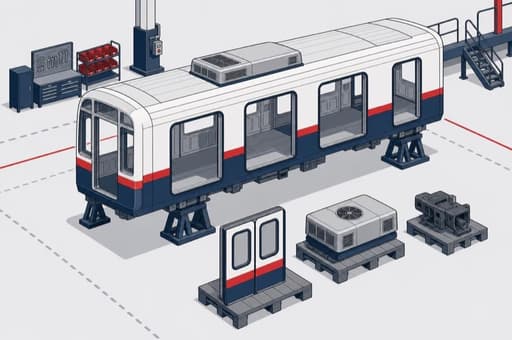
Brake systems, doors, air conditioning, couplers and passenger displays fitted into brand-new metro and mainline passenger cars. $1.39 billion in 2025; across the whole passenger business, orders due within a year reached $2.57 billion by early 2026.
Competes with Rail Vehicle Systems and IFE doors (Knorr-Bremse) · In-house train subsystems (Siemens Mobility) · Scharfenberg couplers (Voith)
In plain English
When a factory builds a new subway train or regional coach, it does not make everything itself. It buys the braking system, the sliding doors, the air conditioning on the roof, the coupler at each end and the screens announcing the next stop — and Wabtec sells all of those to the car builders, plus the sliding doors that guard station platforms.
Work arrives as multi-year vehicle programmes, so one win feeds revenue for years: Siemens Mobility bought seventy million dollars of passenger information systems for ninety Munich commuter trains, and a Paris rail project fifty-five million dollars of platform doors. Buying Dellner in 2026 added the connections between carriages to the shelf.
Digital Intelligence
Train-control software and trackside sensors: remote handling of locomotives spread along a train, fuel-saving driving software, braking that stops a train automatically. Sales grew 31% in 2025 and nearly doubled by mid-2026 — the jump came from acquisitions, not from selling more of the old products.
Competes with Signalling and train control (Siemens Mobility) · LEADER driver advisory (New York Air Brake (Knorr-Bremse)) · Train control systems (Hitachi Rail)
In plain English
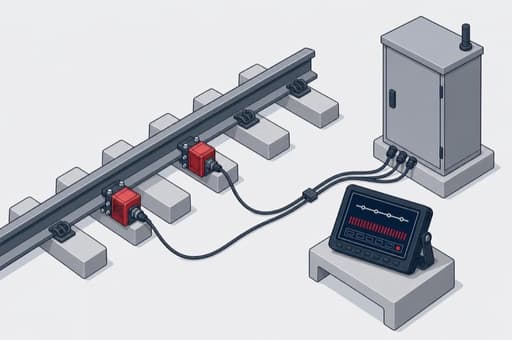
Trains now report on themselves. Wabtec's electronics sit in the cab and beside the rails: one system lets the driver at the front control engines placed in the middle and at the tail of a very long train; another works out the most fuel-efficient way to drive a route; another watches speed and signals and applies the brakes itself if the crew misses one. Small boxes clamped to the rail count axles rolling past so a signaller knows which stretch is occupied.
Railroads pay for the hardware, the fitting and the ongoing licences, and the enormous fleet Wabtec already built is the natural place to sell them.
Inspection Technologies
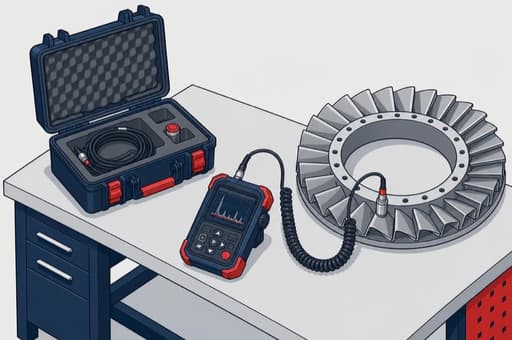
Testing gear that looks inside metal without cutting it — ultrasound, X-ray and camera probes. Bought from Evident for about $1.8 billion in 2025, it carried Wabtec out of rail into aerospace, energy and factory inspection.
Competes with Waygate Technologies inspection (Baker Hughes) · Eddy-current and advanced testing (Eddyfi Technologies) · Inspection instruments and services (MISTRAS Group)
In plain English
Ultrasound for machines. These instruments check whether a turbine blade, a weld or a pipe has a crack hidden inside: probes that push sound or X-rays through metal, and tiny cameras on flexible cables that reach where a hand cannot.
Wabtec paid roughly $1.8 billion for the business in 2025 — its largest purchase since buying GE's locomotive arm — from Evident, previously the scientific instruments side of Olympus. Buyers are aerospace, energy and industrial firms that must inspect ageing equipment on a schedule, so the buying repeats as those deadlines come round. Management says each sale earns more than the Wabtec average, but costs more to go out and win.


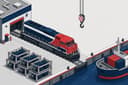 Equipment — locomotives & mining drivesNew freight locomotives, plus the electric drive systems inside the largest mining haul trucks. Sales grew 12% in 2025 and far faster through the first half of 2026; the multi-year order book passed $30 billion by mid-2026, up 42% in a year.
New freight locomotives, plus the electric drive systems inside the largest mining haul trucks. Sales grew 12% in 2025 and far faster through the first half of 2026; the multi-year order book passed $30 billion by mid-2026, up 42% in a year.
In plain English
A freight locomotive is the pulling machine at the head of a heavy train — a diesel engine that makes electricity, and electric motors that turn that into grip at the wheels. Wabtec builds them in Texas, Pennsylvania, Brazil and India, and sells the same drive technology to mining companies for their biggest haul trucks.
Railroads order years ahead and pay as units are handed over, so the revenue showing up now was agreed long ago. Much of the recent buying sits outside North America — Kazakhstan, Brazil, India, Australia — and delivery talks already stretch to 2028. Tariffs on imported parts and chip supply are the things that can spoil a build slot.
Competes with SD70ACe-T4 locomotives (Progress Rail (Caterpillar)) · Export locomotives (CRRC) · Ultra-class haul truck drive systems (Komatsu)
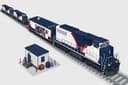 KTZ Locomotive & Service ProgramKazakhstan's national railway ordered $4.2 billion of locomotives plus years of fleet maintenance in September 2025 — the largest order in Wabtec's history. Sales to the region actually fell in 2025, so almost all of this money is still ahead.
Kazakhstan's national railway ordered $4.2 billion of locomotives plus years of fleet maintenance in September 2025 — the largest order in Wabtec's history. Sales to the region actually fell in 2025, so almost all of this money is still ahead.
In plain English
One order, larger than anything in the company's past. Kazakhstan's state railway — the operator carrying traffic on the Trans-Caspian trade route — agreed to buy Evolution Series locomotives and to have Wabtec look after them for years afterwards.
The cash arrives slowly. A contract like this pays out as units roll off the line and as maintenance hours get worked, spread across several delivery years, with some fabrication and assembly done locally in Kazakhstan while the engine controls stay with Wabtec. It is also business that leans on one government's budget and one region's politics holding steady.
Competes with Locomotive exports (CRRC) · Regional fleet supply (Transmashholding) · EMD export platform (Progress Rail)
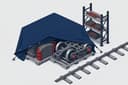 Freight ComponentsBrakes, wheel trucks, couplers and heat exchangers sold to the builders of new freight wagons. Revenue barely moved in 2025 at $1.59 billion, and the North American wagon build is expected down roughly a fifth again in 2026 — the cyclical soft spot.
Brakes, wheel trucks, couplers and heat exchangers sold to the builders of new freight wagons. Revenue barely moved in 2025 at $1.59 billion, and the North American wagon build is expected down roughly a fifth again in 2026 — the cyclical soft spot.
In plain English
Every freight wagon behind a locomotive needs brakes that clamp, a steel frame on wheels underneath, and a coupler holding it to the next wagon. Wabtec makes those parts and sells them to the factories assembling new wagons and to railroads replacing worn ones.
So this line rises and falls with how many wagons North America decides to build — and that number dropped hard in 2025 with another decline expected in 2026. Wabtec is also deliberately walking away from low-margin products here, which subtracts sales but leaves a better mix behind. Selling engines and parts to industrial and power plants takes up some of the slack.
Competes with Freight car brakes and trucks (Amsted Rail) · New York Air Brake freight braking (Knorr-Bremse) · Couplers and draft gear (Voith)
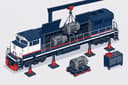 Locomotive Services & ModernizationsThe single biggest line: parts, overhauls, maintenance contracts and full rebuilds of locomotives railroads already own. It grew just 1.2% in 2025 as rebuild deliveries slipped, and management expects it back to growth in the second half of 2026.
The single biggest line: parts, overhauls, maintenance contracts and full rebuilds of locomotives railroads already own. It grew just 1.2% in 2025 as rebuild deliveries slipped, and management expects it back to growth in the second half of 2026.
In plain English
Rebuilding a locomotive is like re-engining and re-wiring an old truck instead of buying a new one: the frame stays, the tired guts come out, and the machine goes back to work for another long stretch at a fraction of the price. Wabtec does that work, and sells the brake shoes, spare parts and long-term maintenance deals that keep fleets moving in between.
The demand is already sitting on the tracks — more than a quarter of North America's working locomotives are over twenty years old. Railroads pay per programme; Union Pacific's latest runs to about $1.2 billion. Wabtec does not win them all: Norfolk Southern sent thirty-three units its way and ninety-six to a rival.
Competes with Locomotive modernization (Progress Rail (Caterpillar)) · In-house back shops (Class I railroads) · Brake component overhaul (Knorr-Bremse)
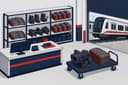 Transit AftermarketSpare parts and overhauls for passenger vehicles — metro cars, commuter and high-speed trains, light rail, buses. $1.74 billion in 2025 and the faster-growing half of the passenger business, rising and falling with public transport budgets.
Spare parts and overhauls for passenger vehicles — metro cars, commuter and high-speed trains, light rail, buses. $1.74 billion in 2025 and the faster-growing half of the passenger business, rising and falling with public transport budgets.
In plain English
Passenger trains wear out on a predictable clock: brake pads thin, door mechanisms stiffen, couplers need rebuilding. A transit authority either keeps spares on the shelf or hires someone to do the overhauls, and Wabtec sits on both ends of that — it makes the parts and it does the work.
Because the payer is a public body or the operator it hires, the money follows tax budgets and how many people ride, not how much freight moves. New York City Transit, for instance, bought about fifty million dollars of brake and coupler servicing. Something over half of everything Wabtec sells into passenger rail is this kind of repeat work.
Competes with Rail Vehicle Systems aftermarket (Knorr-Bremse) · Fleet services & maintenance (Alstom) · Aftermarket parts and service (CRRC)
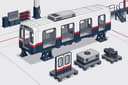 Transit Original EquipmentBrake systems, doors, air conditioning, couplers and passenger displays fitted into brand-new metro and mainline passenger cars. $1.39 billion in 2025; across the whole passenger business, orders due within a year reached $2.57 billion by early 2026.
Brake systems, doors, air conditioning, couplers and passenger displays fitted into brand-new metro and mainline passenger cars. $1.39 billion in 2025; across the whole passenger business, orders due within a year reached $2.57 billion by early 2026.
In plain English
When a factory builds a new subway train or regional coach, it does not make everything itself. It buys the braking system, the sliding doors, the air conditioning on the roof, the coupler at each end and the screens announcing the next stop — and Wabtec sells all of those to the car builders, plus the sliding doors that guard station platforms.
Work arrives as multi-year vehicle programmes, so one win feeds revenue for years: Siemens Mobility bought seventy million dollars of passenger information systems for ninety Munich commuter trains, and a Paris rail project fifty-five million dollars of platform doors. Buying Dellner in 2026 added the connections between carriages to the shelf.
Competes with Rail Vehicle Systems and IFE doors (Knorr-Bremse) · In-house train subsystems (Siemens Mobility) · Scharfenberg couplers (Voith)
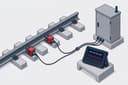 Digital IntelligenceTrain-control software and trackside sensors: remote handling of locomotives spread along a train, fuel-saving driving software, braking that stops a train automatically. Sales grew 31% in 2025 and nearly doubled by mid-2026 — the jump came from acquisitions, not from selling more of the old products.
Train-control software and trackside sensors: remote handling of locomotives spread along a train, fuel-saving driving software, braking that stops a train automatically. Sales grew 31% in 2025 and nearly doubled by mid-2026 — the jump came from acquisitions, not from selling more of the old products.
In plain English
Trains now report on themselves. Wabtec's electronics sit in the cab and beside the rails: one system lets the driver at the front control engines placed in the middle and at the tail of a very long train; another works out the most fuel-efficient way to drive a route; another watches speed and signals and applies the brakes itself if the crew misses one. Small boxes clamped to the rail count axles rolling past so a signaller knows which stretch is occupied.
Railroads pay for the hardware, the fitting and the ongoing licences, and the enormous fleet Wabtec already built is the natural place to sell them.
Competes with Signalling and train control (Siemens Mobility) · LEADER driver advisory (New York Air Brake (Knorr-Bremse)) · Train control systems (Hitachi Rail)
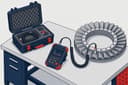 Inspection TechnologiesTesting gear that looks inside metal without cutting it — ultrasound, X-ray and camera probes. Bought from Evident for about $1.8 billion in 2025, it carried Wabtec out of rail into aerospace, energy and factory inspection.
Testing gear that looks inside metal without cutting it — ultrasound, X-ray and camera probes. Bought from Evident for about $1.8 billion in 2025, it carried Wabtec out of rail into aerospace, energy and factory inspection.
In plain English
Ultrasound for machines. These instruments check whether a turbine blade, a weld or a pipe has a crack hidden inside: probes that push sound or X-rays through metal, and tiny cameras on flexible cables that reach where a hand cannot.
Wabtec paid roughly $1.8 billion for the business in 2025 — its largest purchase since buying GE's locomotive arm — from Evident, previously the scientific instruments side of Olympus. Buyers are aerospace, energy and industrial firms that must inspect ageing equipment on a schedule, so the buying repeats as those deadlines come round. Management says each sale earns more than the Wabtec average, but costs more to go out and win.
Competes with Waygate Technologies inspection (Baker Hughes) · Eddy-current and advanced testing (Eddyfi Technologies) · Inspection instruments and services (MISTRAS Group)
Named in filings, launches and programs
- Evolution Series locomotiveProductThe heavy-haul diesel-electric platform behind the big orders — Kazakhstan's railway, Brazil's Vale and Norfolk Southern all buy versions of it.
- EVO Advantage / eTurboProduct · RampingAn engine upgrade with a turbocharger-integrated generator, credited with about five to seven percent better fuel use; first North American order came in 2026.
- EVO ModServiceThe rebuild package that swaps a locomotive's direct-current motors for alternating-current ones, claimed to lift reliability and pulling power by more than a fifth.
- Union Pacific AC4400 modernization programCustomer programA $1.2 billion rebuild agreement signed in late 2025 — Union Pacific's fourth since 2018, taking its rebuilt fleet past 1,700 locomotives.
- FLXdrive battery-electric locomotiveProduct · RampingA battery-powered heavy-haul locomotive; the first units went to miner BHP, reported in February 2026.
- LOCOTROL Distributed PowerProductLets one driver handle locomotives spread along a very long train; Wabtec puts it on more than 20,000 locomotives across seventeen countries.
- Trip OptimizerProductDriving software that picks the most fuel-efficient way to run a route; it travels along with international locomotive orders.
- I-ETMS positive train controlProductOnboard and back-office kit that brakes a train automatically if the crew misses a signal; Brazil's Vale ordered $184 million of it.
- ECP-4200 electronic brakeProductElectronically controlled air braking for locomotives and freight cars, part of the electronics-and-software family.
- Frauscher Sensor Technology GroupBrandBought for about $792 million in December 2025: trackside sensors that detect trains and count axles, sold into Alstom, Hitachi and Siemens signalling.
- Dellner CouplersBrandAcquired for roughly €890 million in February 2026; makes the safety-critical connections between passenger carriages and reports inside the transit business.
- Mining drive systemsProduct lineElectric drives for ultra-class mining haul trucks; deals include a $125 million multi-year agreement and a $52 million order for 240-ton trucks.
- Power generation engines (250SDC)Product lineStationary diesel engines with their parts and service — part of the industrial sales cushioning the weak freight-wagon market.
- Green Friction / Green AirBrandWabtec's low-emission brake friction and air-treatment product families, fed by outside friction-material and casting suppliers.
- Mining drive-systems mega-orderCustomer programA multi-billion-dollar order for drive systems and aftermarket parts booked in early 2026; Wabtec did not name the buyer.
- Australian integrated orderCustomer programAbout $1 billion of locomotives, services, components and digital systems booked in mid-2026 for a customer Wabtec did not name.
- Simandou locomotive programCustomer programThe first four heavy-haul locomotives for the Simandou project reached Guinea in late 2025, built at Wabtec's plant in Marora, India.
Evolution Series locomotiveProduct
The heavy-haul diesel-electric platform behind the big orders — Kazakhstan's railway, Brazil's Vale and Norfolk Southern all buy versions of it.
EVO Advantage / eTurboProduct · Ramping
An engine upgrade with a turbocharger-integrated generator, credited with about five to seven percent better fuel use; first North American order came in 2026.
EVO ModService
The rebuild package that swaps a locomotive's direct-current motors for alternating-current ones, claimed to lift reliability and pulling power by more than a fifth.
Union Pacific AC4400 modernization programCustomer program
A $1.2 billion rebuild agreement signed in late 2025 — Union Pacific's fourth since 2018, taking its rebuilt fleet past 1,700 locomotives.
FLXdrive battery-electric locomotiveProduct · Ramping
A battery-powered heavy-haul locomotive; the first units went to miner BHP, reported in February 2026.
LOCOTROL Distributed PowerProduct
Lets one driver handle locomotives spread along a very long train; Wabtec puts it on more than 20,000 locomotives across seventeen countries.
Trip OptimizerProduct
Driving software that picks the most fuel-efficient way to run a route; it travels along with international locomotive orders.
I-ETMS positive train controlProduct
Onboard and back-office kit that brakes a train automatically if the crew misses a signal; Brazil's Vale ordered $184 million of it.
ECP-4200 electronic brakeProduct
Electronically controlled air braking for locomotives and freight cars, part of the electronics-and-software family.
Frauscher Sensor Technology GroupBrand
Bought for about $792 million in December 2025: trackside sensors that detect trains and count axles, sold into Alstom, Hitachi and Siemens signalling.
Dellner CouplersBrand
Acquired for roughly €890 million in February 2026; makes the safety-critical connections between passenger carriages and reports inside the transit business.
Mining drive systemsProduct line
Electric drives for ultra-class mining haul trucks; deals include a $125 million multi-year agreement and a $52 million order for 240-ton trucks.
Power generation engines (250SDC)Product line
Stationary diesel engines with their parts and service — part of the industrial sales cushioning the weak freight-wagon market.
Green Friction / Green AirBrand
Wabtec's low-emission brake friction and air-treatment product families, fed by outside friction-material and casting suppliers.
Mining drive-systems mega-orderCustomer program
A multi-billion-dollar order for drive systems and aftermarket parts booked in early 2026; Wabtec did not name the buyer.
Australian integrated orderCustomer program
About $1 billion of locomotives, services, components and digital systems booked in mid-2026 for a customer Wabtec did not name.
Simandou locomotive programCustomer program
The first four heavy-haul locomotives for the Simandou project reached Guinea in late 2025, built at Wabtec's plant in Marora, India.